The Wristband Wars: For the Rich, $93,000 Watches, Glitzy Galas; For the Rest of Us: Blood Tubes to Sell Our Plasma, $60 Per Pop.

What’s obscene is not just the $93,000 watches, & the MET Gala’s’ $100,000 tickets, but that 215,000 working people per day are forced to sell their blood plasma to afford food, rent & health care

Steve Villano

May 08, 2026

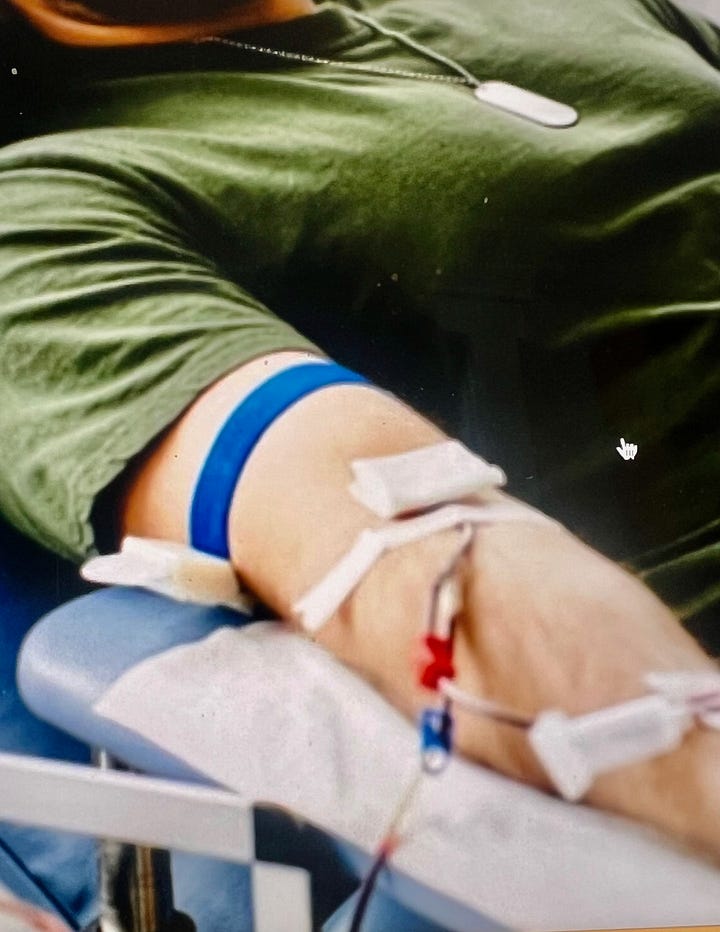
(An average American (l.)—one of 215,000 per day—sells his blood plasma for $60 to $80 per litre at one of 1,200 Plasma Extraction Centers in the US, while the 26-year old actor Connor Storrie arrives at the $100,000 per ticket MET Fashion Gala wearing a $93,000 Omega gold watch on his wrist, instead of a Y-tube for separating blood from plasma. There are more Plasma Extraction Centers in the United States than there are Costco Stores, according to NBC News.)

One month and one-day before the utterly over-the-top, garish Metropolitan Museum of Art’s 2026 Fashion Gala for the fabulously rich, famous and momentarily famous, a life-and-death story bled out of the New York Times Sunday Business Section—dwarfed by a full-color graphic that dominated 3/4’s of the page dealing with “Teens and Chatbots.”

The story (April 5, 2026) by Kurtis Lee and Robert Gebeloff was headlined: “The Middle Class Is Selling Blood Plasma to Get By.”

In the daily orgy of news about Trump’s billion-dollar-a-day War against Iran; exploding oil prices that now cost a family at least $100 per week just to fill up one car; Jeff Bezos’ $10 million sponsorship of the MET Gala and $50 million Venice wedding to Lauren Sanchez, $120 million NYC townhouse, AND his $500 million yacht; and the Trump family’s plundering of the Presidency for their own pig-like, personal profit, no one paid much attention to the “blood-selling” story.

Two months earlier, NBC News’ Shannon Pettypiece did an eye-opening version of the “Blood Money” story , but few others paid attention, since most corporate network producers preferred puffing up their tiny nightly newscasts with a ‘feel good’ story about “America Strong.” Social media sites didn’t as much as sneeze at the story in the lead-up to the MET Gala, because lingering too long on tough-to-take stuff loses them clicks and cash.

In the Hunger Games-like dystopian world in which we dwell, where a completely corrupt government and a rich, removed, powerful ruling class controls the narrative and the wealth, no one of consequence wants the well-heeled citizens of “The Capitol,” to be made uncomfortable by whats actually happening to nobodies in the “poorer Districts” of the country. Better to fawn over how cute it was that singer Sam Smith’s boyfriend, designer Christian Cowan, held up the fabric train of the 52 pound ensemble he designed for Smith, than to worry about strangers starving to death.

Since the real-life interviews in Pettypiece’s NBC’s piece back in February of people selling their blood plasma for money to survive, hardly any other news organizations wanted to be bothered by the millions of Americans shamefully slipping quietly into so-called “Plasma Extraction Centers” in suburbs, cities and rural communities across the country several times per week. According to NBC, there are now over 1,200 “Plasma Extraction Centers” across the United States, more outlets than Costco, driving the multi-billion dollar industry American blood industry, which provides 70% of the world’s blood plasma., raking in billions of dollars in profits.

Of course, It’s far easier, loads more fun, and laughably more lucrative for all—including the flush-with-money blood plasma conglomerates—to amuse ourselves to death, by focusing on the “Hunger Games” model of a multi-million dollar celebrity costume party known as the MET Fashion Gala to which no working stiffs—and certainly no blood sellers— were invited.

Lost on the effusively empty-headed entertainment reporters gagging on every gaffe at the Gala, was the double irony that “The Devil Wears Prada 2” premiered at exactly the same time as the MET Gala, with Stanley Tucci reprising his role as high-fashion’s facilitator, and reminding us of his portrayal of Cesar Flickerman in the Hunger Games, where his bizarre character, demeanor and appearance ridiculed everything about the entire culture. Tucci’s dual roles served as a perfect validation at the precise time for the vacuity of all involved.

The price of admission to the MET’s Hunger Games Gala was fame, fortune or being carefully chosen (by the fashion elite) for a precious $100,000 ticket to attend the pretty predators’ ball in a city where 1 in 4 people live in poverty and the median household income is $79,000.

New York City’s extraordinary Mayor Zoran Mamdani recognized as much by skipping the grotesque gala of the greedy, and honoring NYC’s Garment workers, where the average annual salary for a seamstress is $41,271, or $793 per week. The Democratic Socialist Mayor wisely chose to stay in the Districts.

For those starved for sensory stimulation, why worry about 215,000 normal people a day, many of them your neighbors, selling their blood plasma to survive, when you can be whisked away from the gritty realities of the world on the long, flowing trains of the sparkling million dollar garments draped over the toned and tony, dripping down the MET’s storied staircase; or, when you be distracted and dazzled by the $93,125 Omega Constellation Watch in “moonstone gold” flashed by the Fashion Industry’s latest “It-boy”, Connor Storrie, one of the instantaneous stars of the wildly successful “Heated Rivalry” Netflix series. After all, wouldn’t you rather look at the smoothly muscled arm and perfectly pierced ears of a young Robert Mapplethorpe, than the scarred, unsightly arm of a middle-aged man’s pierced with with tubes designed to suck valuable plasma from the rest of his blood?

Why be such a downer when all everyone wants to talk about was which celebrity was wearing whose clothes? Who really cares if you had to sell your own blood plasma—twice per week, at $60, $70, or $80 per pop, to afford day-care for your child? Isn’t watching this Oligarchs’ orgy more fun? After all, like the Hunger Game’s competition for survival, it’s only entertainment— can’t you forget your troubles for a few hours?

Well, actually, no. Not when you have to sit still for a few hours every week in a “Plasma Extraction Center,” in suburban Houston, or downtown NYC, or rural Idaho, with a Y-tube hooked up to your arm, feeling the blood plasma being pumped out of you with the same mechanical, methodical way cows teats are milked.

The Times reporters Lee & Gebeloff described a typical day at two Webster, Texas “Plasma Extraction Centers” just down the road from the Johnson Space Center:

On recent mornings, people waited in lines outside both locations. Many described themselves as middle class, and said that even a few years ago they would not have imagined exchanging their plasma for cash There was a 30-something tech worker trying to save for a house, a sixth-grade special education teacher looking to cover rising health care costs; a night shift nurse struggling to pay for child care fees.

Most of the blood “sellers” were visiting the stark “Plasma Extraction Centers” twice per week—the maximum allowed under FDA regulations—earning an average of $70 per visit, or $140 per week, and in many cases, nearly $600 per month. Alternatively, they could do what’s done by the citizens of most other countries in the world—donate their blood for free to their fellow citizens, and family members. The World Health Organization discourages the practice of individuals selling their blood plasma, since long term health effects on the human body are not known.

Kathleen McLaughlin, an award winning journalist who specializes in reporting on economic inequality, wrote in her 2023 book, Blood Money: The Story of Life, Death and Profit Inside America’s Blood Industry (Simon & Schuster, NY) about how many of these so-called “plasma extraction centers,” first targeted communities of laid-off auto workers in the Rust Belt, and poorer communities along the US/ Mexico border. Now those extraction centers—which literally suck the plasma out of people for pay— are ubiquitous in suburban shopping malls in virtually every community in middle-class America.

Outside one such community near Phoenix, Arizona, a women laid-off from her job in finance making $87,000 per year and now making $16.11 per hour, told NBC’s Shannon Pettypiece a few months ago:

““I’m angry that I’m working this much, that I’m educated, that I’m articulate, that I have marketable skills, and that I’m reduced to selling my plasma,” said Jill Chamberlain. “I was ashamed at first, but now I’m angry. This is not how things are supposed to be.”

Peter Jaworski, a Georgetown University Professor who studies the ethics and economics of America’s plasma business told NBC, that: “As America’s economic divide widens, with the top 1% of households owning more than 30% of the country’s wealth, the payments people receive for selling plasma are playing a quiet role in keeping households above water financially.”

One of the most striking stories of blood literally being squeezed out of Americans gasping to breathe and stay afloat, was told to NBC’s Pettypiece by Michelle Egan from suburban Minneapolis, selling her plasma to pay her young son’s $700 per month pre-school tuition:

“It’s a nice preschool. Sometimes I do think, ‘I bet there are no other parents here that are donating plasma to pay for this preschool,’” said Eagan, who has made around $400 a month from her plasma since September.

NBC went on to report that:

The money has become a necessity for Eagan’s family after she left her job making $75,000 a year as a paralegal for UnitedHealth Group to care for her son full time. Even living in a relatively affordable part of Minneapolis, her husband’s $90,000 salary as a business manager hasn’t been enough for the family of three to get by, and their credit card balances have been steadily rising.

Eagan told NBC that she sells her plasma to BioLife— a part of the large Japanese drugmaker Takeda. Pettypiece went on to report that many plasma centers are run by a handful of biopharmaceutical companies that turn the fluid into medicine.

BioLife, like others, uses incentives to keep Michelle Egan coming back:

“For instance,” the NBC story goes on, “her first payment of the week is $45, but if she goes back a second time that week, she gets $65. In November, the company ran a “Sweater Weather” promotion where clients who sold their plasma eight times that month would get entered into a raffle to win $1,000. In December, BioLife offered reward points for people who donated seven times in a month or for three consecutive months that they could redeem for gift cards” Astonishing.

“It’s like a drug dealer,” Eagan added. “Once they have you in there, they have to keep you coming back.’

The Plasma Protein Therapeutics Association notes that it can take plasma from more than 100 people to support one patient each year. In a major American industry—the Blood Plasma Industry—which exported more than $6.2 billion of Plasma last year— the need for an endless supply of plasma sellers— driven to desperation by an increasingly crushing economic system—who must earn money to support their own families—even if those already-low Plasma harvesting fees are reduced as some of the blood-sucking companies have already talked about doing. Increased financial pressure on plasma sellers, and the industry’s ghoulish push to maximize its’ profits, are the two most powerful forces propelling this twisted, purely American, capitalist phenomenom.

Jill Chamberlain, scrambling to pay her bills for herself and her 18-year old son, has neither the time, nor the inclination to watch the obscene Hunger Games-like MET Gala, which mocks the daily struggles of working families, and glorifies gaude, greed, celebrity and vast differences of wealth in this country:

“We always heard the middle class was disappearing,” she said. “But really, really quickly, the rich are getting richer and the rest of us are sinking.”

Ten years ago, singer/songwriter Paul Simon wrote prophetically that “Wristbands” (Stranger to Stranger, 2016, Concord Records) were symbols of the increasing stratification of our society and the growing chasm between the very rich, and the rest of us who weren’t:

“Wristband, my man,

You’ve got to have a wristband;

If you don’t have a wristband, my man,

You don’t get through the door.”

I’m not sure even such a profound poet and visionary as Simon ever imagined a glittering gold $93,000 watch as the wristband of admission to a comfortable life, and a Y-shaped Plasma/blood sorting tube, as a Yellow tattoo, signifying omission from it.
May the Force Be Strong in Each of Us.

We are ALL Jedis now; No “try”; DO!

Steve Villano

May 04, 2026

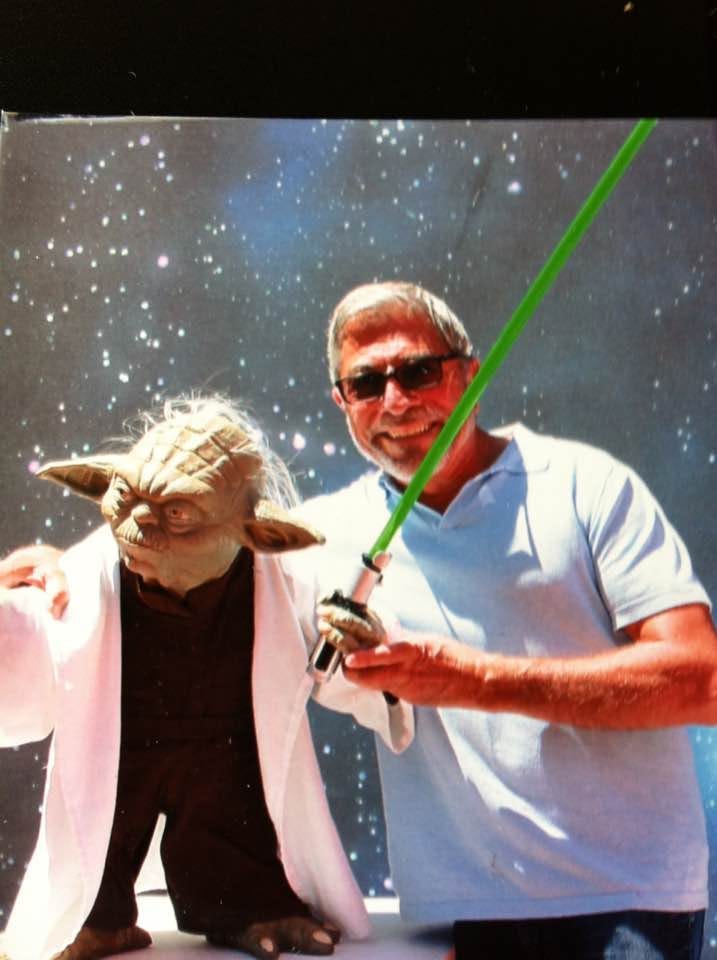
(May the Force be strong in all of us, on May the 4th and everyday: my mentor and me.)

We are all Jedis, now.

Darkness descending, so fast,

Erasing the past.

Hate, Lies, Bigotry

Spreading plague-like, killing vows;

We are all Jedis, now.

Death and dying near,

Princess Leia no more here —

We are all Jedis, now.

Ali, Ali, where are thee?

Floating, and stinging like bees.

We are all Jedis, now.

Hal-le-lu-oo-ya

Leonard Cohen, you too-ya?

We’re all Jedis, now.

Easy, so easy

To turn out the lights, give in

To the coming night.

But we are alive,

With breath, mind and beating heart —

Each day, a new start

To love, live, create;

Never surrender our light,

Our hope, souls, our fight.

We are all Jedis, now.

Fearless with our strength and skills,

Hearts on fire, refusing to bow….

We are ALL Jedis, NOW.

Relentless Resistance and Fearless Escape Point the Way Out of Our Present Insanity.

The key to getting free from the utterly insane world of Donald Trump, and those making lots of money from the lunacy, can be found in Ken Kesey’s “One Flew Over the Cuckoo’s Nest.”

Steve Villano

Apr 29, 2026

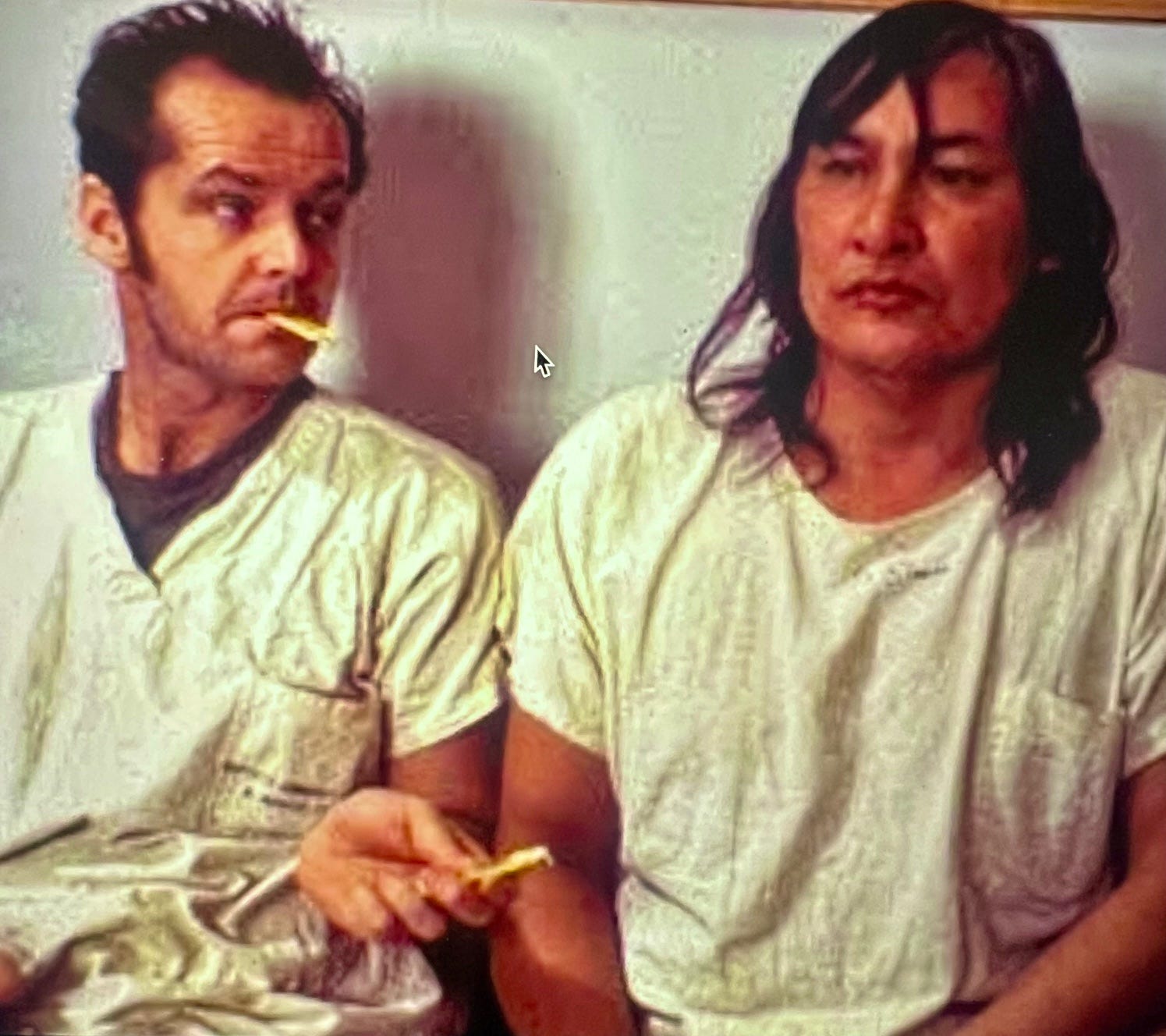
(Jack Nicholson (l.) playing Randall Patrick McMurphy, and Will Sampson, as Chief Bromden, in the 1975 film version of Ken Kesey’s story “One Flew Over the Cuckoo’s Nest.”)

For years now, some of us have been asking how long the lunatic, chaotic, erratic, fanatical, pathological and dangerous behavior of Donald Trump can go on. Is he really this crazy, or just acting this way to keep others off balance and increase his power? What about the possibility that he is both: diabolically sane, and insane simultaneously, and the difference between the two behaviors is no longer distinguishable, even to him?

In Ken Kesey’s seminal work about insanity, control, compliance and rebellion within the world of a lunatic asylum, One Flew Over the CuKoo’s Nest, such dynamics are ever-present between Nurse Ratched who exercises authoritarian control over the Psych Ward, Randle Patrick McMurphy who wrestles her for power, control and dignity, and the narrator, Chief Bromden, a Native American , and the longest tenured resident of the ward.

Trump is the Nurse Ratched (Wretched?) of our nationwide asylum in which he has bullied and badgered all inhabitants into questioning their own sanity, not his, even though he may be more pathological and removed from reality than everyone else.

You know it, and I know it,” Trump repeatedly bellows into the minds of people who neither know, nor believe he knows any such thing. It’s Trump’s hypnotic mantra of social control, implying that if you don’t know it, something is wrong with you, and since he knows it, and he’s famous and on television and a model of “American success,” it must be you who is wrong—or, as Nurse Ratched would phrase it, acutely insane.

Until recently—when Trump has gone utterly bonkers over sea shells in the sand; over the looks of Jim Comey and the laughter Jimmy Kimmel; over his gilded cage of a ballroom that keeps slip sliding away; over his Reich-like Renaissance Arch designed to cast a dark, demonic shadow over the graves of legitimate heroes of democracy; over a Pope who simply and faithfully preaches the Gospel of Jesus and exemplifies love over hate; over his waging of a daily war of terror against humans pursing a safe, peaceful life; over his transforming the US into an Apartheid state, like Israel, and, over the awful arming and executing a grotesque genocide against non-white populations in Gaza, Lebanon, and anywhere else around the world, I believed that much of his early insanity was calculated, and compared Trump’s behavior to that of one of his New York Mobster role-models, Vinnie “The Chin” Gigante.

New York Mob boss Vincent “The Chin” Gigante, the power behind the Genovese Crime Family during the 1980’s and 1990’s, avoided prosecution for decades by pretending to be “crazy.”

Nicknamed “The Oddfather,” Gigante took rambling street strolls in pajamas, a terrycloth robe and slippers around Greenwich Village, where he lived in a small apartment with his mother, who, in a screeching Stephen Miller-like defense of her son, insisted the only thing he was “boss” of was the bathroom. Whatever worked to keep The Chin out of the clink.

The Chin’s “elaborate deception” — as Federal Judge Eugene Nickerson described Gigante’s behavior in declaring him mentally competent to stand trial in the 1990’s — kept him out of jail for years, and the wealthy & powerful Mob boss manufactured reams of purchased doctors’ notes attesting to his lunacy; hypocritical notes in violation of doctors’ Hippocratic Oaths, like the ones Trump paid for, to get doctors to see bone spurs, and continue the Trump family’s cowardly tradition of actively dodging military service, like his grandfather Frederich, stripped of his German citizenship for failure to serve his country. Instead, Trump’s family role-model fled to the US and Canada, during the Gold Rush, where he operated a gold-lame decorated brothel (Oval Office inspiration?), the earliest know version of Epstein’s Island.

Who’s crazy now?

“The Chin’s” phalanx of paid psychiatrists missed a few salient facts: Gigante’s slipping out at night, dressed in normal clothing, to be with his girlfriend on the Upper East Side; Gigante ordering a hit on John Gotti, head of the rival Gambino Crime Family because he felt Gotti broke the Mob’s rules with the “unsanctioned” murder of Paul Castellano; Gigante ordering his underlings never to mention his name in conversations, but simply point to their “chins” when referencing him; and Gigante gingerly extorting payoffs from vendors and pocketing money donated to a neighborhood church during New York’s Annual Feast of San Gennaro. It all sounds very Trump-like.

In a weird way, Trump’s life of duplicity, deceit and Drag, was far more poisonous, if not as graphically violent—as far as we know— as the life of “Vinnie the Chin.” The “Chin” concocted his entire charade to keep his competition and the cops off balance AND to stay out of jail. Instead of executing other Mobsters, Trump goals were far grander: to kill the truth, and erase facts, history and humanity; to enrich himself beyond his grandfather’s—and father’s—wildest dreams; to take control of the culture; to place himself outside of the law, of everyday life and of any accountability for his actions; to use racial hatred or phony patriotism, or Elmer Gantry-like religious con-jobbery and his own, perverse obsession with celebrity (and America’s) to create a whole new universe, which he alone ruled.

In short, Trump worked relentlessly to craft the world as his own Jabba the Hut’s throne room, with himself pulling the chains of women and young girls, and to turn the country into the kind of mental asylum, which Nurse Ratched ruled. And, like Nurse Ratched or “Vinnie The Chin,” Trump needed to eliminate any challenge to his absolute control, or anyone who stood in his way.

Kesey’s Cuckoo’s Nest (either the 1962 novel, the 1963 Broadway Play starring Kirk Douglas who immediately bought the movie rights, or the 1975 movie starring Jack Nicholson and directed by Milos Forman) is incredibly instructive here, during this heightened period of society-encompassing insanity.

Nurse Ratched (Trump) exercises diabolical control over the 18 men in her Psych Ward by belittling each, and constantly setting off each against the other. Perhaps the most insightful scene takes place during the first Group Therapy Session experienced by the story’s protagonist, Randle Patrick McMurphy, who compared what Ratched (Wretched) did to her subjects as her getting them to peck each other to death, like chickens:

“ The flock gets a sight of a spot of blood on some chicken, and they all go to pecking’ at it, see, till they rip the chicken to shreds, blood and bones and feathers. But usually, a couple of the flock gets spotted in the fracas, then it’s their turn. And a few more get spots and get pecked to death, and more and more…”

And each time this occurs, it’s Nurse Ratched, who rules the roost with an iron fist, who draws the first drops of blood. She saves her fiercest venom—electric shock therapy and, eventually, lobotomization (in Trump’s case, he weaponizes the Justice Department, or unleashes vitriolic attacks on social media) for whom she (he) perceives to be the greatest threat to her continued reign of terror, or power. In the Psych Ward which the Wretched Ratched rules, that clear threat is McMurphy, a criminal con-man not insane at all, who sees right through her curtain of cruelty.

One of the key characters in Cuckoo’s Nest, Dale Harding, a closeted gay man who chose voluntary institutionalization over living in the real world (similar to Trump’s toadying Treasury Secretary Scott Bessent) who constantly kowtows to Nurse Ratchet for fear of retribution, makes a key observation about the struggle for power and dominance:

“Never before did I realize that mental illness could have the aspect of power; POWER. Think of it: perhaps the more insane a man is, the more powerful he could become.”

What’s left hanging out there is the question of self-control: what happens when the insane “actor” stops acting for effect and advantage, and slips into being utterly uncorked every hour of every day? What happens when he, or she, can no longer tell the difference, nor control it?

How is Nurse Ratched, (Trump Wretched) sane when she (he) orders a lobotomy ( or its’ equivalent, criminal prosecution, incarceration, reputational destruction) on her (or his) perceived enemies? Who is acting more pathological? More insane?

Kesey leaves no doubt in Cuckoo’s Nest, that the only “sane” response to the Wretched Ratched’s “insane” world was the unrelenting rebellion of McMurphy’s or the profoundly powerful escape of Chief Bromden, the powerful Native American, incarcerated in a mental institution for the last 10 years, simply because he was different, and misunderstood.

If the insanity is called out , if it’s no longer pumped up for fun, obscene profit or the comfort of predictability, then the insane world is challenged and shattered—like the huge glass window of the asylum smashed to smithereens by Chief Bromdem. Only then, are peace and sanity able to return, as least for some of us.

Tom Steyer: Experience, Fearlessness, Progressivism & Money, that Nothing Can Buy.

And the fact that Steyer is a no bullshit New Yorker, whose mother worked at the Brooklyn House of Detention, goes a long way with me.

Steve Villano

Apr 24, 2026

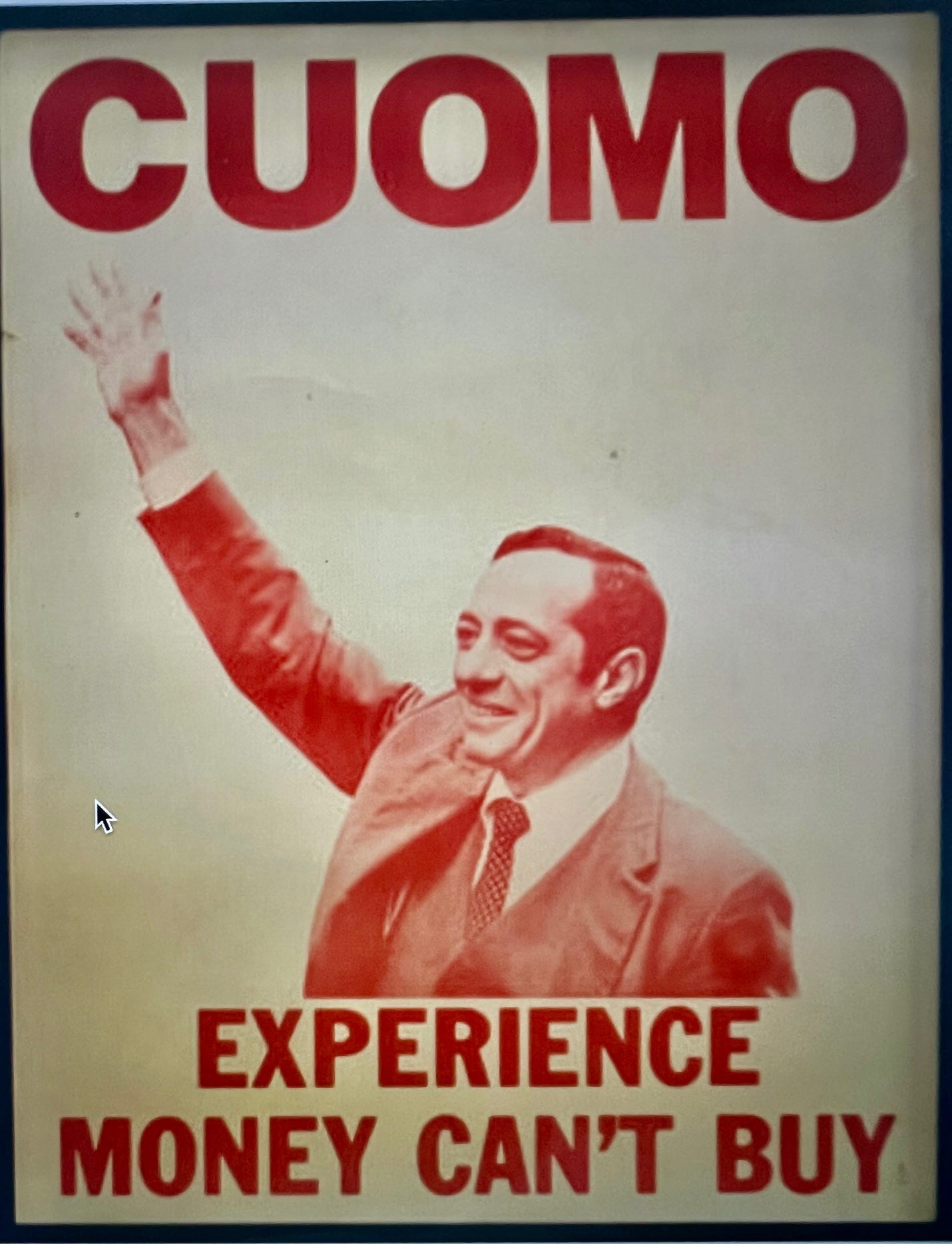
(Campaign poster from Mario M. Cuomo’s 1982 New York State Gubernatorial Campaign against multi-millionaire Lewis Lehrman, heir to the Rite Aid Pharmacy fortune.)

In 1982, Mario M. Cuomo, ran for Governor of New York State as a Democrat. He had no money, but was the incumbent Lt. Governor of NY State, and Secretary of State for the four years before that. Those eight years were Cuomo’s sum total of experience in public office.

A lawyer by training, and a brilliant one of the highest integrity, Cuomo gained another kind of hands-on public service experience when he was called upon by NYC Republican/Liberal Mayor John Lindsay in 1971, to mediate a highly controversial public housing proposal in Forest Hills, Queens. Cuomo, acting as a private citizen, succeeded by cutting the size of the NYC Housing Authority proposal in half. He documented his work in the book, Forest Hills Diary: The Crisis oif Low Income Housing, by Mario Cuomo, 1973. The preface to Cuomo’s book was written by the journalist Jimmy Breslin.

During his campaign for Governor, Cuomo picked up the endorsement of the State’s progressive public sector labor unions, and mercilessly attacked his GOP opponent—Lew Lehrman, heir to the Rite Aid Pharmacy fortune—for his “excessive” wealth of what was then $25 million, and of his trying to “buy” the Governorship by spending $8.8 million of his own money on the campaign. All of that, came against the backdrop of a Rockefeller (Nelson) spending a total of $10-12 million for all four (4) of his NYS Gubernatorial campaigns from 1958 through 1970.

Fast forward to California, 2026, and the battle for the Governorship of the nation’s largest state, and the world’s 4th largest economy. Again, the issue between two of the leading candidates in our State’s June 2 “Open Primary” election, is coming down to experience vs. money. In this instance the money gap is much greater, but the experience differences are far more difficult to pigeonhole.

For California voters, we’ll be fortunate if it we get to choose between Progressive environmentalist and change-agent Billionaire Tom Steyer—who has already spent $121 million of his own money on his campaign, and Xavier Becerra, a self-professed institutionalist, and a steady, life-long staple of California’s public life, and former Biden Administration HHS Secretary. Because of California’s crazy “Open Primary” system, the alternative to either of those solid and sane candidates could be calamitous.

The latest polling averages as of April 23, 2026, from the Race to the White House/California 2026 Governor’s Polling have such a Democratic dream match-up within the range of possibility, with the polling—two weeks before mail balloting begins —reflecting a tight battle between: MAGA Fox News commentator Steve Hilton at 18.2%; Tom Steyer, 14.5%; former Far Right Oathkeeper Chad Bianco, 14.3 %, and former HHS Secretary, Becerra, 13.7%. Less than four percentage points separates all four of them.

Having grown up on the intensely competitive political party primary system in New York State—and waging my one and only campaign for public office as a “reform Democrat” more than a decade before I began working with Mario Cuomo—I’ve always found California’s “Open Primary,” multi-party, anything goes system of voting to be both bizarre and begging for abuse, since it’s inception 14 years ago. The only thing I see as more “Open” here, are more open-ended political spending, more never-ending campaigning, and more second and third rate and perennial candidates who somehow persuaded themselves that they were ready for prime time, or were what we needed.

Barring the unlikely catastrophe of the two MAGA monsters finishing first and second in the voting on June 2—with the looney law precluding any opportunity to write in a new candidate, run on a third party line, do the whole nightmare over, or declare a state of emergency—the best scenario for sensible Californians would be for either Steyer or Becerra to finish in the top two.

Ideally, if those two Democrats finish as the top two vote getters, than we voters—who receive our mail ballots for the ‘Open Primary’ in two weeks—will face the best of all possible choices, between Steyer and Becerra, which could be an informative campaign for the heart and soul and future direction of the Progressive movement in this country.

Unlike Cuomo’s campaign against Lew Lehrman 44 years ago, it won’t be a campaign of “experience” vs. “money”, but of substantively different and compelling experiences and backgrounds, and of who can best control the runaway wealth of billionaires, and best deliver public services to all Californians. It’s well worth taking a look at the backgrounds and stories of Becerra and Steyer, both 68 years old, to understand what drives them, how hard, and what could be in store for all of us.

BECERRA:

Xavier Becerra is a true American success story, especially for many of us from immigrant families. The Sacramento-born son of Mexican immigrants, Becerra is the first member of his family to ever attend college, and that was as a Stanford University undergraduate, and Stanford Law School graduate, Class of 1984.

Becerra first worked for Legal Aid, and then joined the State Senate Staff of Senator Art Torres, an early and consistent mentor for many young Latinos in California government and politics, and the longest serving chair in the history of the California State Democratic Party. The Sacramento native stayed close to home, working for three years as a Deputy Attorney General in the California Department of Justice from 1987-1990, before getting elected to the State Senate for one-term, in 1990. In 1992, Becerra ran for, and won, a Congressional seat in the Los Angeles area, which he represented until 2017, or some 24 years.

Yet, Becerra’s smooth political career glide path was just beginning. In 2016, he found himself on Hilary Clinton’s short list for potential Vice Presidential running mates. When then California Attorney General Kamala Harris was elected to the US Senate from California that same year, Becerra popped up on another high-level “short list,” and was appointed by California Governor Jerry Brown to become the State’s first Latino AG—a position to which he was elected in his own right in 2018. During his tenure as State Attorney General, Becerra sued the First Trump Administration some 122 times on issues from the Affordable Care Act to DACA.

When Joe Biden was elected President in 2020, he selected Becerra to become the first Latino to run the federal Department of Health and Human Services in U.S. history. Now, the man with the golden resume is running to become the first Latino Governor in California, since 1875.

While Becerra’s political path appears to have been charmed from the outset, he has been consistently criticized during his pubic career for not being a risk-taker; not rocking-the boat; for moving too slowly and methodically on crucial social justice, economic, public health and environmental issues in Congress, as a State Attorney General and as the head of HHS under the Biden Administration. In an opinion piece in the LA Times (4/23/26), he was again labeled as too “chill” by the writer Gustave Arellano, and his preternatural imperturbability and pre-boiled boilerplate answers to most questions can often come across as glib, insincere, or just a polished way of avoiding any answer at all.

For example in a recent televised interview with CNN’s Dana Bash, the journalist asked Becerra if he didn’t think it was a bit strange that even though he was a former HHS Secretary, California’s Nurses had officially endorsed Steyer. Becerra’s smiling, stonefaced answer was incomprehensible, leaving the fact of the Nurses endorsement floating out there like a hot air balloon.

STEYER:

Tom Steyer’s story of success is no less compelling than Becerra’s and completely different.

He was born on the other side of the country, on the Upper East Side of Manhattan, to a mother who was a remedial reading teacher at the Brooklyn House of Detention, and a father with the white shoe law firm of Sullivan & Cromwell, who served as a prosecutor at the Nuremberg trials. Steyer’s mother was a devout Episcopalian, and his father was Jewish, a fact of birth that has not prevented Steyer from courageously criticizing AIPAC’s “dark money” influence on American Political campaigns.

Steyer earned his BA at Yale, where he captained the University’s Soccer Team, ironically, a position held a few decades later by California’s current Attorney General Rob Bonta, who succeeded Xavier Becerra as California’s current Attorney General.

Stanford’s Graduate School of Business brought Tom Steyer out to Northern California in 1981, putting him and Becerra on the same campus—but at different Stanford professional schools—Business and Law—at precisely the same time. They were both in their mid-20’s. While at Stanford completing his MBA, Steyer worked on Walter Mondale’s long-shot campaign for President, against former California Governor Ronald Reagan. Not many Stanford Business School graduates could be found working on Walter Mondale’s presidential campaign in 1984.

A passionate environmentalist, Steyer was active in every Democratic Presidential campaign from Mondale’s right on through both of Barack Obama’s, becoming the single biggest fundraiser for Obama, and securing for himself a speaking position at the 2012 Democratic National Convention in Charlotte, North Carolina. Already a leading voice on environmental and energy policy, and working with leaders like Bill McKibben, Steyer told the nation that the election of 2012 was “a choice about whether to go backward or forward. And that choice is especially stark when it comes to energy.”

Steyer, whose present net worth hovers around $2.4 billion, made his fortune through the San Francisco-based hedge fund he founded, Farallon Capital. When he left the hedge fund in 2012, at the age of 54, Steyer disposed of his carbon polluting investments and his investments in private prisons—both of which have come under fire during this year’s Governor’s campaign. Steyer has rebutted those charges by pointing to his impeccable environmental credentials since then—and his support from leading environmental groups and environmentalists like McKibben—and his no-holds barred position on ICE, calling for the complete abolition of the agency.

In addition to being the founder and driving force behind “Next Gen America,” Steyer—a consistent backer of major environmental and voter protection initiatives— was the biggest contributor (some $12 million) to the Campaign to pass Prop 50, the historic California redistricting Proposition passed in November 2025, with some 64% of the Statewide vote.

And, unlike several other leading Democrats in the State of California—including incumbent Governor Gavin Newsom and San Jose Mayor Matt Mahan, the quixotic captive of tech billionaires attacking Steyer for being a billionaire—Tom Steyer has given his full support to a wealth tax on billionaires and millionaires, winning him Progressive support from Bernie Sanders, Ro Khanna, Our Revolution, the California Teachers Association, the California Nurses Association, Smart Justice California, Courage California and State Assemblymembers who have supported prison reform legislation, including, Isaac Bryan, Lola Smallwood-Cuevas, and Mia Bonta—the partner of present California Attorney General Rob Bonta, Becerra’s successor in the AG’s Office, and himself, a prison reform champion.

In a story in the April 23, 2026, San Francisco Chronicle entitled “Bernie Sanders Group Makes Suprise Endorsement in Cal.Governor’s Race,” the Bay Area’s Our Revolution group—which vehemently opposes billionaires’ involvement in politics—defended its endorsement by saying Steyer is working “to challenge the very system that benefits people like him.”

Since leaving his private equity firm, some 14 years ago, Steyer has spent hundreds of millions of dollars on behalf of liberal/progressive candidates and causes across the country. In addition to supporting a wealth tax on California’s wealthy like himself, Steyer has pushed progressive ideas like breaking up the PG&E monopoly, and supporting a single-payer health care system—admitting that Bernie Sanders was right in 2020 on the single-payer issue and he was wrong.

Tom Steyer’s experience—and the crucial causes and progressive candidates to which he has devoted his personal fortune over the past decade—is extraordinarily different and far more enlightening and inspiring than anything that wealthy candidates like the GOP’s Lew Lehrman, 44 years ago in New York, or Meg Whitman, 16 years ago in California, brought to the public’s table on opposite coasts of the country.

Steyer is giving us the opportunity to give him the kind of chance we can all benefit from, and he’s got the tenacity, courage, fearlessness, flexibility, record, commitment, and yes, wealth, to fight with everything he’s got on our behalf.

In Search of Dr. Robby, and Stopping the Bleed.

In the final week of the Second Season of “The Pitt,” I ended up as a patient in two different emergency rooms in two separate states, and had two unique experiences.

Steve Villano

Apr 18, 2026

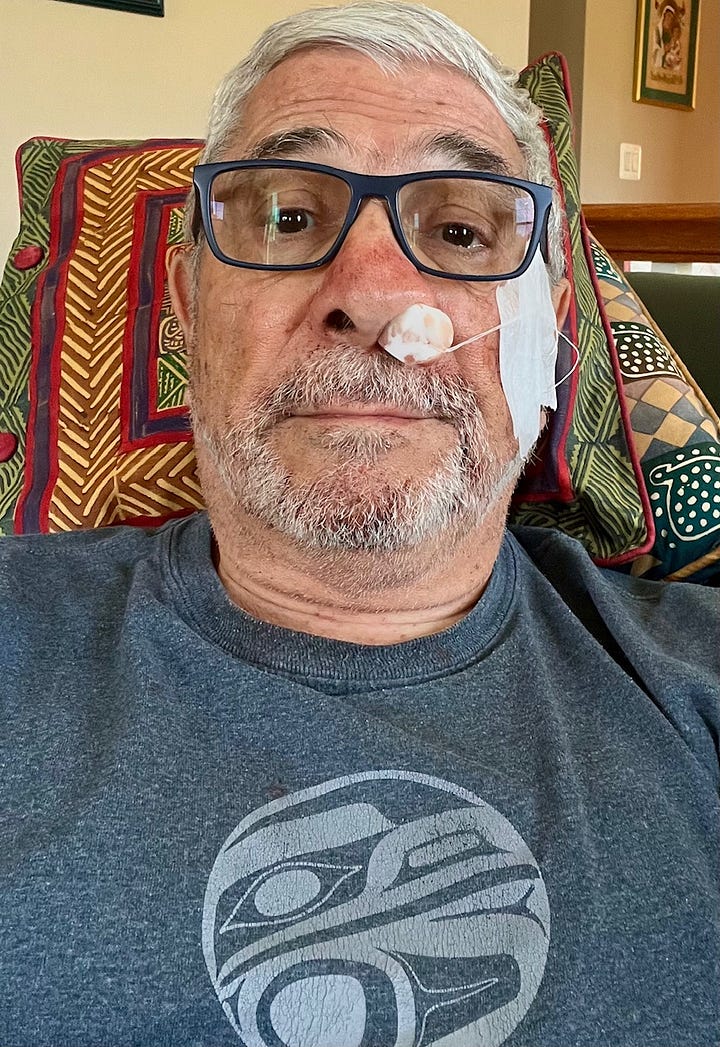
(Is a nose with deviation such a crime agains the nation? Me and my “Rhino Rocket,” and Dr. Robby (Noah Wyle).

I didn’t start out searching for Dr. Robby.

All I wanted was for my spontaneous nosebleeds to stop.

The first one hit me some 36 hours after I flew from the West Coast into Nashville, Tennessee. It could have been from the dry air on my flight, or the even drier air in the hotel, or my parched and aging blood vessels in my nose, or a sinus infection, or allergies, or a deviated septum, fixed once, but ever quirky, or the fact that my nose is like a large landing-field for anything airborne. Whatever it was, I couldn’t stop the bleeding.

I bled for a half-hour straight that morning, pinching my nose, plugging it up with anything I could get my hands on to try to stem the red tide. I filled two hotel towels and two washcloths with blood, until finally, just as suddenly and unpredictably as the bleeding started, it stopped. I must have exhausted my blood supply, I thought, knowing that probably could not be true. But, I hadn’t had a nosebleed in decades, so it spooked me.

I was comforted being only minutes from Vanderbilt Medical Center, just in case my blood felt like flowing again, like the long, serpentine Cumberland River that was close by. And, I thought, I had a former colleague who administered the COVID vaccine to Dolly Parton at Vanderbilt, so what could possibly go wrong. I’d be in great hands. Vaccine, vaccine, Vaccine! The thought of Dolly made me smile.

Two days later, after viewing the Dolly exhibit at the Country Music Hall of Fame, with my nose still dry & tender, we flew from Nashville to Baltimore/Washington Airport to visit friends we’ve known for nearly six decades, from our college days, when our noses—and other organs—were young, supple, and resilient.. Mine bore scars from being broken by a baseball bat when I was 10 years old, and playing the catchers position in sandlot baseball without a catcher’s mask. It was a schnozz with “character” I was told.

At dinner with our friends in suburban Washington, D.C. the night we arrived, the only character my nose knew to play was the role of a bloody mess, once again. Pinching, plugging and bathroom hugging didn’t help. Off we dashed to an urgent care clinic around the corner. Paging, Dr. Robby.

I arrived bleeding profusely through my proboscis, was immediately admitted, and laying my finger aside of my nose, an Emergency Medicine, MD, appeared—unusual for an Urgi-care center these days. And, as we’d later learn, a rarity for 1 in 13 Hospital Emergency Rooms around the country.

Unfortunately, the Urgi-care center was under-equipped—not unusual at a time of crippling health care cuts— and the specific device they needed to stop the bleeding—known as, yes, a “Rhino Rocket,”—was not available. They only had a child-sized gizmo, and in my cavernous size schnozzola, it could only hold back the Red Sea for so long, and could do nothing for the coagulating of blood in my throat, making it tough to breathe. I panicked that I would bleed to death, or, worse, choke on my own blood, in an understaffed, poorly equipped Urgi-care center, a continent away from home.

“I’ve never lost a patient to a nosebleed,” the Urgi-Care Doc said, who also told me he worked as an ER Doc at a major medical center for 20 years. Comforting.

When all you can taste is your own blood, and you’re gasping for air, none of that matters. In fact, nothing else matters. I didn’t want to make medical history and be the first patient to die such an ignominious death. The Urgi-Care MD called the large, local teaching hospital and told them to take me immediately. Paging, Dr. Robby, or Head Nurse Dana.

My nose was bleeding non-stop for nearly 90 minutes when I arrived at the Washington Metro Area Hospital’s ER, and was immediately ushered into the hospital’s Emergency Department. I was greeted by two nurses, and a Physician’s Assistant who were on duty. They were caring and concerned but could not stem the blood flow for several hours, despite rigging up a Y-shaped wooden splint to slow the flow.

“Am I hemorraging?”, I spit out to the Physician’s Assistant along with a mouthful of blood. He didn’t think soand like the Urgi-Care Doc, he’d “never lost a patient to a nosebleed.” Hmmmmm. A mantra, that, somehow, did nothing to calm my anxiety, which was driving my blood pressure up.

I gasped for air, and everytime I cleared my throat to grab a breath, the PA scolded me to not do that because it would unclot any clots that were forming to block the bleeding. The PA kept going back and forth to consult with the Attending ER Physician, whom I had not yet seen, and came back with the recommendation of applying the Nasal “Nuclear Option”: the “RhinoRocket.”

“You’re going to hate me,” he said, “because it’s painful to insert, but it will stop the bleeding.” Paging, Dr. Robby, please.

At that point, gurgling for air, and convinced my obit would read “Died of a Never-ending Nosebleed”, I would have agreed to anything, including slicing off my nice big nose entirely, so I said yes to the “Rocket.”

Billed as a “Tampon” for the nose, which soaked up the blood, The “Rocket” made me feel like a Rhino (not the nasal kind) overcome with rage. As it was inserted deep into my left nostril, I followed its upward trajectory by climbing up off my chair, making the pain much worse. The PA screamed at me.

“You can’t fight me,” he shouted.

“I’m not fighting, “ I sputtered. “It’s instinct.”

Once back on earth, with the “rocket” jammed up my nose, and it’s anchoring string taped to the side of my face, the bleeding was held a bay, for a while. The PA assured me he was contacting the ENT (Ear, Nose, Throat Physician) on call and that he would come and remove the “RhinoRocket,” once the bleeding stopped.

Two hours into this nasal nightmare, and I still hadn’t seen Dr. Robby, or any ER attending physician, and the DC-area emergency room was no where near as crowded as Pittsburg Trauma Medical Center on “The Pitt.” Such gaps in care, according to the American Academy of Emergency Medicine (AAEM), are not unusual and raise serious concerns about corporate medicine’s ties to private equity firms.

The National President of the AAEM, Dr. Robert Frolich Stein calls it a “national trend,” which “unfortunately, are not rare. Across the country, independent physician groups are increasingly being replaced by large national staffing companies. These conflicts are becoming a defining issue in Emergency Medicine.”

And, according to AAEM, “about half of all Nurse Practitioners (NPs) and Physician’s Assistants (PAs) who work in Emergency Departments now work independently—without the supervison of a physician.”

Around midnight, or some three full hours after I’d continued to bleed in the hospital’s ER—despite the presence of a tampon up my nose and continual labored breathing—the PA announced to me triumphantly, that the ER’s Attending Physician, was about to see me. Sound the trumpets, but not too loudly because it might make me want to blow my nose.

The ER Doc came in, and quickly saw that the first-stage of the Rhino Rocket had misfired, was not doing its job, and that I was still gagging on my own blood. He carefully, and painfully, pulled the “rocket” out by it’s string, and told me I could blow my nose to get rid of all the clotting so he could have a look into the dark recesses of my Nose’s unknown. I was fearful of even clearing my throat, under the PA’s uncertain and anxiety producing demeanor.

Globs of clots came out enabling me to breathe again, and the ER Doc, calmly and competently painted the inside of my nostrils with Afrin to prepare my nose for a second, more skilled launch of the raging Rhino Rocket. He did the procedure in a matter of seconds, and I didn’t leap out of my chair as I did the first time.

I thought of what Dr. Jacob Lentz, a real ER Doc at UCLA Health and an advisor and instructor to the actors on The Pitt,” said: “I think a lot of the success of the show is probably that people just like seeing people who are competent do nice things for other people and try to help them.” It was a relief but took much too long to get there.

Three days later an ENT specialist removed my now-saturated “Rhino tampon,” in preparation for my flight back to the San Francisco Bay Area from BWI. Things looked stable enough with my exhausted nasal septum, to risk a cross-country flight “rocket” free, but he loaded my partner and I up with cotton balls, and gauze pads—and a portable nose-tampon—just in case.

The flight home was blood free, and so were the next few days, but on the morning after the final Season 2 Episode of “The Pitt,” the nasal blood gates spontaneously opened again in my own bed at home. Fortunately, we live across the street from a terrific community hospital—Healdsburg Hospital—staffed 24/7 with an ER Physician on site. Just minutes after we walked into our community hospital’s ER, Dr. Robby appeared.

I didn’t have to wait hours to see him, nor endure a never-ending nosebleed; I wasn’t pre-screened by an NP, nor by a PA, to see if my condition was serious enough to bring it to the ER’s Attending Physician’s attention. My partner shepherded me into the ER with blood pouring out of my nose, and even out of my eyes in the form of tears. In the early morning hours, of a beautiful calm day at our small community hospital an hour north of San Francisco, the ER Doc saw me immediately—not because he knew me, which he did not, but because he knew exactly what to do for me.

Without hesitation or more bleeding on my part, he asked me to clear all of the clots of blood out of my nose, so he could see clearly what was going on. What he discovered was that I was a perfect candidate for nose cauterization, using the chemical silver nitrate to stop my recurring nosebleeds. “Chemical cautery” he called it.

Relieved to finally be in the care of a medical professional who knew what he was doing and remained unflappable throughout the process, I was finally able to joke:

Good thing I have a Big New York Italian Jewish nose,” I said. “It gives you plenty of room to work.”

My own Dr. Robby laughed: “We are fortunate,” he said, making me laugh, and relax even more. I felt swaddled in his calmness and confidence.

Meticulously, he “painted” the inside of my nose and the bleeding areas with the silver nitrate. and carefully told me what I could and could not do over the next few days. With more than 20 years of intense ER experience in larger Emergency Medicine Departments in San Francisco, and Oakland, we were incredibly fortunate to have such a calm, competent, experienced ER physician in our corner.

The night before my lucky experience at our local community hospital, in our small, rural wine country community—the kind of places which around the country are starved for high quality Emergency medical care, since 92% of all Emergency Care occurs in urban areas—we watched the final episode of Season Two of “The Pitt.”

The incredibly written, acted and produced episode—some of the best, most effective storytelling and patient advocacy on TV since Dr. Neal Baer’s pioneering work on the orginal ‘“ER”—left our family in tears, especially during a few eloquent soliloquys by the main ER Docs. Dr. Robby’s monologue was superb:

The most important things I’ve ever done in my life has been in this hospital. Nothing will ever matter more than what I’ve done in this hospital, but it is killing me. You know how they say that a part of you dies when you lose something you love? I’m not convinced that a part of you doesn’t die every time you see a fellow human being pass…”

Or, as his ER colleague, Dr. Jack Abbott summed up in an equally emotional comment, sharing with Dr. Robby the beauty and laughter and life that keeps him carrying on: “That’s what we’re here for.”

And, I’m glad they are.

“The Fluid from Their Melted Eyes Had Run Down Their Cheeks.”

The world’s first Nuclear weapon, dropped upon the civilian population of Hiroshima, Japan, by the US in 1945, erased humans from existence. American journalist, John Hersey, wrote an early report.

Steve Villano

Apr 07, 2026

(With the unhinged American President hallucinating about “sending Iran back to the Stone Age” or of wiping out Iranian civilians, and civilization, in “one night”, the terrifying possibility of the use of nuclear weapons against innocent human beings has become very real, for the first time in my 77 years of life. Having written and researched this subject extensively for over five decades, the prospect of the use of nuclear weapons against humans once again, must be exposed for the utter insanity—and international war crime that even the threat of committing such a genocide—constitutes.

It was 81 years ago this summer, when the United States dropped two nuclear weapons on the Japanese population centers of Hiroshima and Nagasaki, three days apart, wiping out nearly 200,000 humans going about their everyday lives. (The first bomb, dropped on Hiroshima had more power than “20,000 tons of TNT,” far and away the largest bomb ever used in the history of warfare,” up until that time.

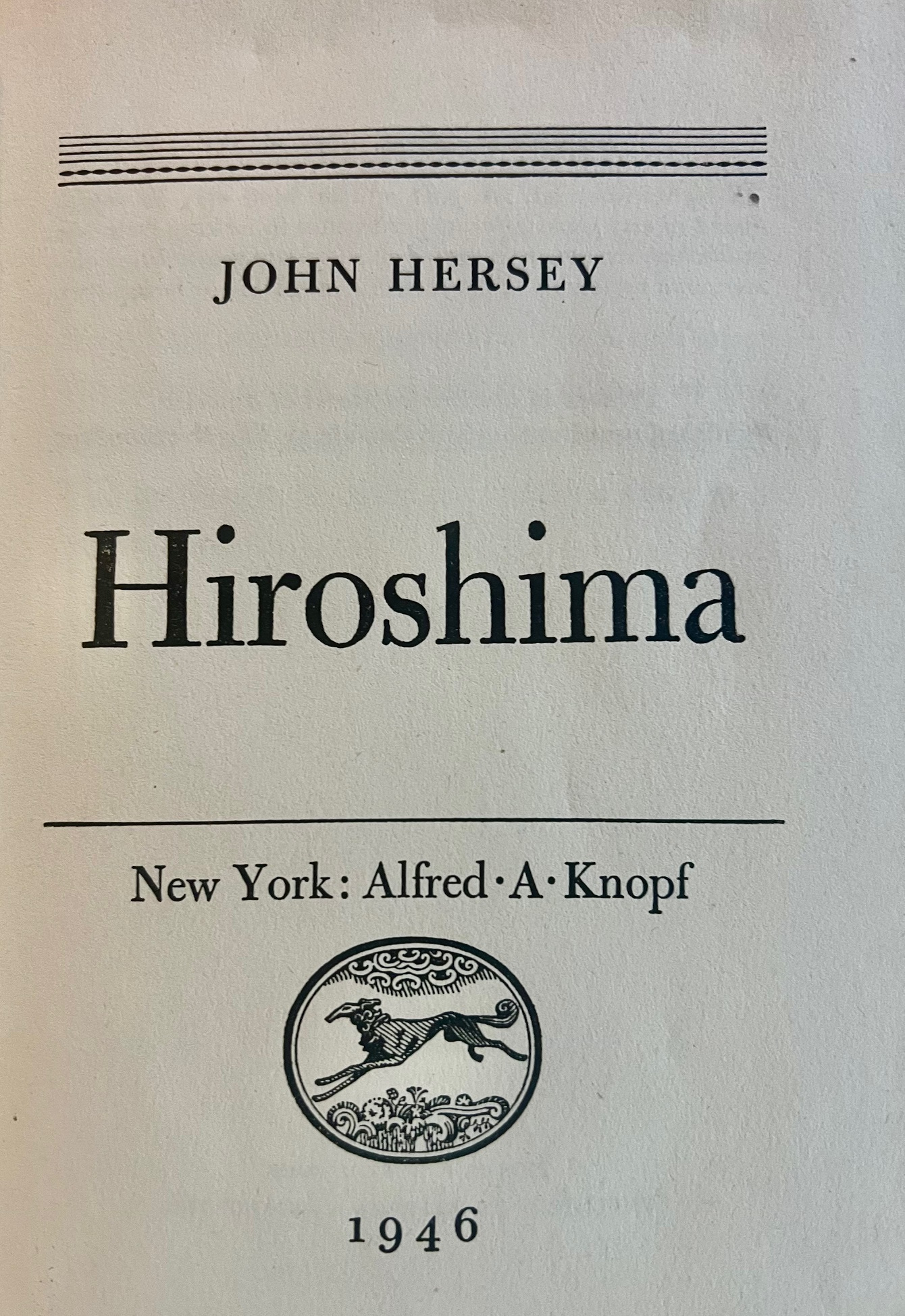
American journalist & author John Hersey wrote one of the earliest accounts of the horrific effect on human life of the dropping of the first of the two ”Atomic” bombs upon ordinary, non-combatant Japanese citizens. Originally planned to be published as a series of articles in The New Yorker in 1946, the publication devoted its’ total issue of August 31, 1946, to publishing Hershey’s entire story of “Hiroshima.”

Later published in hardcover book format by Alfred A. Knopf publishers of New York, in 1946, Hiroshima, has gone on to sell more than three million copies. Owning one of those original copies, has given me a deep sense of duty to read and share Hersey’s words over and over again, so that no such intentional mass torture of fellow human beings is every contemplated again.

This week, in my most recent re-reading of Hiroshima, as the madness of American threats against Iran have escalated to genuine Genocidal proportions, the simplicity and clarity of Hersey’s writing struck me as pure as a poem, demanding that we pay attention to the kind of terror we are, once again, threatening to inflict upon the innocent. The vision and observations in this version I’ve entitled “Hiroshima, Revisited”, are all Hersey’s; the extraordinary words of John Hersey’s are bracketed by quotation marks; other transitional words or phrases are mine; the selection, editing and emphasis of them are mine. The responsibility to prevent this crime against humanity, and war crime, from happening again, is all of ours.)

HIROSHIMA, Revisited.

A normal workweek began with a noiseless flash;

Clerks at their desks, nurses with patients,

Clergy at their best, families paying rent.

The windows of their offices,

Hospitals, churches and homes

Welcoming the morning light, one last time.

“A tremendous light cut across the sky;

It seemed a sheet of sun.”

The Reverend reacted in terror,

His instinct was to run.

“He threw himself between two big rocks in the garden,

Bellying up very hard against one.”

“He pushed his face against the stone, eyes shut,

Feeling a sudden pressure, and then splinters

And fragments of tile fell on him.

When he dared, the Reverend raised his head,

And thought the bomb fell directly on his neighbor’s house,”

And left him dead.

“Under what seemed to be a local dust cloud,

The day grew darker and darker.” It was 8 am.

The mother, a soldier’s widow, watched

“Everything flashed whiter than any white she had ever seen.

Her mother’s reflex set her in motion toward her children;

She took a single step when something picked her up

And she seemed to fly into the next room over the raised sleeping platform,

Pursued by parts of her house.”

“Timbers fell around her as she landed

And a shower of tiles pommelled her.”

“Everything became dark, for she was buried.

She rose up and freed herself;

She heard a child cry, ‘Mother help me,’

And saw her youngest—the five year old—

Buried up to her breast, and unable to move…”

She “started frantically to claw her way toward the baby,

She could here nothing of her other children.”

The Medical Doctor saw the flash.

“Startled, he began to rise to his feet;

The hospital leaned behind his rising, and

With a terrible ripping noise

Toppled into the river.”

An entire hospital, with patients and nurses; gone.

“The Doctor was alive, squeezed tightly by two long timbers

In a V across his chest—like a morsel

Suspended between two huge chopsticks.”

“Wounded people were hurrying across the bridge

In an endless parade of misery;

Many of them exhibited terrible burns

On their faces and arms.”

The Doctor “saw a nurse hanging in the timbers

Of the hospital by her legs, and then, another

Painfully pinned across the breast.

He thought he heard the voice of his niece for a moment,

But he could not find her; he never saw her again.”

“Of 150 Doctors in the city, 65 were already dead, most of the rest, wounded;

Of 1,780 Nurses, 1,654 were dead, or too badly hurt to work.

“Wounded people supported maimed people;

Disfigured families leaned together.

Many people were vomiting.

In a City of 245,000, nearly 100,000 had been killed…

Or doomed at one blow; 100,000 more were hurt.”

“The eyebrows of some were burned off, and

Skin hung from their faces and hands.

Others, because of pain, held their arms up,

As if carrying something in both hands.

Some were vomitting as they walked.

Many were naked, or in shreds of clothing..

Those who were burned moaned,

Mizu, Mizu! Water, Water!”

“No country except the United States,

With its industrial know-how,

It’s willingness to throw 2 billion gold dollars

Into an important wartime gamble,

Could possibly have developed”

The largest bomb—an Atomic bomb—used,

In the history of warfare.

The morning after the Bomb was dropped on Hiroshima,

The Reverend went to “fetch water for the wounded

In a bottle or teapot he had borrowed…

There were many dead in the garden.

At a beautiful moon bridge, he passed a naked, living women,

Who seemed to have been burned from head to toe…”

When the Reverend had given the wounded water,

“the woman by the bridge was dead.”

On his way back with the water,

As he looked for a way back through the woods,

“He heard a voice ask from the underbrush:

Have you anything to drink? He saw a uniform.

Thinking there was just one soldier, he approached with water.

When he penetrated the bushes,

He saw there were about 20 men, and they were all in the same

Nightmarish state: their faces were wholly burned;

Their eyesockets were hollow;

The fluid from their melted eyes had run down their cheeks..”