In 1894, Gilded Age Godfathers lost over 100 seats in Congress; In 1974, Nixon’s crass corruption swept Democrats into power for 20 years. In 2026, Trump, guilty of everything, got crushed.
42 minutes ago
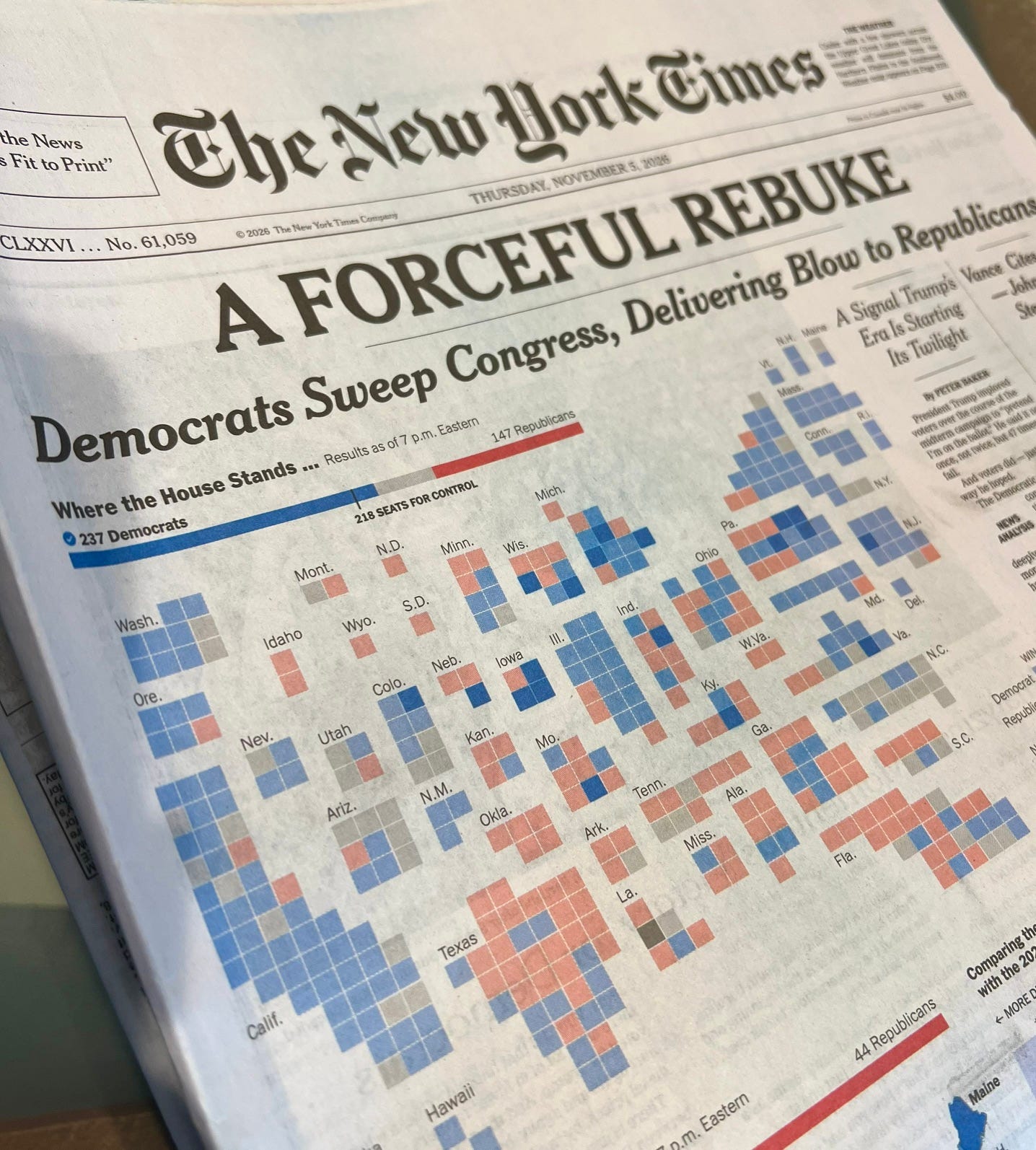
(Front page, New York Times, National Edition, November 5, 2026)
This is the 52nd Anniversary of the last generational political earthquake in American history. I was 25 years old at the time, and working in the campaign trenches for the National Education Association.
It came, like a thunderbolt, on November 5th, 1974, in the wake of the noxious Nixon corruption that led to his resignation from the Presidency in disgrace—and a weak economy hit by “high oil” prices the year before—delivering to the Democrats commanding control of both houses of Congress and 36 Governorships.
The post-Watergate whipping we gave to Nixon and his obnoxious, nattering nabobs of narcissism, resulted in Democrats winning 291 seats in the House of Representatives—2/3 + one, a veto proof majority—and increasing the Democratic Senate Majority to 60 seats. With such an overwhelming mandate for change, the Democratically controlled House and Senate passed a sweeping package of ethics and anti-corruption legislation to prevent another “Watergate” from ever happening again. Those reforms stood for some four decades, until the first Trump Administration took office in 2017.
Before this week’s trouncing of Trump, MAGA, and the corruption, cruelty and incompetence of the Gilded-Gang-That-Couldn’t-Shoot-Straight (except at immigrants and principled protestors) inflicted upon 330 million of us during the past decade, you had to return to the original “Gilded Age” of the mid-1890’s to uncover such a gigantic generational overthrowing of a corrupt, oppressive and self-serving oligarchy—far bigger and more enduring than the changes which emerged from the post-Watergate era.
Unlike the glitzy “Gilded Age” series presently airing on HBO, the heroes of the real-life ghoulish Gilded Age were not those attractive actors living on Fifth Avenue, in posh New York City mansions. They were farmers, ironworkers, and pullman car workers—dozens of whom were killed by Federal and State troops— streaming into the streets and rural communities from the midwest and south to NYC and into Washington, DC., risking their lives for jobs, food and justice.
In the mid-term elections of 1894—the year after the Economic Panic of 1893—when unemployment hit 25%, more than four-dozen greedy railroad robber-barons went bankrupt, and working people’s riots and “Coxey’s Army” of protesters blanketed the United States—progressive & reformist forces won an astronomical 116 seats in the House of Representatives. What made that total number of victories all the more remarkable was that there were ONLY 356 seats in the House at that time, instead of the 435 that exist today. Fully full one-third of the House membership was replaced in the 1894 mid-term elections.
It was a seismic political shift that lasted for two decades, fueling the Progressive movement, and resulting in tough anti-trust legislation, limits on child labor, workplace safety regulations, sweeping civil service reform and tough, new anti-corruption legislation. It also led to constitutional, economic and social reforms including: direct election of US Senators, the establishment of the National Parks System, and the 19th Amendment guaranteeing women the right to vote.
Will the response to the end of the Corrupt Trump Gilded & Greedy Age be as dramatic as those progressive, anti-corruption, good government reforms of the mid-1890’s, and early 1900’s?
There’s a strong chance it could, based upon the breadth and scope of the rejection of Trump’s corruption and pernicious policies.
Susan B. Glasser wrote in the New Yorker this week (November 4, 2026) that:
“The scale of Tuesday night’s (November 3rd’s) reckoning defies even his (Trump’s) ability to lie…For now and forever, the midterm elections of 2026 will be known as one of the most decisive rejections of an American president since long before Richard Nixon got on that helicopter in 1974.”
Glasser went on to write that it was an “epic self-own,” and the “clearest possible sense of moral revulsion. “They did not want Trump, his policies and his party anymore.”
Election data already bears Glasser’s prediction out. At press time, Democrats were closing in on a 50-seat gain in the House of Representatives, winning formerly “red” seats thought unwinable just two-years ago, when Trump was re-elected.
In the US Senate, Democrats are poised to flip control of as many at 8 seats, giving them a total of 56—only four less than they had in the post-Watergate mid-term sweep. And the victories are coming from across the country: Texas, Georgia, South Carolina, Mississippi, Ohio, Iowa, Alaska and even Kansas—the first time a Democrat won a Senate seat in that state in 94 years.
Perhaps even more tellingly, Democrats took over a total of 29 Governorships, up from a paltry total of only 16 Governorships a mere eight years ago. They registered resounding wins in key states like Texas, Georgia, Ohio, Iowa, Michigan, Wisconsin, Nevada and Minnesota, New York & California with six women Governors being elected, the first Latino (California) and Latina (Texas) in their respective state’s history, and two Black men (Nevada & Wisconsin).
The New York Times reported in a major story entitled “In Generational First, Democrats Will Hold Most Governorships,” (November 5, 2026, by Jack Healy):
“Democrats flipped five Governor’s seats, all in States that president Trump won in 2024, sometimes by double digits. The victories gave them a total of 29 governorships and control of a majority of the nation’s governorships for the first time in a generation.”
The last time the Democrats had such dominance of Statehouses, was following the 1974 “generational change” midterm elections, when they controlled 36 Governorships.
In Georgia—a crucial swing state for 2028—Keisha Lance Bottoms won in a romp as that State’s first Black, female Governor, and could be in a position to appoint a successor to Georgia Senator Jon Ossoff (who won by 20 points) if he runs for (and wins) the Presidency in 2028.
Up & down the ticket in Georgia, Black women were elected to high Statewide offices for the first time in that State’s history, increasing the prospect that the architect of the Georgia Voting Project which began 10 years ago—Stacey Abrams—could be selected by Governor Bottoms to serve out Ossoff’s Senate term, if he is on the Democratic National ticket in 2028.
Kentucky Governor Andy Beshear, Chair of the Democratic Governors’ Association, who engineered the strategy for the 2026 string of Democratic gubernatorial victories across the nation, pointed out that:
“ Tonight, we delivered a Democratic Governor in every swing state from the past several elections, and we expanded the map. There will be some 2028 candidates who can compete in a place like Iowa or Ohio.”
And, as the New York Time, noted:
“After Tuesday’s (November 3) election, about 75 percent of Americans will live in a state with a Democratic Governor.”
If the massive “revolutionary” generational elections of 1894 and 1974 are any guide, the latest Age of Gold, Greed, and Gilded, corrupt deals for family members and cronies of the rich, powerful, wealthy and well-connected, is about to come to an abrupt end.