


Frederick Douglass, James Baldwin, Viet Thanh Nguyen & Justice Ketanji Brown Jackson and the never-ending fight for humanity and justice.
Jul 05, 2026
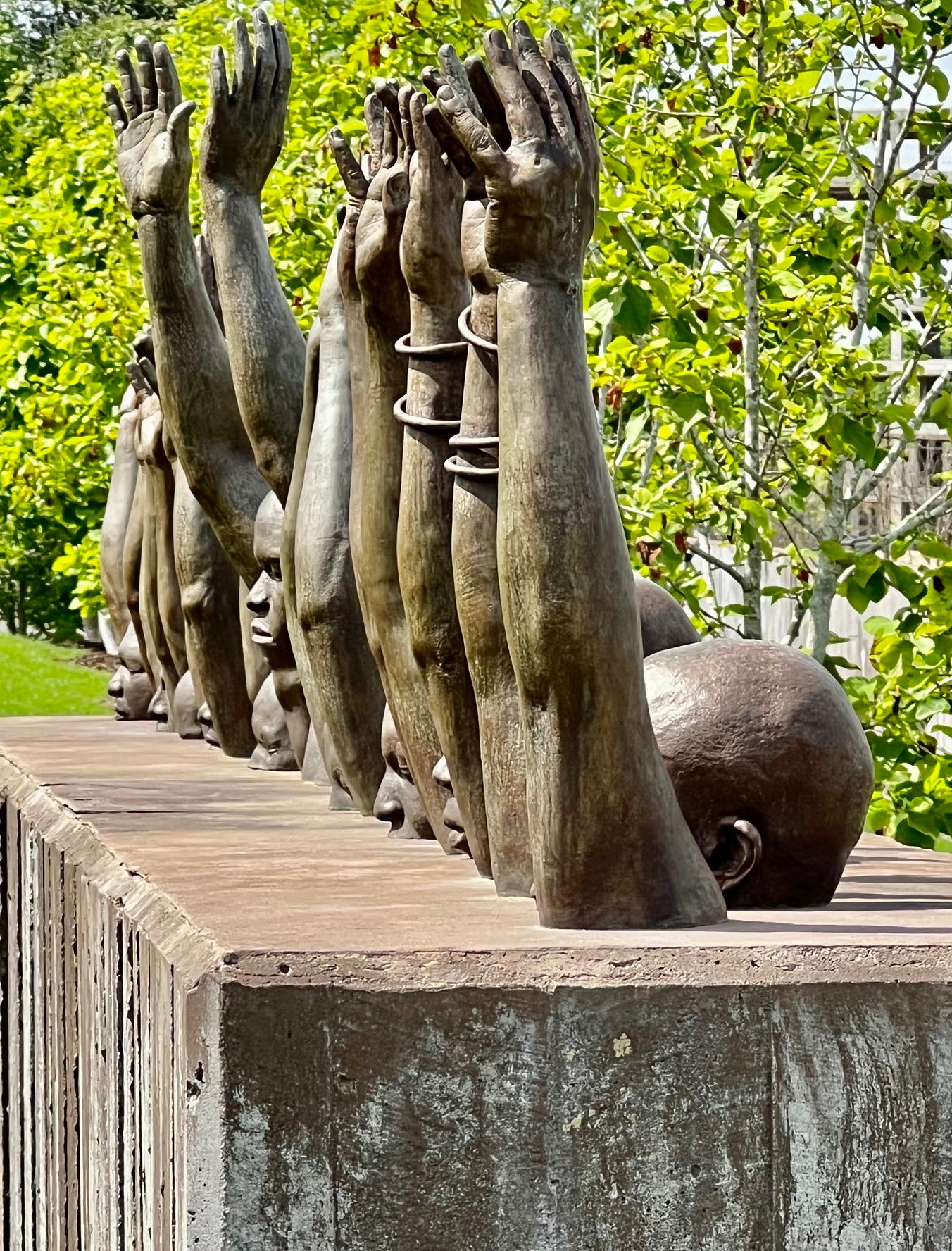
(Photo by Steve Villano, at the National Memorial for Peace & Justice; Montgomery, Ala.)
I didn’t blow out any candles to celebrate the 250th birthday of the United States.
I spent the day quietly, the way I often like to put big celebrations in perspective: I read; I wrote; I sat outside in my garden and thought; I had breakfast with my best friend; got together for a shared dinner with our neighbors; and relished the joy in my youngest granddaughter’s eyes as she played with our next-door Pugs, declaring that the thing she liked best about the fireworks was the smoke trail they left behind in the night’s sky.
It was the perfect metaphor for what was important and lasting once all the hype, hysteria, flashes in the sky, and in the pan, were gone; that, and who remained, was what mattered.
For hours during the day I lost myself in the words and wisdom of Frederick Douglass and James Baldwin; in the clear, sharp observations of Viet Thanh Nguyen, the Pulitzer Prize winning writer, who escaped war and oppression at age 4, just before America’s Bicentennial; and, in the brilliant legal analysis of Justice Ketanji Brown Jackson in her powerful concurring opinion in the Birthright Citizenship case decided by the U.S. Supreme Court right before the July 4th holiday weekend began.
I sat and conferred with all of these geniuses to make some sense of the carnival-like cage match between totalitarianism and the truth being played out in Washington, DC, the latest demolition site for the destruction of Democracy by Donald Trump, the architect of anarchy, repression and greed.
Sometimes, the never ending deluge of demoralizing news, challenging our most fundamental rights and beliefs—and all that we’ve worked toward over the past 60 years—makes me want to say “enough,” throw up my hands, and live out my remaining days in peace somewhere else, like Costa Rica, Spain, Portugal, England or France. But then, I remember. I could no sooner walk away from my grandchildren than I could from the roiling world we are leaving for them.
We have been here many times before, I think, under far worse life and death circumstances. One such test came 160 years earlier, when the Civil Rights Act of 1866 was enacted to enshrine birthright citizenship into law, to erase racial inequality, and to move America closer to the universal equality ideals expressed in the Declaration of Independence. Two years later, and the 14th Amendment to the U.S. Constitution passed overwhelmingly with a Citizenship Clause, that extended US citizenship to any slave born on American soil, and to others. The cost of extending equality to “all men”, as Jefferson originally promised, was severe: up to 750,000 American deaths—slaves and free men— and 470,000 Americans wounded in 4 years of the Civil War, the deadliest conflict in US history, fought over the fulfillment of a sacred promise for fundamental human rights and dignity.
Fast forward to today, when masked White Supremacists waving Confederate flags and wearing neatly pressed Khaki slacks marched through the streets of our Nation’s Capitol on the 250 Anniversary of our Declaration of Independence—which declared that “all men were created equal,”— tried again to use terror to erase all of that history and suffering and death, and pretend that “citizenship” was, instead to be found in the “blood” of only certain people, instead of in the universal protections of the common law, or the soil of a special land. It’s the same diabolical web of blood libels the Nazis used against the Jews nearly 100 years ago, inspired in fact, by Jim Crow laws of some of the same Southern States that legalized slavery and flew the Confederate Flag.
Frederick Douglass, in his famous oration on July 5, 1852, entitled, “What, to the American Slave, is your 4th of July?,” forced White Americans nearly a decade before the Civil War began, to face the humanity and dignity of the Black population it ignored while celebrating “freedom & liberty” and pretending that, as Jefferson wrote in the Declaration of Independence “all men were created equal and endowed by their creator with inalienable rights:”
“The rich inheritance of justice, liberty, prosperity and independence, bequeathed by your fathers, is shared by you, not by me. The sunlight that brought life and healing to you, has brought stripes and death to me. This Fourth July is yours, not mine. You may rejoice, I must mourn. To drag a man in fetters into the grand illuminated temple of liberty, and call upon him to join you in joyous anthems, were inhuman mockery and sacrilegious irony.”
Douglass never relented, nor gave up in the face of increasingly violent opposition to his position. Even after the election of Abraham Lincoln in 1860 and the onset of the Civil War the following year, Frederick Douglass continued to fight for full-citizenship for America’s Black population. He took nothing for granted:
“Abraham Lincoln was not, in the fullest sense of the word, either our man, or our model…He was preeminently the white man’s president, entirely devoted to the welfare of white men. He was ready and willing at any time during the first years of his administration to deny, postpone, and sacrifice the rights of humanity in the colored people to promote the welfare of white people in this country. YOU are the children of Abraham Lincoln. We are, at best, only his step-children; children by adoption, children by forces of circumstances and necessity.”
Douglass was not just referring to Lincoln’s longstanding advocacy of Colonization—relocating American Blacks to either the West Indies or to Africa. He was directly referencing the North’s necessity of freeing the slaves in order to defeat the Confederacy and preserve the union. Whether by design or default, freeing the slaves had become an essential military tactic for the North to win the War. Following the announcement of the Emancipation Proclamation in 1863, thousands of freed black, enslaved persons left Southern plantations, and reinforced battered Union troops, instrumental in the Union’s victory over the Confederacy.
I looked to Douglass and James Baldwin to learn how to channel my fury over the systematic efforts by Trump, his troglodyte followers and their rebranded version of White Supremacy (Patriot Front? MAGA? Christian Nationalists?) and to strengthen my resolve to fight fatigue, or, worse, the temptation to walk away from the battle ahead.
I turned to James Baldwin, in his take-no-prisoners book, The Fire Next Time, first published in 1963, the year four little Black girls were murdered at Sunday School in a Birmingham Church; and Medgar Evers and President Kennedy were assassinated. Baldwin’s book was republished in 1964, the year that Civil Rights Freedom Riders, Chaney, Goodman and Schwerner were gunned down in Mississippi by the KKK working in collaboration with local law enforcement officials. The fire, the fury, was all around us; the following year, Malcolm X was assassinated; three years later, Dr. Martin Luther King, Jr:
“One is, after all, emboldened by the spectacle of human history in general, and in American Negro history in particular, for it testifies to nothing less, than the achievement of the impossible.”
“If we—and now, I mean the relatively conscious Whites and the relatively conscious Blacks, who must, like lovers, insist on, or create, the consciousness of others—do not falter in our duty now, we may be able, handful that we are, to end the racial nightmare, and achieve our country, and change the history of the world.
“If we do not now dare everything, the fulfillment of that prophecy, re-created from the Bible in a song by a slave, is upon us: ‘God gave Noah the rainbow sign, no more water, the fire next time!’
Baldwin, once again, helped me answer the questions I continually asked myself and friends: “Why do we stay? Why after 60 years of struggling for human rights in this century and the one before, do we continue to fight?”
The obvious answer was always: for our children, for my granddaughters, to repair this broken world and make it better, fairer, more just; to fight alongside others who should not face these fights alone. Fleeing to a saner, gun-less, more democratic, more egalitarian, less-hate filled, less cruel country— although we had the means to do it—was never really an option. We were compelled to stand our ground.
An essay published on Zeteo’s Substack by one of my favorite writers, Viet Thanh Nguyen, on July 3, 2026, entitled “250 Years of Cruelty: The American Empire and How to Save the US” riveted my attention with its’ opening sentence:
“The word I think of to describe the United States on its 250th anniversary is cruelty. There are other words, of course, that could describe a country of such size, power, and diversity.”
The author’s earlier works, particularly his Pulitzer Prize winning novel, The Sympathizer, had powerfully influenced my thinking and my own writing, as did his personal journey.
Born in South Vietnam in 1971, during the peak of the Vietnam War, Viet’s family fled to the US after the fall of Saigon in 1975. During the American Bicentennial, they wer were living in a Fort Indiantown Gap, a Lebanon County, Pennsylvania, refugee camp, where more than 32,000 Vietnamese and Cambodian war refugees were re-settled. It was a bitter irony that the same camp was used throughout the previous decade as a large ROTC training camp for US Army soldiers, heading off to fight in the American war in Southeast Asia.
Viet Thanh Nguyen goes on to raise the disconcerting possibility that the “arc of the moral universe,” of which Dr. Martin Luther King, Jr., so eloquently spoke, might not always turn toward justice, but:
“…the gravity of American history bends that arc towards something far worse than justice.”
He goes on to write that we may be witnessing:
“…the black hole of cruelty that has always been there from the very beginning of the United States, or “America,” or the “New World.”
He quotes the late anti-colonialist poet and politician Aime Cesaire, who described the age of American Imperialism this way:
“The hour of the barbarian is at hand. The modern barbarian. The American hour. Violence, excess, waste, mercantilism, bluff, conformism, stupidity, vulgarity, disorder.”
Viet goes on to write that “the persuasiveness of American propaganda about being the greatest country in the world has never worked on everyone, but increasingly that propaganda is failing to work for ever greater numbers of people.”
Linking the present US Government’s war against our own neighbors with the unending war against non-Whites around the globe, Viet Thanh Nguyen warns us that:
“American propaganda has always been about the spectacle of the city upon a hill on whom the world’s eyes are turned, a brightly lit extravaganza marked by Hollywood and lubricated with Coca-Cola. Now the spectacle is about the demonization of immigrants, the sickening rituals of hunting them down in the streets with masked government enforcers, the lurid punishments of inhuman detention that spur cheers and glee from a significant part of the American people, encouraged by the would-be American Nero and his fawning minions who take pleasure in their taunts and insults. The bullying of the weak and the desperate inside American borders is matched by the lobbing of missiles outside those borders, the flexing of admittedly enormous muscles that is not matched by intelligence.”
The author dispenses with the notion that this “American cruelty” is something new, or the result of a “declining empire:”
“The cruelty was always there, from the slaughter of Indians to the exploitation, murder, torture, and rape of Black African enslaved peoples to the abuse and mockery of Mexicans and Chinese, Latinos and Asians, who were forcibly incorporated into American empire or brought in as cheap labor. American empire was also erected on the labor, subservience, and silencing of women, and the suppression of sexual diversity. If some idea of American exceptionalism is to be saved – this idea that Freedom is the greatest American invention and export – then the liberation of all peoples inside American borders will have to be realized, regardless of race, gender, sex, religion, nationality, or any other feature that is used to single out elements of humanity.”
Too many Americans take delight in cruelty, he observes, since they “cannot take delight in generosity, hospitality and possibility.”
Just a few days before Viet’s message was published of how to mitigate future “American cruelty,” a great-great-great granddaughter of slaves schooled the nation on how the U.S. Constitution commands that we follow “the universal vision of belonging and citizenship,” and not the path of cruelty, exclusion & hate.
Writing what may be one of the most powerful, historically accurate and important concurring Judicial opinions of our time, U.S. Supreme Court Justice Ketanji Brown Jackson—the first Black women to serve as a Supreme Court Justice—issued a clarion call for clarity and primacy of the Citizenship Clause of the 14th Amendment, at a time when this core principle of the US Constitution is under its most severe attack since the post-Civil War Reconstruction period, 160 years ago.
Born in Washington, D.C, in 1970, and raised in Miami, Florida, by a father who was the Chief Attorney for the Miami Dade County School Board, and a mother who was a principal for an Arts High School in Miami, Justice Jackson brilliantly articulated the majority decision of five other Supreme Court justices of how the 14th Amendment was essential to the “Second Founding” of the United States, in 1868.
Justice Jackson, a champion for equal justice, demolishes the myopic, historically wrong and legally incorrect views of the Trump Administration—and of it’s unintelligible and unthinking mouthpiece on the Court, Justice Clarence Thomas:
Justice Jackson writes: “By ignoring that our Constitution stands firmly against caste and subjugation—on all axes and in all manners—they deny the clear, universalist vision shared and proclaimed by the Fourteenth Amendment’s Framers: to “rebuild a shattered empire . . . to plant deep and solid the corner-stone of eternal justice, and to erect thereon a superstructure of perfect equality of every human being before the law.”
Thomas, jettisoning his own long-expressed, tone-deaf “racial blindness” test for the Constitution, makes the tortured claim that the 14th Amendment only applied to freed and enslaved Black men, in response to the dreadful Dred Scott decision of 1857, which denied citizenship to Black people because of their “blood,” regardless of their birth on American soil. Justice Jackson easily disposes of Thomas’ historically & legally empty arguments, and she exposes the bald-faced duplicity of Thomas’ overnight flip-flop of his decades-long insistence on “racial blindness.”
“Of course,” Justice Jackson writes, “ the ultimate irony is that for all the talk about the detestable Dred Scott decision, the Government and the principal dissent (Justice Thomas’) propose a return to its core tenet (of the Dred Scott decision).”
“Their bottom line is that, for certain people, being born on American soil will not suffice to confer citizenship. It is that odious conclusion that the Citizenship Clause plainly rejects, as the Court explains… I add only that the Fourteenth Amendment’s universalist aims should forever be the death knell for this kind of claim—one that seeks to make bloodline the marker of birthright. The America that was reborn from the rubble of the Civil War simply does not countenance that inequitable result. Thankfully, a majority of the Court remembered this today, and has dutifully preserved the most basic animating principle of our Nation’s founding—that all human beings are created equal— once more.”
I read and re-read Justice Ketanji Brown Jackson’s tour-de-force of an opinion over the course of the July 4th weekend, savoring every tightly reasoned phrase, zeroing in on her compelling case that, in fact, the US Constitution before the passage of the 14th Amendment, was anything but color-blind, since fundamental rights were denied to Blacks on the very basis of their skin color. Despite those racial restrictions written into the original Constitution, Justice Jackson noted that “freed Blacks who advocated for the 14th Amendment “fought for the shared humanity of all people.” It’s a concept of the universal rights of man that Clarence Thomas is incapable of comprehending.
I went back to Justice Jackson’s writing to hear once again, the call to history and memory articulated by Frederick Douglass, especially in the face of the Trump Administration’s jingoistic jihad against history it is hell-bent on hiding, and its’ frantic fanaticism to whitewash the truth:
“Douglass declared that his own aim was to “‘show that nations should have memories.’ In the time since Douglass’s prescient observation, Americans have come to learn that fading memories are not the only danger. The distortion of historical facts—retellings that reimagine and repurpose past events to lend credence to misbegotten aims—may be an even greater threat.”
I watched my youngest granddaughter follow the fire works across the night’s sky on the 250th Anniversary of the signing of the Declaration of Independence, marveling that once the lights had burned out, she carefully followed the trails of smoke that reminded us of what we just witnessed, and what we could be part of again.
I watched the wonder on her pure, cherubic face, and knew that I was exactly where I was meant to be for all the nights and days and challenges yet to come.
##