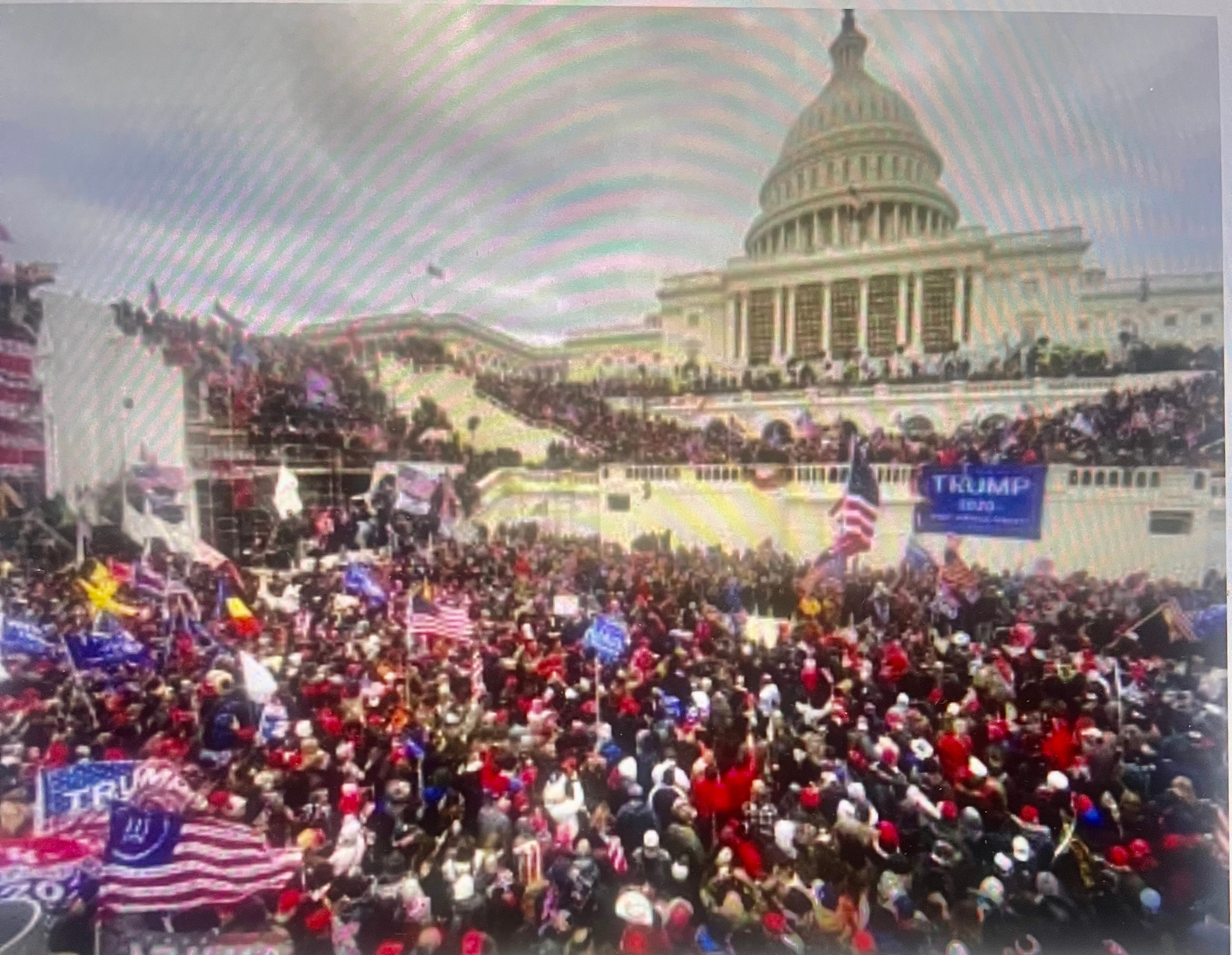
Jack Smith, on January 6: “An unprecedented effort to overturn the election.” Just like Maduro.

Jack Smith’s 8 hrs of under-oath testimony before Congress finds the evidence of Trump’s guilt was “beyond a reasonable doubt.”

(The January 6, 2021, Trump led “unprecedented criminal effort to overturn the election,” and “unlawfully stay in power”)

  • https://www.pbs.org/newshour/show/special-counsel-report-alleges-trump-would-have-been-convicted-had-he-not-been-reelected

In his final report to the attorney general, special counsel Jack Smith stood behind his decision to criminally charge President-elect Trump for his efforts to overturn the 2020 election. Smith detailed the evidence he and his team amassed and would have presented at trial, writing “the admissible evidence was sufficient to obtain and sustain a conviction at trial.” William Brangham reports.

Read the Full Transcript

Notice: Transcripts are machine and human generated and lightly edited for accuracy. They may contain errors.

Amna Nawaz:

In his final report to the attorney general, special counsel Jack Smith stood behind his decision to criminally charge president-elect Trump for his efforts to overturn the 2020 election.

In the 137-page report, Smith again detailed the evidence that he and his team amassed and would have presented at trial, writing — quote — “But for Mr. Trump’s election and imminent return to the presidency, the office assessed that the admissible evidence was sufficient to obtain and sustain a conviction at trial.”

The report was written before Smith resigned from the Department of Justice last week.

Our William Brangham has been following all the criminal investigations into the president-elect and joins us now.

So, William, this is Jack Smith saying he’s confident that he could have convicted Trump, but he was blocked by this longstanding DOJ policy that prohibits the prosecution of a sitting president. What else did he have to say in the report?

William Brangham:

That’s right, Amna.

We should also say, federal prosecutors always say, as a general rule, that, if we could have gone to trial, we would have been able to convict the defendant. I mean, federal prosecutors, by their nature, do not indict people they do not have a great deal of confidence that they could win against.

But, that said, this report is really a summary and a sort of encapsulation of all the evidence that his indictments have shown over the last year. There’s nothing really new in here. They’re simply alleging that Donald Trump knew that the 2020 election was lost, that Joe Biden beat him, that there was no widespread fraud, and that he refused to accept those results.

And Smith writes; “Trump then engaged in an unprecedented criminal effort to overturn the legitimate results of the election in order to retain power.”

And this report, those many, many pages detail all the ways that we have talked about over the past year that Trump allegedly unlawfully tried to stay in power. That was pressuring state and local elections officials. That was pressuring Department of Justice officials.

That was creating this fake electors scheme, pressuring Mike Pence, culminating, of course, with what Smith alleges was, Trump’s campaign of lies of a stolen election is what drove that violent horde into the Capitol on January 6, where 140 law enforcement officials were savagely beaten and attacked.

And, again, as you said, Jack Smith says all of that evidence, if I had been able to present it in court, would have been persuasive. But because Trump won and the DOJ doesn’t prosecute a sitting president, that case and all of that evidence got dropped.

Amna Nawaz:

And, William, Mr. Trump tried to block this report from coming out, from being released. Last night, he criticized that release. He called Jack Smith a lamebrain prosecutor.

And all along, Donald Trump has basically alleged this was a political Democratic effort led by President Biden to, in his words, weaponize the Justice Department against him. Did Jack Smith address any of that?

William Brangham:

Yes, he did.

In fact, he reiterated this quite a bit in his report. Smith goes to great lengths to reject that allegation, writing — quote — “Nobody within the Department of Justice ever sought to interfere with or improperly influence my prosecutorial decision-making.”

Smith writes throughout that the decision in this case, in all of them, was his and his alone. He writes: “The ultimate decision to bring charges against Mr. Trump was mine. It is a decision I stand behind fully.”

On the issue that President Biden himself was somehow the puppet master in all of this, Smith says: “For anyone who knows me, they know that that idea is, in a word, laughable.”

Amna Nawaz:

So, William, this report covered the January 6 investigation, but there was another investigation by Jack Smith that was into Mr. Trump’s alleged mishandling of classified documents at his Mar-a-Lago estate. That is not in this report. Will we ever see that volume?

William Brangham:

That volume, it’s complicated.

That case, as you remember, was dismissed by the judge, that she argued that Jack Smith was improperly appointed to his position. That report has been written. It is with the Department of Justice, but the department has said they’re not going to release it publicly at least until the cases involving two of the other defendants in that case are finished.

So maybe we will see it. We don’t know. It won’t be any time soon.

Amna Nawaz:

All right, our William Brangham, thank you so much.

The Narcoleptic Terrorist.

Like Vecna, the evil villain in “Stranger Things,” Trump pretends to sleep, while terrorizing the world, and sucking all the oil, gold, money and life out of humanity.

Steve Villano

Jan 03, 2026

(The evil Vecna from “Stranger Things,” sucking all the life out of the world, on Netflix.)

NARCOLEPTIC TERROR,

Not an error.

The septic Narcoleptic

Pretends to sleep

While his lawless gangsters

Reap whatever they can

Steal or grab on the cheap.

TAKE VENEZUELAN OIL,

Which they did, and said,

Dragging the leader & wife from their bed—

“Abduct”, they clucked.

“How easily they were plucked!”

And, how all pretense of any law

Was fucked.

THE NARCOLEPTIC TERRORIST

Awake, now pounds his chest

Proclaiming this nighttime raid

Was the BEST since D-Day—

And maybe better, since then,

Those suckers & losers got wetter

And some even died

Fighting Nazi Evil.

NOW, THE EVIL IS WITHIN

Slyly “sleeping” like Vecna

Ready to suck OIL or LIFE

From any sector, of the world

That hangs like Nectar in the dreams

Of the Narcoleptic Terrorist.

NARCOLECTIC TERROR

Committed while a nation sleeps,

And weeps, and wrings its hands

Over “the law, the law, the law,”

Which is no more.

MASKED GANGS ROAM OUR STREETS,

Orders issued from plush jetplane suites,

To take, to rape, to starve the young—

As long as the Rich are snorting money,

Having fun.

No law, no law to stop them,

Only us,

Long ago thrown under the bus.

NARCOLEPTIC TERROR

Rules the night,

When everything wrong, is right

And nothing lawful can be seen,

No matter how loud we scream,

“EPSTEIN, EPSTEIN, EPSTEIN.”

THE NARCOLEPTIC TERRORIST

Pretends to sleep

While fanged dogs of his dreams

Control the streets,

Kidnapping those they do not eat.

Sucking blood, money and life, from everywhere—

Simply because it’s there, it’s THEIRS,

For the taking, for the raping,

While we fail to wake.

“When Old Blue Eyes was ‘Red’.

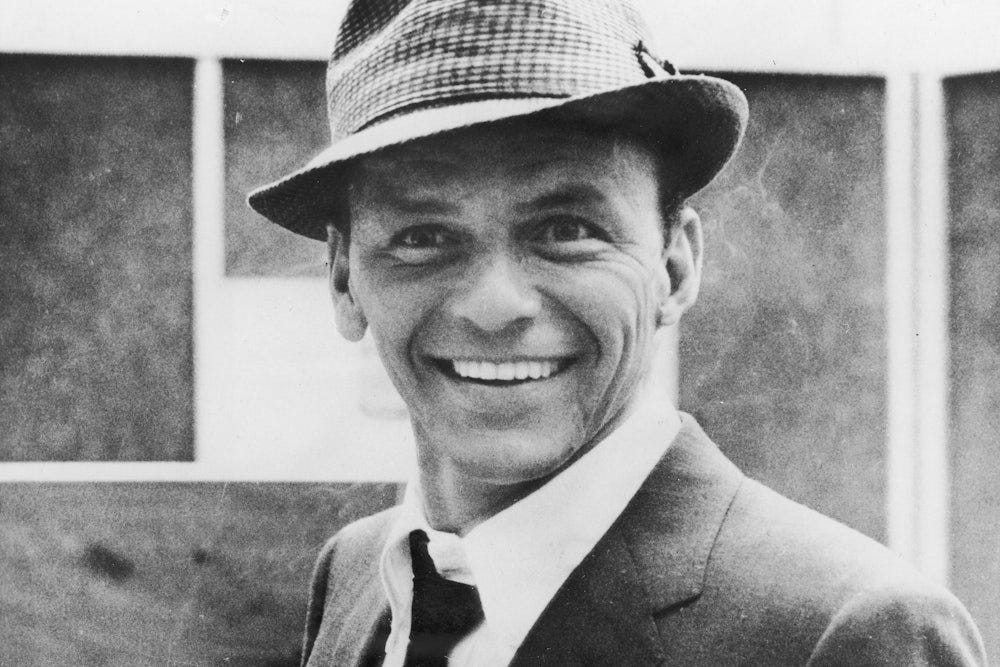
Trump said Sinatra would have “loved him.” Nancy Sinatra trashed that lie. The Nazi Stephen Miller–frothing to kill “leftists”–tried to steal Sinatra’s memory. The fact is, Fascists feared Frank.

Steve Villano

Jan 02, 2026

(In the immediate aftermath of more Big Lies from Donald Trump that “Frank Sinatra would have loved him and MAGA,” and from the Nazi Stephen Miller, who during Christmas tried to normalize his flagrant abnormalities by attempting to cloak himself in the music of Frank Sinatra, I was preparing to write a scathing rebuttal of the “spazzatura” (garbage) spit out by such scum. Nancy Sinatra, Frank’s 85-year old daughter fired the first truth bomb at the MAGA megaliars, by taking to social media to remind people that her father “loathed” Trump.

This is NOT my father’s America, “ Nancy Sinatra posted on X. “He would be devastated. Trump is so wrong in so many ways.”

So far, the cockroach Stephen Miller—who spreads the disease of hate each time he opens his mealy mouth—has not yet been squashed. Even a cursory knowledge of Frank Sinatra’s history of fighting hard for immigrants, and his civil rights activism—which led J. Edgar Hoover and the House Un-American Affairs Committee (HUAC) to label him a communist—would have clearly demonstrated that Sinatra stood for everything which MAGA,Miller and other Far Right troglodytes have opposed for more than 80 years.

However, in my research I discovered something so powerful about Frank Sinatra’s political journey that it had to be shared in full.

I’ve reposted this New Republic story from almost 40 years ago (March 31, 1986), by Jon Weiner, which lays out in great detail Frank Sinatra’s crusading record on immigrant and civil rights, his opposition to the Hollywood Black List, and how the MAGA movement of the 1940’s and 1950’s tried to crush him for expressing “leftist” views.)

When Old Blue Eyes Was ‘Red’

The poignant story of Frank Sinatra’s politics.

Hulton Archive/Getty Images

By Jon Weiner (New Republic, March 31, 1986)

I remember Sinatra who didn’t pal around with rich Republicans. During the early 1950s, at my Sunday school in St. Paul, Minnesota, one of the highlights of the year was the annual screening of The House I Live In, a short film starring a young and skinny Sinatra. In it, he told a gang of kids that racial and religious differences “make no difference except to a Nazi or somebody who’s stupid.” He sang about “The people that I work with / The workers that I meet. . . . The right to speak my mind out / That’s America to me.” The House I Live In, made at the peak of Sinatra’s popularity, won him a special Academy Award in 1945. Four years later his career was in ruins, in the wake of charges that he was tied to both the Mafia and the Communists. Forty years later his career is legend, his politics solidly conservative.

At first glance Sinatra’s political Odyssey from left to right seems to have followed a well-trod path. “Maturity” has been defined by figures as different as John dos Passos and Jerry Rubin as the abandonment of youthful ideals. But Sinatra’s case is different. Beaten down as an activist leftist, his career destroyed by the right-wing press, he made a stunning comeback, then found himself snubbed and abused by the liberals whose views he shared. Only then did he sign up with his old right-wing enemies.

The House I Live In was a turning point. The Cumulative Index to Publications of the Committee on Un-American Activities (HUAC), a handy list of everyone named as a communist in 20 years of committee hearings, indicates that in the eight years following The House I Live In Sinatra was named 12 times. The New York Times Index for 1949 contains a single stunning cross-reference: “Sinatra, Frank: See US—Espionage.” Sinatra reportedly denied the reports that he “followed or appeased some of the CP [Communist Party] line program over a long period of time.”

But once the allegations had been made, Sinatra’s image in the press changed dramatically. He was first linked to the Mafia in a February 1947 gossip column that reported he had been seen in Havana with mobster Lucky Luciano and other “scum” and “goons” who “find the south salubrious in the winter, or grand-jury time.” The columnist’s source, and the source of many subsequent Mafia-Sinatra stories, turns out to have been Harry Anslinger, a crony of J. Edgar Hoover. Anslinger served as head of the federal narcotics bureau and was out to get Sinatra because he was a “pink.”

“Frank’s big nosedive,” as the pundits called it, began on April 8, 1947. That was the night he punched Hearst gossip columnist Lee Mortimer at Ciro’s celebrated Hollywood night spot. The Hearst papers went wild, running whole pages on the incident, repeating the Mafia story and HUAC charges. “Sinatra Faces Probe on Red Ties,” a headline read. Soon gossip titans Hedda Hopper, Louella Parsons, and Dorothy Kilgallen were heaping abuse on him. Overnight Sinatra was transformed by the right-wing press from the crooning idol of bobby-soxers into a violent, left-wing Mafioso.

Overnight Sinatra was transformed by the right-wing press from the crooning idol of bobby-soxers into a violent, left-wing Mafioso.

Sinatra said he punched Mortimer because the columnist called him a “dago.” In fact Mortimer had been calling him some other things in print. He wrote about what he called “the crooner’s penchant for veering to portside” and reminded readers that Sinatra had been named in HUAC testimony as “one of Hollywood’s leading travelers on the road of Red Fascism.” Mortimer, nephew of the editor of the Hearst-owned New York Mirror, pledged that “this column will continue to fight the promotion of class struggle or foreign isms posing as entertainment”–like The House I Live In.

How pink had Sinatra been? HUAC’s sources were pretty disreputable. The first to name him was Gerald L. K. Smith, a raucous native fascist. In 1946 he told the committee that Sinatra “has been doing some pretty clever stuff for the Reds.” Sinatra was named again in HUAC testimony in 1947 by Walter S. Steele, a private Red-hunter who had once accused Campfire Girls of being “Communistic.” Jack B. Tenney, a California state senator who headed a state version of HUAC, reported in 1947 that Sinatra had taken part in a dinner sponsored by American Youth for Democracy, which J. Edgar Hoover had declared a communist front.

Between The House I Live In in 1945 and the big 1947 HUAC hearings, Sinatra had in fact moved much closer to organized left-wing political activity. In 1943, when riots broke out in Harlem, he went uptown to speak at two integrated high school assemblies, urging the kids to “act as neighborhood emissaries of racial goodwill toward younger pupils and among friends.” Shortly after, when white students in Gary, Indiana, boycotted classes at their newly integrated high school, Sinatra spoke in the school auditorium and sang “The House I Live In” What other star at the top of the charts has thrown himself into the civil rights struggle so directly?

In May 1946 Sinatra issued what Billboard called “an anti-Franco blast.” The statement was remarkable for two reasons. First, the only people who still remembered the support that Spain’s dictator received from Hitler and Mussolini were real leftists. And second, there was Sinatra’s Catholic background. The comment caused the Catholic Standard and Times of Philadelphia to label him a “pawn of fellow-travellers.”

Sinatra moved closer to the Communist Party in July 1946, when he served as vice president of the Hollywood Independent Citizens Committee of the Arts, Sciences and Professions. Known by its asthmatic acronym, HICCASP had been a broad coalition of pro-Roosevelt liberals and leftists, ranging from Thomas Mann to Rita Hayworth. Sinatra became an officer during a faction fight in which Communists pushed liberals out of the organization and steered it toward Henry Wallace’s leff-wing challenge to Truman in 1948. Sinatra wrote an open letter in the New Republic to Wallace at the beginning of 1947, calling on him to “take up the fight we like to think of as ours—the fight for tolerance, which is the basis of any fight for peace.” Within three months headlines appeared linking him to the Communists.

A month later he was fired from his radio show; six months after that his New York concerts flopped. Soon his personal life was falling apart as fast as his career. By December 1949 his affair with Ava Gardner had become an open scandal. Columbia Records was trying to get back the advance they had given him. In 1950 he was released from his MGM film contract, and his own agent, MCA, dropped him. He was a has-been at 34.

After Sinatra’s stunning 1953 comeback in From Here to Eternity, he remained a Democrat. He sang “The House I Live In” at the Hollywood Palladium at a 1956 campaign salute to Adlai Stevenson. He returned to the political wars with new energy during the spring of 1960. He had two projects that season: working for the Kennedy campaign (Sinatra’s version of “High Hopes” was the official Kennedy campaign song) and breaking the Hollywood blacklist that had barred left-wingers from working in the movies ever since the 1947 HUAC investigations.

The second project was announced shortly after Kennedy won the New Hampshire primary. The New York Times headline read, “Sinatra Defies Writer Blacklist / Hires Albert Maltz for his job filming of ‘The Execution O’ Private Slovik.’” Maltz had written The House I Live In. In Execution of Private Slovik, a recently published novel, told the story of the World War II G.I. who became the only American since the Civil War to be executed for desertion. “This marks the first time that a top movie star has defied the rule laid down by the major movies studios” 13 years earlier, the Times explained. Sinatra would produce, Robert Parish was to direct. Slovik would be played by a TV tough guy named Steve McQueen.

Sinatra, asked if he was fearful of the reaction to hiring a blacklisted writer, had a defiant, I-told-you-so response. He quoted his own 1947 statement criticizing HUAC’s witch-hunt: “Once they get the movies throttled, how long will it be before the committee gets to work on freedom of the air? . . . If you make a pitch on a nationwide radio network for a square deal for the underdog, will they call you a commie?”

A square deal for the underdog seemed to be exactly what Sinatra was after—for underdog Maltz, who served time in a federal penitentiary for refusing to name names, and also for Slovik. According to director Parish, Sinatra regarded Slovik not just as a victim of an unjust system of military justice, but as “the champ underdog of all time.”

“They’re calling you a fucking Communist!” Harry Cohn, king of Paramount Pictures, shouted at Sinatra. The attack had come, predictably, from Sinatra’s old enemies in the Hearst press. Editorial writers for the New York Mirror reminded readers that the guy who just hired a Red had once had a “‘romance’ with a dame to whom he was not then married.” (Sinatra must have murmured, “Hey, that was no dame, that was Ava Gardner!”)

John Wayne found Sinatra’s Achilles’ heel. Asked for his opinion on Sinatra’s hiring of Maltz, Duke said, “I don’t think my opinion is too important. Why don’t you ask Sinatra’s crony, who’s going to run our country for the next few years, what he thinks of it?” Sinatra responded with “A Statement of Fact,” for which he bought space in the New York Times. In it, he declared that connecting candidate Kennedy to his decision to hire Maltz was “hitting below the belt. I make movies. I do not ask the advice of Sen. Kennedy on whom I should hire. . . . I have, in my opinion, hired the best man for the job.”

Just as the controversy seemed to be dying down, the Hearst papers ran the banner headline: “Sinatra Fires Maltz.” The Times and the trades contained a new ad signed by Sinatra, headlined simply “Statement”: “Mr. Maltz had … an affirmative, pro-American approach to the story. But the American public has indicated it feels the morality of hiring Albert Maltz is the more crucial matter, and I will accept this majority opinion.”

In an interview shortly before his death in 1985, Maltz recalled the incident. “Sinatra threw down the gauntlet against the blacklist,” he said. “He was prepared to fight. His eyes were open. The ad firing me was ridiculous. The American people had not spoken; only the Hearst press and the American Legion had. Something had come from behind that caused him to change his position.”

Maltz brought out his scrapbooks. Among hundreds of faded clippings was one from Dorothy Kilgallen’s gossip column. “The real credit belongs to former Ambassador Joseph P Kennedy,” she wrote. “Unquestionably anti-communist, Dad Kennedy would have invited Frank to jump off the Jack Kennedy presidential bandwagon if he hadn’t unloaded Mr. Maltz.” Kennedy’s campaign advisers worried also about Sinatra’s Mafia aura and expressed the hope that the singer would keep his distance from the senator. But, the advisers said, they hoped Sinatra would help with a voter drive in Harlem, “where he is recognized as a hero of the cause of the Negro.”

After the election, JFK asked Sinatra to organize and star in his inaugural gala. The singer proudly escorted Jackie, but Jack was the one he cared about. In a gesture of classic macho deference, Sinatra offered to share a prize girlfriend, Judith Campbell Exner, with the president. Kennedy liked the idea and began an affair with Exner. (Sinatra’s hit that year, appropriately enough, was All the Way.) Then Sinatra Went too far; he introduced Exner to Chicago Mob leader Sam Giancana.

J. Edgar Hoover’s ever-present eyes and ears quickly discovered the liaisons. Bobby Kennedy, in the middle of a campaign to crush the Mafia, put a stop to his brother’s involvement with Exner. The Kennedys had been planning to stay with Sinatra in Palm Springs. He’d remodeled his house in anticipation of the presidential visit. At the last minute, JFK announced they’d stay instead with Bing Crosby—who wasn’t even a Democrat. To the public, it was an inexplicable snub.

Sinatra always was, as Village Voice jazz critic Gary Giddins puts it, “a virtuoso at storing wounds.” He got even with Bobby in the 1968 California primary by supporting Humphrey. Then he discovered the Humphrey campaign had the same reservations that the Kennedy campaign had had, and he quietly left.

As youth culture flowered in 1966, Sinatra married Mia Farrow; he’d just finished an album he called September of My Years. He was 51, she was 21, five years younger than his daughter Nancy. A sixties rebel, Mia cut her hair short and wore pants, and opposed the Vietnam War. Sinatra’s friends explained the attraction: “He digs her brain.” Soon, however, she was denouncing him and his pals: “All they know how to do is tell dirty stories, break furniture, pinch waitresses’ asses and bet on the horses,” she said. She left him to join the Beatles in India, meditating with the Maharishi.

Sinatra announced his retirement in 1971. “The principle activity of his retirement years,” New York Times music critic John Rockwell writes, “was his political shift from left to right.” The key moment seems to have come when the House crime committee held a new investigation of Sinatra’s Mob ties in 1972. The committee was headed by Democrats including California senator John Tunney, an old Kennedy friend for whom Sinatra had raised $160,000 with a special show. The main evidence against him was the testimony of a confessed hit man who said that a New England Mafia boss had boasted that Sinatra was “fronting” for him as part owner to two resort hotels. The committee called Sinatra. “That’s all hearsay evidence, isn’t it?” Sinatra asked. “Yes, it is,” the committee counsel admitted.

Always a public man, Sinatra explained the shift in his political thinking in a New York Times Op-Ed piece he wrote just after he appeared before the committee. His old politics of standing up for the little guy had been altered. Now he embraced the right-wing populism that defined the principal oppressor of the little guy as big government. And he saw his subpoena as a prime example of government oppressing a little guy. Sinatra became a Reagan Republican. “It didn’t gall him as much as he had thought it would,” reported columnist Earl Wilson.

His turn to the right coincided with a deepened contempt for women and his most offensive public behavior ever. At a pre-inaugural party in 1973, he shouted at Washington Post columnist Maxine Cheshire, “Get away from me, you scum. Go home and take a bath. . . . You’re nothing but a two-dollar cunt. You know what that means, don’t you? You’ve been laying down for two dollars all your life.” He then stuffed two dollar bills in her drink, saying, “Here’s two dollars, baby, that’s what you’re used to.” He made that kind of language part of his concert routine for several months, to the evident enjoyment of his new right-wing following.

President Nixon invited him to perform in the White House in 1973—something the Democrats had never done. He sand “The House I Live In.” Twenty-eight years earlier, he had sung it for students at newly integrated high schools. Now he was singing for the man who began his career as a member of HUAC from 1946 to 1950, when the committee smeared Sinatra. The president beamed with satisfaction, and Pat Nixon kept time by nodding her head. At the end of the program, for the first time in his public career, Sinatra was in tears.

© The New Republic, March 31, 1986.

Eva, Eva, Karoline Braun Is About to Spawn.

Only one year into the Rich Man’s Reich, Trump’s Eva Braun — married to a Rich, White pawn — is about to spawn. Magda Goebbels had 6 Aryan children. She and Joseph killed them all in Hitler’s Bunker.

Eva, Eva, Karoline Braun,

Clicks her heels to Hans Homan!

Her cross of Gold;

His stare of Cold;

Cut from Goebbels/Miller’s Mold.

Eva, Eva, Karoline Braun,

Monstrous men know she’s their pawn;

Trot her out, pregnant now;

She’s the perfect Aryan sow.

“The Constitution is Unconstitutional,” Eva declared,

And, even Aryan AG Bondi was shocked & scared.

Each time the Fuhrer waves his thinning hair,

Eva Karoline Braun is there!

Each time his thin, little lips spew lies,

Eva certifies them with wide Aryan eyes.

“Ridiculous,” she sniffs when anyone calls out his Grifts;

Qatar’s $400 million jet? The Smash & Grab hasn’t started yet!

Bob Martinez got his Mercedes Benz —

What can Trump steal? World without end. . .

Crypto? Gold coins? Media stock?

Eva’s good felon can sell any old schlock.

“If the President sells it, it’s fair trade,”

Says Eva Karoline, milk-skinned handmaid.

No DOJ to get in the way;

No S.E.C. to oversee.

Attack the Judges!

Attack the Courts!

Eva, Goebbels/Miller & Hans

Do it with Loud, Angry snorts.

For White Collar Criminals: AMNESTY!

Since everything White, must be free.

Erase Black History, and Gay People, too;

Eva flashes her cross, and Stepford Smile for you.

Habeas Corpus? Rigor Mortis! Process Due? Not for you!

NOT, if you’re Black, Brown, foreign born, LGBT, or a liberal Jew.

Eva, Eva Karoline Braun,

Distraction is her siren song;

Bomb Argentina! Bow toward Musk!

Nothing nailed down is gone by dusk.

Eva, Eva Karoline Braun,

Slithering across the cement Rose Garden “Lawn.”

Hail to Trump! To Hans and Goebbels/Miller!

Hail to the true Democracy Killers!

“I Want to Have What They Have.”

Serendipitously, three miracles graced my life this week, two in the form of terrific television and film, and one in an elegantly written print story about a woman of valor.

Sometimes, not always, I love it when life mugs me, especially when serendipitous happenings tear open my heart and my eyes, lift me out of despair, and, I know, will change me forever.

This time it was two “movies” that did it; one made for television this year; one crafted for the big screen 10 years ago. Both were elevated even higher by a New York Times piece about Michele Singer Reiner, titled “A Life Rooted in Activism & Listening to Others.” It was written by the Times Tayla Minsberg, and published on Sunday, December 21, 2025.

The brilliant hour of television which grabbed me was Episode 5 of the new HBO Max series “Heated Rivalry.”

A fun, not-quite-soft porn Canadien series about two male hockey players who fall madly in love, had been entertaining escapist television for the first four episodes, with lots of action, lots of beautiful bodies (no frontal nudity), and a desultory script about an unlikely pairing of arch-rival hockey plays, from Canada and Russia.

The breakaway star of the mini-series, from the very first scene, was the Russian Hockey Star Ilya Rosanov, played by American action Connor Storrie, whose James Dean vibe, and Patrick Swazye/Rudolf Nureyev rugged good looks would have been enough to make anyone sit up and take notice. But Storrie went one better. He perfected a Russian accent and attitude of arrogant confidence that electrified every scene in which he appeared.

Storrie’s Canadian counterpart, Shane Hollander, played by Hudson Williams played the perfect straight-arrow (although not sexually) professional athlete, who’s “boring” personality, was a friendly foil for the risque Russian. Except for a few naked love scenes (butts only), locker room scenes, kissing sequences, and a coquette-ish coupling between yet another hockey player (played by Francois Arnaud) and a NYC-based barrista, “Heated Rivalry” could have been confused for an after-school special. Until, along came Storrie. In every scene. In every conversation. With every look. In every way imaginable.

Rosanov’s back-story—son of a Russian Police apparatchik, brother of a coke-addict draining his famous hockey-playing brother for money, superstar in a nation notorious for violent punishment against the LGBTQ community—was riveting enough to hold your interest and keep you guessing, throughout the first 4 episodes, where the only other big on-screen mystery was how the talented hockey players could find ways to discreetly hook up for sex, without their families, and the rest of the world, knowing. But, there was a sameness settling in. Until, Episode 5.

Episode 5 began with Hollander (Hudson Williams) opening up to a movie-star girlfriend of his about being attracted to men, and Ilya in Moscow, mourning the death of his father. Distraught with grief, and feeling trapped by his life’s circumstances, Ilya calls Hollander on his cellphone, and is frustrated by his inability to express his feelings to him in English. Hollander, as deeply in love with the Russian hockey star as Ilya is with him, gently urges Rosanov to express himself to him in Russian, just to let things out.

Storrie (Ilya) steals the scene, and the series, with an explosive monologue of his feelings for Hollander and the urgency of his need to be himself. The power of this Russian’s repressed feelings pours out of Rosanov, and the English subtitles do no justice to his extraordinary expression of anger, frustration, desperation and love.

But, Hollander’s (Williams’) facial expressions are better than any literal translation. Even though the Canadian doesn’t understand a word of Russian, the depth of Ilya’s feelings transcend the barriers of language, and pierce the audience, and Hollander, with the universal language of love and aguish and desire.

The scene may be among the best on television this year, and Storrie’s stirring performance has him marked for superstardom. This was James Dean in Rebel Without a Cause. The performance was transformative.

So, I turned to another film intended to be a vehicle for expressing deep emotion that could not be expressed in person, or even completely understood in the same native language: Being Charlie, the 2015 film written by Nick Reiner, and directed by his father, Actor/Director/Producer Rob Reiner.

Being Charlie tracked the story of Nick Reiner’s descent into heroine and cocaine addiction, his struggle with mental illness, and his inability to communicate his feelings to his famous father. Interviews of both Reiners when the film debuted 10 years ago, quoted Nick, who earlier this month is alleged to have stabbed his father and his mother, Michele Singer Reiner to death, as having felt overshadowed by the lives of his famous father, and his famous grandfather Carl Reiner.

Watching “Being Charlie” was like watching a car drive off a cliff in slow motion, especially when you knew the real-life ending to this story which was meant to avoid that horrible descent into hell. A quote from the character playing the father was particularly haunting, since it was the precise quote Rob Reiner gave to media 10 years ago in explaining his approach to his son’s addiction: “We listened to every expert with a degree and a desk who recommended that tough love was what you needed.”

Tragically, the experts were wrong. That wasn’t what Nick Reiner needed, nor were Nick Reiner’s 18-trips into and out of rehab centers, and repeated relapses into drug addiction. Nor, sadly, was making a film about his addiction with the father —a sure fire formula for a happy Hollywood ending, some thought.

In “Being Charlie”, the character of the mother listens carefully to her son, and appears to be able to get through to him, when no one else can, although not without great struggle, which only families grappling with mental illness can fathom.

The New York Times story about Michele Singer Reiner, gives us a bit more clarity into the life of the least famous Reiner, the daughter of an Auschwitz survivor, whose mission in her family and community was to make sure everyone was heard.

“One conversation at a time,” Ms. Singer Reiner would say at the dinner table, clinking her glass with a utensil. “One conversation.”

She believe in Tikkun Olam, the Jewish principle of repairing the world, and never giving up on fighting for what one believed was right. She prodded her famous husband to use his celebrity to advance social causes, and led the way in helping to overturn California’s Propostion 8, the ban on same sex marriage.

The Times reported the observations of Kris Perry, a plaintiff in the case that overturned Proposition 8, who later became a friend of the Reiner Family. “They didn’t just hop in and out or swoop in and get attention—they were just quietly there,” Perry said.

As the Times noted: “When Ms. Perry took the stand and was asked why she wanted to get married to her partner, Sandy, she looked at the Reiners (Rob & Michele) who were sitting in the front row.”

“I want to have what they have,” she said.

##

The Unimaginable…Again, and Again, and Again.

13-years to the day of the Sandy Hook Gun Massacre of 20 children, gun violence fueled by hate & madness, killed 15 Jews celebrating Hanukkah in Australia, and 2 Brown University students in R.I.

(Artwork by Ezra Jack Keats, a Jewish artist and writer, who dedicated his life’s work to fighting discrimination against others.)

On the 13th Anniversary of the Sandy Hook Elementary School gun massacre of 20 children — ages 6 & 7 — and six adults, the news of a mass murder of Jews celebrating Hanukkah in Sydney, Austalia, and the killing of 2 Brown University Students, served as a stark reminder that the unimaginable has become all too real again and again.

No place is safe, nor immune from gun violence — not bucolic college campuses, not beautiful beaches full of holiday revelers, not elementary schools with walls adorned by the innocent artwork of our babies.

As the never-ending mind-numbing news from Australia and Providence, Rhode Island continues to unfold, Daniel Barden’s smiling, toothless 7-year old face keeps flashing in front of me, as does the unbridled joy of his classmate Dylan Hockley, flapping his arms in delight like a “beautiful butterfly.”

Daniel & Dylan — two of the babies ripped from us in Sandy Hook — would be 20 years old today. For many of us, they are our children, our grandchildren, and they are alive every day through our efforts, and through the work of https://www.sandyhookpromise.org, the anti-gun violence organization founded by the parents of Sandy Hook’s children.

Tonight, I will celebrate Hanukkah with my family at home, in
California, with our precious granddaughters. Part of me will also be in Sydney, Australia, and Sandy Hook, and Providence, R.I. The unimaginable is with us, again and again and again, and it is an inerasable memory.

***

I first heard the news reports about the massacre of 20 first graders Sandy Hook Elementary School in Newtown, Connecticut, after I walked out of court in Marin County, California, and turned my car radio on that December 14, 2012.

I had just secured a restraining order from a judge to prevent a mentally ill individual, who bragged he had a gun, from coming onto the campus of the Institute of Noetic Sciences (IONS) which I was running at the time. He had threatened several of my staff members, and starting ranting to the judge that the CIA was after him.

The judge asked me if I had anything further to add, and I rolled my eyes and said “No, your honor. I think my case has been made.” The Judge immediately granted the restraining order. We were fortunate; we had a warning; we had time to act.

If only, I thought, such warnings were paid attention to, and swift, stern legal action or mental health intervention was taken toward the young man who slaughtered 20 innocent babies–26 people in total–that terrible day in December, 2012.

Unimaginably, things have gotten worse since then, with the election of a heartless, brainless, shrunken souled tool of the NRA as President, the unbounded proliferation of assault weapons which can assassinate hundreds in a mere few minutes, the normalization of violence against people of different faiths, races, or nations, and the passage of a legislation in Congress and in States around the US, which would allow more individuals — including those with mental health warning signs — to more easily obtain weapons, and use them, anywhere they want.

Medical research into gun violence — the leading cause of death for children and teenagers, ages 1 through 17, according to Johns Hopkins Medical School — is being forcibly fought by fact-denying public officials, and by propagandists for the gun lobby in the US, and around the world, who are often the same shills.

Citizens in Florida, and many other states, are now permitted to openly carry weapons into grocery stores; pre-meditated gun murders are committed in a Pittsburg Synagogue because the congregants are Jews and they supported immigrant rights; in the historic Mother Emanuel Church in Charleston, South Carolina because the worshippers were Black: in a Buffalo supermarket, with a predominantly Black clientele; in Uvalde, Texas, an overwhelmingly Latino community; in nightclubs where gays gather; at open-air concerts, at Walmarts, and at school after school after school.

On any given day, I walk past my granddaughters’ schools — all within proximity to my house — just to check that things are safe and calm, and nothing looks out of the ordinary, and that the windows covered with paper snowflakes, or announcements of bookfairs, or holiday concerts have not been shattered.

On any given occasion when I attend my synagogue in Santa Rosa, I thank the Security guards who are there to protect us, and look around the Sanctuary to size up the chair or book or item I would pick up to throw at an attacker, to save one life or maybe more.

I no longer want to listen to reason or engage in discussion on the subjects of guns or violence or hatred or inhumanity. I want gun confiscation without accommodation; I want crimes of hate against all people, regardless of difference, severely punished: I want hate speech and winks and nods toward violence banned, especially when uttered by public officials. I want acts of love and humanity to be recognized, elevated and rewarded.

I want all our children to live like beautiful butterflies, free from domestic violence, or random acts of violence, or State sponsored acts of violence, or war. I want them to live bathed in love, free of fear or famine, and protected from the consequences of the failures of the adults around them.

I want the unimaginable to become unimaginable once again.