It takes a fraud to know one. Rep. Elise Stefanik (R-NY) and George Santos, in an official GOP Campaign Photo, when Stefanik, House GOP Conference Chair, was boosting Santos as part of “The Next Generation of Republican Leadership.”
Over the past year, I’ve written a few pieces about Georgie Santos, the former Drag Queen of a thousand lavish costume changes and faces, as he and his fellow blowhards like Steve Bannon, Elise Stefanik, Lee Zeldin and Kevin McCarthy inflated Santos, like a Diva Diribigle, onto the New York and National Political scenes.
Then, like the Hindenburg blimp bursting into flames over Lakehurst, New Jersey, the imposter immolated himself as he lied and lied as fast as he could flap his arms and his gums. First came a swath of indictments for breaking a number of federal laws, then his arrests. Now, Elise Stefanik’s favorite dragged queen—who cast a crucial vote to make Kevin McCarthy (briefly) Speaker of the House, is being kicked out of the Congress he faked his way into.
Sadly, it was only when House Ethics investigators discovered that Santos illegally used campaign funds for Botox, Spa Treatments, lavish hotel visits, fancy meals and expensive clothing—all such stereotypically Drag Queenie stuff—that they decided he was too much of a fraud, even for House Republicans—who have masqueraded as lawmakers, ever since they tried to burn the U.S. government down on January 6, 2021.
So before you have to listen to the bloviation over “fraud,” and “trust,” being bleated by the GOP-smacked ghouls in Congress next week, when they finally kick Santos in the pantos—to prevent the flames licking at his daring disguises from leaping onto THEM (I’m talking to YOU, ELISE!), remember who sold us Georgie Porgy as part of the “Next Generation of Republican Leadership.” (See Official GOP Campaign Photo).
(Back in December, 2022, I wrote about the blizzard of Trump-like lies swirling around newly-elected Republican Congressman George Santos, who fraudulently stole the New York Congressional seat in the district where I lived for 20 years. Santos was the poster-boy for the “Next Generation of Republican Leadership,” and campaigned with House Republican Conference Chair, Rep. Elise Stefanik, from upstate New York. Stefanik even helped raise money for Santos, and used some of those funds to support other GOP Congressional candidates, giving the GOP control of the House of Representatives.
This morning those lies, fraud and alleged crimes caught up with George Santos when he was arrested by the FBI, and indicted on 13-federal charges including money laundering, fraud, and theft of public money — COVID money.
Like many law abiding Americans, I love the sound of GOP frauds, liars and cheats being handcuffed in the morning…
Here’s my original piece, entitled “Georgy Santos Has No Pantos.”
He never went to Horace Mann,
He lies and lies as fast as he can.
Baruch, a goof; Citibank, a prank.
Georgy Santos has no pantos.
Deaths in the Holocaust? 9/11? Or Pulse?
Surely such horror was meant to repulse.
No one will fact check; no one will question.
To grift on such grief,
Is to cause indigestion.
Georgy Santos, has no pantos.
Ukrainian-ISH, Jew-ISH, or just a tad gay;
The lying was pure TrumpISH,
Even Elise would say.
To them, one big con game, so ripe to play.
An overnight wonder, like Elizabeth Holmes or Crypto;
Santos source of $$$, didn’t come from calypso.
From Brazilian fascists? Putin? Stefanik, perhaps?
Just cook up a fake resume, and goddamn the facts.
In the frontispiece to Volume II of Art Spiegelman’s Pulitizer Prize winning graphic novel, Maus, there is a quote from a 1930’s newspaper article from Pomerania, Germany:
“Mickey Mouse is the most miserable ideal ever revealed…Healthy emotions tell every independent young man and every honorable youth that the filth-covered vermin, the greatest bacteria carrier in the animal kingdom, cannot be the ideal type of animal…Away with the Jewish brutalization of the people! Down with Mickey Mouse! Wear the Swastika Cross!”
A contributing editor and artist for The New Yorker, Spiegelman’s drawings and prints have been exhibited in museums around the world.
In frame after frame of his nearly 300-page monumental masterpiece Maus, Spiegelman carefully shows how years of calculated dehumanization of referring to Jews as “Vermin”, led to the massacre of millions of Jews, the disabled, members of the LGBTQ community, the press, liberals and humanists—whom Hitler wrote about extensively in “Mein Kampf”—as just an extension of world Jewry.
Spielgelman, who still lives in NYC with his family, speaks even more graphically when discussing how methodically Nazi propagandists carried out their decades long campaign of dehumanization as a predicate to mass extermination:
“ The most shockingly relevant anti-Semitic work I found was “ The Eternal Jew,” a 1940 German “documentary” that portrayed Jews in a ghetto swarming in tight quarters, bearded caftaned creatures, and then a cut to Jews as mice—or rather rats—swarming in a sewer, with a title card that said “Jews are the rats” or the “vermin of mankind.” This made it clear to me that this dehumanization was at the very heart of the killing project. In fact, Zyklon B, the gas used in Auschwitz and elsewhere as the killing agent, was a pesticide manufactured to kill vermin—like fleas and roaches.”
With his flimsy, toupe-like veil of not mentioning us Jews specifically in his definition of “Vermin”—delivered in a New Hampshire Veterans Day speech supposedly honoring thousands of American Veterans who sacrificed their lives fighting Hitler, and Fascism—Trump targeted many groups long tagged by tyrants like Hitler, Mussolini and Joseph McCarthy as “fellow travelers” of Jews: “radical leftists,” “sinister, dangerous forces from within,” “communists,” “Marxists” and, “thugs.”
Mein Kampf, Hitler’s deranged diatribe against the Jews and “liberal” society, written nearly 100 years ago from his cell in Landsberg Prison, explodes with the same kind of vitriol that Trump and his MAGA-Nazis use against many of their imagined contemporary enemies. Sounding much like Trump, Hitler rants:
“…all at once the Jew also becomes liberal and begins to rave about the progress of mankind…Slowly, he makes himself the spokesman for a new era…To strengthen his political position he tries to tear down the racial and civil barriers…To this end, he fights with all the tenacity innate to the Jew, for religious tolerance; …another weapon in service to the Jews is the Press; the Jew talks of ‘enlightenment,’ ‘progress’, ‘freedom,’ ‘humanity’…and of the equality of all men without regard to race and color. He (The Jew) poisons the blood of others, but preserves his own.” (From, section of Mein Kampfentitled “Development of Jewry”)
Michael Tomasky, writing in The New Republic on November 12, 2023, is right to point out the difference in Trump’s Veterans Day version of “Mein Kampf,” :
“Trump, let us clarify, does not mention the Jews. He means SOME Jews—the ones who aren’t for him, which, come to think of it, is most (American) Jews.”
American Jews, considerably to the left of our Israeli counterparts, have repeatedly rejected Trump, seeing right through his previously coded discriminatory, racist and totalitarian comments and tactics. In 2016, Hillary Clinton won 71% of the Jewish vote, while receiving only 37 % of the overall white vote; Biden did even better among American Jewish voters in 2020, receiving 77% of the Jewish vote. Polls taken earlier this summer positing a Biden/Trump match-up for 2024, show Biden with a massive 50 point lead among Jewish voters. And that was before the Israel/Hamas war, in which Biden’s strong response has pushed his numbers among Jews even higher.
Perhaps most telling—and I’m sure Trump’s own Joseph Goebbels, Stephen Miller, has read this—at the end of Hitler’s maniacal Mein Kampf section entitled “Development of Jewry,” Hitler reveals what we Jews are really after:
“His ultimate goal in this stage is the rule of ‘democracy,” or as he understands it: the rule of parliamentarianism.”
Among us Jews and our fellow travelers, we understand it as the “Rule of Law.”
Memories which have come back to me as nightmares, blaring to me like air-raid sirens in the night, because they tried to warn us—some 30 years ago—of the mass murders which just occurred in Israel, the killing of civilians in Gaza, and the haunting spectre of a dark endless pit, carved out by hate and violence, into which thousands of innocent human beings would disappear.
If only we had listened and acted upon those warnings.
In one memory, the face and voice of Shimon Peres, former Israeli Prime Minister, President, Foreign Minister, and Nobel Peace Prize winner is right in front of mine. In the other, Yitzak Rabin, Israeli war hero, Prime Minister, and Nobel Peace Prize winner, shakes my hand, and repeats the word “Shalom” over and over and over again.
I first met Shimon Peres 32 years ago this summer, as part of a small group of public officials on a fact-finding mission to Israel, sponsored by New York’s Jewish Community Relations Council. Peres, then Chairman of the out-of-power Israeli Labour Party and a member of the Israeli Knesset, talked passionately with us about peace and democracy for nearly an hour.
He had devoted his life to the pursuit of both, first as a fighter in Israel’sHaganah—under the direction of his mentor David Ben-Gurion—when the nation was formed in 1948; then, two-years after our meeting, Peres was a signatory to the Oslo Accords for peace with the Palestinian Liberation Organization, along with Yasir Arafat, Israeli Prime Minister Yitzak Rabin, and U.S. President Bill Clinton.
Speaking freely on the day before Mikhail Gorbachev returned to power during a tumultuous time in the Soviet Union, Peres talked of history happening as we spoke, not far from the classroom where me met, in Jerusalem.
I asked Peres about the prospects for peace in the Middle East, since he was so closely identified with the effort to achieve it. He quickly outlined his plan for peace, and for Israel’s future:
“ The three basic problems in Israel’s future are: 1) We must achieve peace before the Middle East goes nuclear; 2) We must keep Israel from becoming a bi-national state. We may end up keeping the territories asLikud wants, but losing our country. What makes a country is not land, but people. We don’t want to dominate others. Who is a hero? The one who dominates himself.”
Shimon Perez, paused and stayed silent for a moment, to allow the vision he had for the Israel’s future, to sink it. He had been grappling with these matters for most of his lifetime, appointed by Ben-Gurion to be Israel’s first Navy Secretary at the age of twenty-four, in 1948, the year before I was born.
I stared at his face, following each deeply creased line, to see how far back in time I could trace his thoughts, and the beliefs that drove him.
“The third problem,” Perez said, “is economic. We cannot live forever on aid of the U.S. Right now, world markets are more important; dangers and opportunities are regional; we cannot solve our problems without reorganizing our water sources.”
Peres was preaching now, his soul on fire:
“We should combine the oil of the Saudis, with the water of Turkey and the know-how of Israel to build a common market. For us, the way the peace will wind up is more important than how it will be obtained. For us, it is a matter of life and death; the only option we have is to become a medical center for the region, a technological center for the region, what with the number of Soviet doctors and engineers coming to Israel. We shall have to give back the territories — they should be demilitarized. They would run their lives without our intervention, such as Gaza. Jerusalem would have to remain united. We have to work toward a regional economy with regional solutions…The motivation for the Palestinian conflict may disappear if it’s solved along the lines I have suggested.”
Peres’ bright eyes sparkled as he detailed his plan for peace throughout the region. He noted that Israel did not have territorial issues with Eqypt or Jordan, but only with Syria, over the Golan Heights, which, he noted, “was not a holy place.”
I asked Peres to suggest some alternatives for dealing with the Golan and Gaza.
“I’m not in the mood to enter into negotiations, “ Peres said. “When we start negotiations, then we’ll see. One day, Saddam Hussein will disappear. Ourenemies are not the people, nor a religion. Wemust judge the land by its’ people. What is Gaza? For me, Gaza doesn’t belong to us; it belongs to the people who live there. I’d give back Gaza; I’d admit it is a fact of life — it is theirs. The same goes for the West Bank. We have to cut the geography in accordance with the demography. Both areas would have to be demilitarized.”
He finished answering our questions and Shimon Peres, dressed in an open-necked, short-sleeved sport shirt that matched mine, shook my hand and posed for photos. I told him I worked with New York Governor Mario Cuomo and his heavy, tired eyes, lifted at each corner.
“ Please give the Governor my warmest regards,” Peres told me.
The following year, 1992, I accompanied Cuomo on his first trip to Israel, watching as the Governor and Peres embraced like long lost brothers; marveling at how each resembled the other in voice, manner, gravitas and appearance. The deep lines in their faces seemed to be mirror images.
Peres had just lost a bruising leadership battle to lead Israel’s Labour Party, to Yitzhak Rabin, who went on to be elected Prime Minister in June of that year.
Rabin, who was the Israeli Army’s Chief of Staff during the 6-Day War of 1967, and a war hero, was the first native-born Israeli to be elected Prime Minister. As Prime Minister, Rabin immediately put a freeze on new Israeli settlements in the occupied territories, infuriating the opposition Likud Party, and the nation’s growing number of fundamentalist religious extremists on the Far Right.
At the suggestion of Peres, who was Rabin’s Foreign Minister, the newly elected leader of Israel met in his Jerusalem office with Cuomo, in September 1992.
Prime Minister Rabin, joined by his wife Leah, welcomed us into his office—a simple, straightforward office without ostentation, much like the man himself.
I sat next to the Prime Minister, by his left side. Governor Cuomo sat across from him and Matilda Cuomo and Leah Rabin sat next to one another, to the right of the Prime Minister. The conversation was warm and cordial. Cuomo, a leading American progressive, was well-liked and highly respected by Israeli Labour Party leaders.
In office just a few months, Rabin talked of his plans for pursuing peace in Israel and throughout the Middle East. He looked at each of us squarely, as he spoke in his deep, monotone, mournful voice. My eyes explored Rabin’s expressive face. It was a face chiseled with sadness, with eyes that had seen too much death and suffering. Later, I would learn that this man, haunted by the thought that he was leading young Israeli soldiers to their slaughter, suffered a nervous breakdown during the 1967 War—the war which secured the Golan Heights and the West Bank for Israel, and represented Rabin’s greatest military victory.
I can still hear Rabin’s voice, that somber voice, warning us of the grave threats to peace posed by political extremists among both his own people and the Palestinians. Just the day before in a public park in Jerusalem, I witnessed some of the Jewish extremists Rabin referenced. They tried to shout down Jerusalem Mayor Teddy Kollek—an effervescent, ebullient five-term Mayor—who was speaking at a public event. The Right Wing zealots—followers of ultra-nationalist and convicted terrorist Rabbi Meir Kahane– despised Kollek, because he believed that all faiths should be able to worship freely at their holy sites in Jerusalem. As a convert to Judaism, I admired Teddy Kollek’s respect for all religions.
I can still feel Yitzak Rabin’s penetrating gaze into my eyes, the firm yet gentle look of a man who had known love and loss, weakness and strength, sorrow and joy, victory and defeat. I can still see the sadness slip from his eyes, each time he spoke of his hopes for bringing peace to the land of his birth;
I can still feel the sweet contradiction in the strength of his handshake and the softness of his voice when he wished each of us “Shalom.”
It was the last word Yitzhak Rabin spoke to us.
Three years later, in November, 1995, Rabin attended at a peace rally in Tel Aviv, to support the Oslo Accords with the PLO which he & Peres had negotiated with Yasir Arafat, and for which he, Peres & Arafat would all be awarded the Nobel Peace Prize.
At the peace demonstration, Rabin sang the words to the “Song of Peace.” He folded the paper on which the words to the song were written, and gently placed it in his jacket pocket. Minutes after that, an assassin’s bullet ended Rabin’s life. The folded paper containing the following lyrics to the “Song of Peace “ (Shir L’Shalom) was found covered with blood:
“ Let the sun rise, the morning shine,
The most righteous prayer will not bring us back.
Who is the one whose light has been extinguished,
And buried in the earth;
Bitter tears will not wake him; will not bring him back.
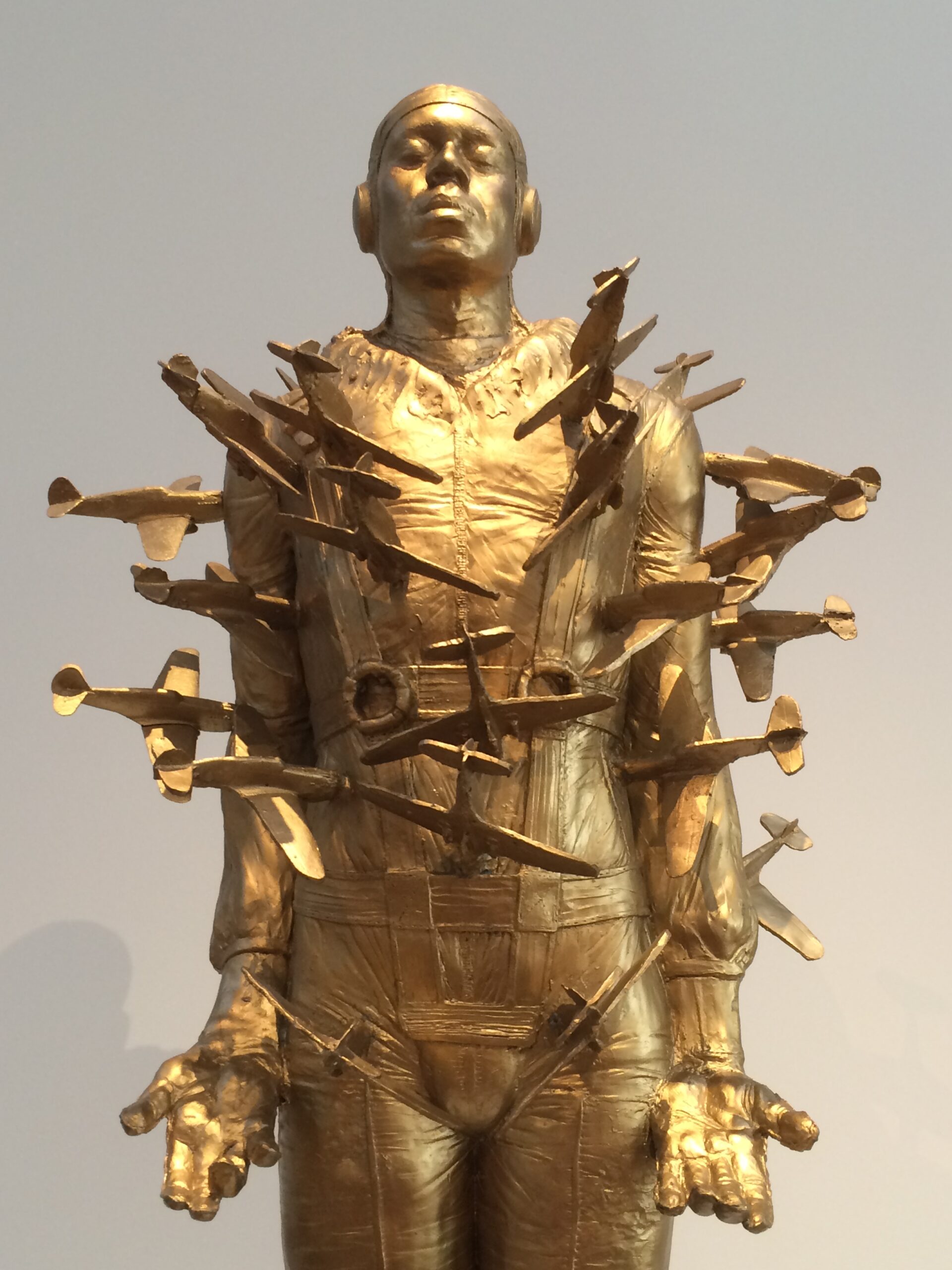
( The haunting sculpture, “Tar Baby vs. St. Sebastian,” communicates two powerful messages against hate and discrimination. The story of St. Sebastian is that he was shot with arrows after refusing to deny his faith. The “Tar Baby” sculpture, done in 1999, by Black artist Michael Richards, was a tribute to the all Black US Air Force unit of the Tuskegee Airmen, who endured decades of intolerance and unfairness because of the color of their skin, despite risking their lives to protect democracy. To add even more poignancy to this extraordinary work, Michael Richards, whose studio was in World Trade Center Tower #1, was killed there on 9/11, when terrorists attacked the World Trade Center in NYC. Richards was 38 years old.)
I Stand With Humanity.
Not jingoistic vanity.
I stand with self-determination,
Not a flag, nor song, nor any nation.
I stand with dignity, life and love,
Not some messianic fiction of superiority,
Obtained from above.
I stand with equality,
Either real or aspirational;
With the value of each life,
Being, by existence, inspirational.
I stand with Rabbi Hillel,
Who knew well, that, to be human,
When others were not,
Would point the way through hell.
I stand with the souls of Babi Yar,
Bucha, Hiroshima & Dachau;
And all the hostages of terror —
Jews, Ukrainians, and One Million
Children of Gaza, pleading,
“Where is humanity, if not now?”
I stand with lovers and mothers
Crushed by the death of babies, and others,
Who could not escape the wickedness of hate,
Nor be rescued by the safe room of their love.
I ask to be heard in theShema,
Thinking always of Babi Yar, Babi Yar,
Never, never, very far;
Buried by the same earth
Which gives each of us birth.
I stand against terror and slaughter
Of your son, my daughter;
And of intentional starvation
Or anycrime against the innocents of any nation
Born to a land they cannot leave,
In a world unable to grieve
The sheer magnitude of such a loss of life,
Or, of our own consciences.
I stand with the belief
That I am no different than you,
Muslim, Christian, Hindu, Jew,
And that shrapnel screaming down
From any sky, scalding flesh, gouging eyes,
Turns any prayers for one side, into lies.
I stand with those who are different,
And those who are despised;
I stand with the outcast,
And others vilified, as somehow, less than human —
(What did Coach Jim Jordan know about the sexual molestation of wrestlers at Ohio State University, and when did he know it?)
There’s already been too much teeth-gnashing among many progressives over the news that Gym Jordan is throwing his jock strap into the ring for the fight over who will now be Donald Trump’s new spokesperson in the Speaker’s Chair.
In response to many of my liberal colleagues bursting into flames over the mention of Jordan’s name, I offer two words: Dennis Hastert.
You might remember good ole’ Denny, the last wrestling coach to rise (no double-entendre intended yet) to be Speaker of the House of Representatives.
The coach of the Yorkville, Illinois Boys High School Wrestling Team, Hastert was the longest serving GOP House Speaker in American history, serving from 1999 through 2007. The problem, however, wasn’t Hastert’s endurance; it was his obdurate obedience to his lust for young boys, being unable to keep his hands out of the tight wrestling jerseys of the muscular teen-aged boys he coached. He later admitted to molesting four of them as young as 14-years old.
Years after his long affair with the Speakership ended, Hastert was indicted in 2015, and served 13 months in prison for being a “serial child molester,” and having sex with some of the underage boys on the Illinois high school wrestling team he coached to a State Championship. Yes, the longest tenured Republican Speaker of the House of Representative actually was a pedophile, anddid precisely that.
One particular team member molested by Hastert, the equipment manager Steve Reinboldt—whom Denny Hastert called his “right hand man”—died of AIDS in 1995.
Hastert, an Evangelical Christian from the Midwest who resembled a genteel, portly minister, was not only convicted of being a pedophile, but also of paying hush money to some of the boys he molested . For years since his conviction as a Pedophile, the GOP Speaker who advanced “family values” during the Reagan Administrations, was the poster-boy for utter and complete hypocrisy, as well as predatory criminalityagainst children, and bribing them to buy their silence. The longest tenured GOP Speaker of the House in US history who is now, 81 years old, celebrated his 50th wedding anniversary this year, and is living in quiet comfort in Illinois.
So, when I hear a quake in the voices of otherwise smart people when they utter the words of the jacketless jackass, Gym Jordan, I quietly respond: Dennis Hastert.
Jordan, who represents Ohio’s 4th Congressional District, only a few hours drive from Denny Hastert’s Illinois home, did not coach high school wrestlers in Illinois, but college wrestlers at Ohio State. Jordan, the Assistant Wrestling Coach for the Ohio State Men’s Wrestling Team for eight years, worked closely with Team Physician Dr. Richard Strauss, held liable by Ohio State University for sexually abusing wrestlers, in the Ohio State Wrestling Team’s massive abuse scandal.
Dr. Strauss killed himself in 2005 at the age of 67—while Jim Jordan was serving in the Ohio State Senate—and, Ohio State University formally apologized to his victims, reaching a $60 million settlement with at least 296 people. In June, 2023, the US Supreme Court left in place a crucial US Circuit Court of Appeals decision allowing more than 230 men to sue Ohio State over the decades old sexual abuse scandal.
The student-athletes who sued were among hundreds of Ohio State alumni who claim they were sexually abused by Dr. Strauss, from 1978-1998. Strauss and Jordan both worked for Ohio State University from 1987-1995.
In March, 2020, CNN reported that “Six Former Wrestlers Say Rep. Jim Jordan KnewAbout Abusive OSU Doctor.” The story details how “six former OSU wrestlers told CNN in recent interviews that they were present when Jordan heard or responded to sexual misconduct complaints about team doctor, Richard Strauss.” Despite statements from former Ohio State wrestlers that Coach Jordan knew about the sex abuse being committed by Strauss, Jordan has consistently denied any knowledge of Stauss’ sexual molestation of athletes, often done in the showers of the OSU locker room, which Jordan, as Assistant Wrestling Coach, shared.
“When we heard Jim (Jordan) say he wasn’t aware, everyone just thought “Are You Kidding?,”former OSU Wrestler Dan Ritchie told CNN. “I like Jimmy, but he took the wrong stance from the get-go and now he can’t back-track.”
Another former Ohio State wrestler, Mike Flushe, said to CNN that he remembers Jordan responding to a complaint about Strauss by saying “If he ever tried that with me I’d snap his neck like a stick of dry balsa wood.”
A third OSU wrestler, Dunyasha Yetts, told CNN he first raised concerns about Dr. Strauss groping him to Assistant Coach Jordan in 1992. One year later, after Yetts was again molested by Strauss in the doctor’s office, he specifically told Jim Jordan about it, and Jordan’s response was “If he tried that on me, I would kill him.”
Two additional former wrestlers, Shawn Dailey and Mike Glane, told CNN that they “remember witnessing Yetts complain about Strauss’ behavior immediately after the incident, in the presence of Jordan.”
During his 2018 re-election campaign to Congress, Jordan’s campaign committee paid some $95,000 to a PR firm, to whitewash the facts about the Ohio State Sex Abuse scandal, and personally pleaded with some of his former wrestler’s to alter their testimony, according to CNN.
So, it’s entirely appropriate, should Gym Jordan snap his lycra after becoming the second Wrestling Coach to be elected GOP House Speaker, for CNN, other media outlets, and Federal and State courts and prosecutors, to reopen the investigation into that massive sex abuse scandal, and find out what Jordan knew about the hundreds of sexual molestations which went on under his nose for years, when did he know it, and why, if he knew, he never came forward with the truth.
If Gym Jordan decides to treat inquiring reporters by threatening to “snap their necks like sticks of dry balsa wood,” they just might be on to something.
(An illustration by children’s book author and illustrator, Ezra Jack Keats, author/illustrator of “A Snowy Day,” “A Whistle for Willie,” and 20 other books, translated into some 20 languages. Born Jacob Ezra Katz in Brooklyn, NY., Keats’ books introduced multiculturalism into American Children’s literature.)
I knew I was taking a risk,
When I gave notebooks marked’
“The Book Of Life,”
To each of our granddaughters,
Ages 14, 11 & 7,
At Rosh Hashanah dinner,
With a side of rainbow-colored challah.
“The Book of Life,” intimidated me
Since I became a Jew at age 30.
“The Book,” where it’s written
For eternity, who shall live, and who’ll die,
And how we’ll go, by and by.
“The Book of Life,” the book of death,
The very notion sucked my breath.
But, I was determined to minimize the fear,
And teach them, that to celebrate the New Year,
We had to approach things with eyes so clear,
Like theirs, that saw what others missed;
With ears sharply attuned to hear
What the Shofar was awakening us to do,
In worlds beyond our doors, and those quite near.
I asked each to think about things they liked best
About the year just passed. Answers came so fast—
Concerts, movies, & favorite foods;
Road trips, & Taylor Swift, and pets, so good.
Write these in your books, I said,
And, for a fleeting moment,
I could only see the tops of their heads.
So, I pushed my luck,
And, playing my usual role of Puck,
Asked them to think how they’d fix a world run amuck.
It was as if we’d stepped onto a soaring coaster ride;
Their ideas tumbled out—some by whisper, some by shout.
“No discrimination; treat everyone alike; Give Trans kids healthcare,”
Such, their visions of repair! “Write, write,” I pleaded. And they did.
Then the youngest one, clearly having fun, got quiet.
“I’d get rid of all the guns,” she said. “I’d get rid of all the guns.”
Stunned, we wrote it in our Books of Life, and learned
That all the Second-graders had a lock-down drill,
And, rather than unleashing screams so shrill,
They quietly filed into “the room behind the classroom.”
The teacher turned out the lights and they sat in silence,
On the floor, in a small room, as dark as night. Until it was “all clear.”
We took a breath, and dipped apples in honey for a “sweet New Year,”
And talked of how we’d feed the hungry, and stay awake
To everything that needs to be repaired, and not be scared.
We’d shower each other with love, and when we stepped outside,
Bathe in the speckled brightness of the stars above,
And be awake to the beauty all around,
Our own lights shining from hearts & souls we’d found.
We entered pages into our Books of Life,
Knowing that memories can fail, unlike ink, however light.
One moment, a gift; the next, perhaps, a fright–
So we laughed and hugged forever, into the night.
Again, I sounded the Shofar, from a homemade cardboard horn,
“Awake! Alive! Take Action!” I bleated like a ram at dawn,
Singing songs of hope, to guide us through each storm.