Only one year into the Rich Man’s Reich, Trump’s Eva Braun — married to a Rich, White pawn — is about to spawn. Magda Goebbels had 6 Aryan children. She and Joseph killed them all in Hitler’s Bunker.
Eva, Eva, Karoline Braun,
Clicks her heels to Hans Homan!
Her cross of Gold;
His stare of Cold;
Cut from Goebbels/Miller’s Mold.
Eva, Eva, Karoline Braun,
Monstrous men know she’s their pawn;
Trot her out, pregnant now;
She’s the perfect Aryan sow.
“The Constitution is Unconstitutional,” Eva declared,
And, even Aryan AG Bondi was shocked & scared.
Each time the Fuhrer waves his thinning hair,
Eva Karoline Braun is there!
Each time his thin, little lips spew lies,
Eva certifies them with wide Aryan eyes.
“Ridiculous,” she sniffs when anyone calls out his Grifts;
Qatar’s $400 million jet? The Smash & Grab hasn’t started yet!
Bob Martinez got his Mercedes Benz —
What can Trump steal? World without end. . .
Crypto? Gold coins? Media stock?
Eva’s good felon can sell any old schlock.
“If the President sells it, it’s fair trade,”
Says Eva Karoline, milk-skinned handmaid.
No DOJ to get in the way;
No S.E.C. to oversee.
Attack the Judges!
Attack the Courts!
Eva, Goebbels/Miller & Hans
Do it with Loud, Angry snorts.
For White Collar Criminals: AMNESTY!
Since everything White, must be free.
Erase Black History, and Gay People, too;
Eva flashes her cross, and Stepford Smile for you.
Habeas Corpus? Rigor Mortis! Process Due? Not for you!
NOT, if you’re Black, Brown, foreign born, LGBT, or a liberal Jew.
Serendipitously, three miracles graced my life this week, two in the form of terrific television and film, and one in an elegantly written print story about a woman of valor.
Sometimes, not always, I love it when life mugs me, especially when serendipitous happenings tear open my heart and my eyes, lift me out of despair, and, I know, will change me forever.
This time it was two “movies” that did it; one made for television this year; one crafted for the big screen 10 years ago. Both were elevated even higher by a New York Times piece about Michele Singer Reiner, titled “A Life Rooted in Activism & Listening to Others.” It was written by the Times Tayla Minsberg, and published on Sunday, December 21, 2025.
The brilliant hour of television which grabbed me was Episode 5 of the new HBO Max series “Heated Rivalry.”
A fun, not-quite-soft porn Canadien series about two male hockey players who fall madly in love, had been entertaining escapist television for the first four episodes, with lots of action, lots of beautiful bodies (no frontal nudity), and a desultory script about an unlikely pairing of arch-rival hockey plays, from Canada and Russia.
The breakaway star of the mini-series, from the very first scene, was the Russian Hockey Star Ilya Rosanov, played by American action Connor Storrie, whose James Dean vibe, and Patrick Swazye/Rudolf Nureyev rugged good looks would have been enough to make anyone sit up and take notice. But Storrie went one better. He perfected a Russian accent and attitude of arrogant confidence that electrified every scene in which he appeared.
Storrie’s Canadian counterpart, Shane Hollander, played by Hudson Williams played the perfect straight-arrow (although not sexually) professional athlete, who’s “boring” personality, was a friendly foil for the risque Russian. Except for a few naked love scenes (butts only), locker room scenes, kissing sequences, and a coquette-ish coupling between yet another hockey player (played by Francois Arnaud) and a NYC-based barrista, “Heated Rivalry” could have been confused for an after-school special. Until, along came Storrie. In every scene. In every conversation. With every look. In every way imaginable.
Rosanov’s back-story—son of a Russian Police apparatchik, brother of a coke-addict draining his famous hockey-playing brother for money, superstar in a nation notorious for violent punishment against the LGBTQ community—was riveting enough to hold your interest and keep you guessing, throughout the first 4 episodes, where the only other big on-screen mystery was how the talented hockey players could find ways to discreetly hook up for sex, without their families, and the rest of the world, knowing. But, there was a sameness settling in. Until, Episode 5.
Episode 5 began with Hollander (Hudson Williams) opening up to a movie-star girlfriend of his about being attracted to men, and Ilya in Moscow, mourning the death of his father. Distraught with grief, and feeling trapped by his life’s circumstances, Ilya calls Hollander on his cellphone, and is frustrated by his inability to express his feelings to him in English. Hollander, as deeply in love with the Russian hockey star as Ilya is with him, gently urges Rosanov to express himself to him in Russian, just to let things out.
Storrie (Ilya) steals the scene, and the series, with an explosive monologue of his feelings for Hollander and the urgency of his need to be himself. The power of this Russian’s repressed feelings pours out of Rosanov, and the English subtitles do no justice to his extraordinary expression of anger, frustration, desperation and love.
But, Hollander’s (Williams’) facial expressions are better than any literal translation. Even though the Canadian doesn’t understand a word of Russian, the depth of Ilya’s feelings transcend the barriers of language, and pierce the audience, and Hollander, with the universal language of love and aguish and desire.
The scene may be among the best on television this year, and Storrie’s stirring performance has him marked for superstardom. This was James Dean in Rebel Without a Cause. The performance was transformative.
So, I turned to another film intended to be a vehicle for expressing deep emotion that could not be expressed in person, or even completely understood in the same native language: Being Charlie, the 2015 film written by Nick Reiner, and directed by his father, Actor/Director/Producer Rob Reiner.
Being Charlie tracked the story of Nick Reiner’s descent into heroine and cocaine addiction, his struggle with mental illness, and his inability to communicate his feelings to his famous father. Interviews of both Reiners when the film debuted 10 years ago, quoted Nick, who earlier this month is alleged to have stabbed his father and his mother, Michele Singer Reiner to death, as having felt overshadowed by the lives of his famous father, and his famous grandfather Carl Reiner.
Watching “Being Charlie” was like watching a car drive off a cliff in slow motion, especially when you knew the real-life ending to this story which was meant to avoid that horrible descent into hell. A quote from the character playing the father was particularly haunting, since it was the precise quote Rob Reiner gave to media 10 years ago in explaining his approach to his son’s addiction: “We listened to every expert with a degree and a desk who recommended that tough love was what you needed.”
Tragically, the experts were wrong. That wasn’t what Nick Reiner needed, nor were Nick Reiner’s 18-trips into and out of rehab centers, and repeated relapses into drug addiction. Nor, sadly, was making a film about his addiction with the father —a sure fire formula for a happy Hollywood ending, some thought.
In “Being Charlie”, the character of the mother listens carefully to her son, and appears to be able to get through to him, when no one else can, although not without great struggle, which only families grappling with mental illness can fathom.
The New York Times story about Michele Singer Reiner, gives us a bit more clarity into the life of the least famous Reiner, the daughter of an Auschwitz survivor, whose mission in her family and community was to make sure everyone was heard.
“One conversation at a time,” Ms. Singer Reiner would say at the dinner table, clinking her glass with a utensil. “One conversation.”
She believe in Tikkun Olam, the Jewish principle of repairing the world, and never giving up on fighting for what one believed was right. She prodded her famous husband to use his celebrity to advance social causes, and led the way in helping to overturn California’s Propostion 8, the ban on same sex marriage.
The Times reported the observations of Kris Perry, a plaintiff in the case that overturned Proposition 8, who later became a friend of the Reiner Family. “They didn’t just hop in and out or swoop in and get attention—they were just quietly there,” Perry said.
As the Times noted: “When Ms. Perry took the stand and was asked why she wanted to get married to her partner, Sandy, she looked at the Reiners (Rob & Michele) who were sitting in the front row.”
13-years to the day of the Sandy Hook Gun Massacre of 20 children, gun violence fueled by hate & madness, killed 15 Jews celebrating Hanukkah in Australia, and 2 Brown University students in R.I.
(Artwork by Ezra Jack Keats, a Jewish artist and writer, who dedicated his life’s work to fighting discrimination against others.)
On the 13th Anniversary of the Sandy Hook Elementary School gun massacre of 20 children — ages 6 & 7 — and six adults, the news of a mass murder of Jews celebrating Hanukkah in Sydney, Austalia, and the killing of 2 Brown University Students, served as a stark reminder that the unimaginable has become all too real again and again.
No place is safe, nor immune from gun violence — not bucolic college campuses, not beautiful beaches full of holiday revelers, not elementary schools with walls adorned by the innocent artwork of our babies.
As the never-ending mind-numbing news from Australia and Providence, Rhode Island continues to unfold, Daniel Barden’s smiling, toothless 7-year old face keeps flashing in front of me, as does the unbridled joy of his classmate Dylan Hockley, flapping his arms in delight like a “beautiful butterfly.”
Daniel & Dylan — two of the babies ripped from us in Sandy Hook — would be 20 years old today. For many of us, they are our children, our grandchildren, and they are alive every day through our efforts, and through the work of https://www.sandyhookpromise.org, the anti-gun violence organization founded by the parents of Sandy Hook’s children.
Tonight, I will celebrate Hanukkah with my family at home, in California, with our precious granddaughters. Part of me will also be in Sydney, Australia, and Sandy Hook, and Providence, R.I. The unimaginable is with us, again and again and again, and it is an inerasable memory.
***
I first heard the news reports about the massacre of 20 first graders Sandy Hook Elementary School in Newtown, Connecticut, after I walked out of court in Marin County, California, and turned my car radio on that December 14, 2012.
I had just secured a restraining order from a judge to prevent a mentally ill individual, who bragged he had a gun, from coming onto the campus of the Institute of Noetic Sciences (IONS) which I was running at the time. He had threatened several of my staff members, and starting ranting to the judge that the CIA was after him.
The judge asked me if I had anything further to add, and I rolled my eyes and said “No, your honor. I think my case has been made.” The Judge immediately granted the restraining order. We were fortunate; we had a warning; we had time to act.
If only, I thought, such warnings were paid attention to, and swift, stern legal action or mental health intervention was taken toward the young man who slaughtered 20 innocent babies–26 people in total–that terrible day in December, 2012.
Unimaginably, things have gotten worse since then, with the election of a heartless, brainless, shrunken souled tool of the NRA as President, the unbounded proliferation of assault weapons which can assassinate hundreds in a mere few minutes, the normalization of violence against people of different faiths, races, or nations, and the passage of a legislation in Congress and in States around the US, which would allow more individuals — including those with mental health warning signs — to more easily obtain weapons, and use them, anywhere they want.
Medical research into gun violence — the leading cause of death for children and teenagers, ages 1 through 17, according to Johns Hopkins Medical School — is being forcibly fought by fact-denying public officials, and by propagandists for the gun lobby in the US, and around the world, who are often the same shills.
Citizens in Florida, and many other states, are now permitted to openly carry weapons into grocery stores; pre-meditated gun murders are committed in a Pittsburg Synagogue because the congregants are Jews and they supported immigrant rights; in the historic Mother Emanuel Church in Charleston, South Carolina because the worshippers were Black: in a Buffalo supermarket, with a predominantly Black clientele; in Uvalde, Texas, an overwhelmingly Latino community; in nightclubs where gays gather; at open-air concerts, at Walmarts, and at school after school after school.
On any given day, I walk past my granddaughters’ schools — all within proximity to my house — just to check that things are safe and calm, and nothing looks out of the ordinary, and that the windows covered with paper snowflakes, or announcements of bookfairs, or holiday concerts have not been shattered.
On any given occasion when I attend my synagogue in Santa Rosa, I thank the Security guards who are there to protect us, and look around the Sanctuary to size up the chair or book or item I would pick up to throw at an attacker, to save one life or maybe more.
I no longer want to listen to reason or engage in discussion on the subjects of guns or violence or hatred or inhumanity. I want gun confiscation without accommodation; I want crimes of hate against all people, regardless of difference, severely punished: I want hate speech and winks and nods toward violence banned, especially when uttered by public officials. I want acts of love and humanity to be recognized, elevated and rewarded.
I want all our children to live like beautiful butterflies, free from domestic violence, or random acts of violence, or State sponsored acts of violence, or war. I want them to live bathed in love, free of fear or famine, and protected from the consequences of the failures of the adults around them.
I want the unimaginable to become unimaginable once again.
Despite the actions taken by the Trump’s (DOS) under fellow Floridian Marco Rubio, to erase the memory of 700,000 Americans who died of HIV/AIDS, the work of Pedro Zamora and World AIDS Day lives on.
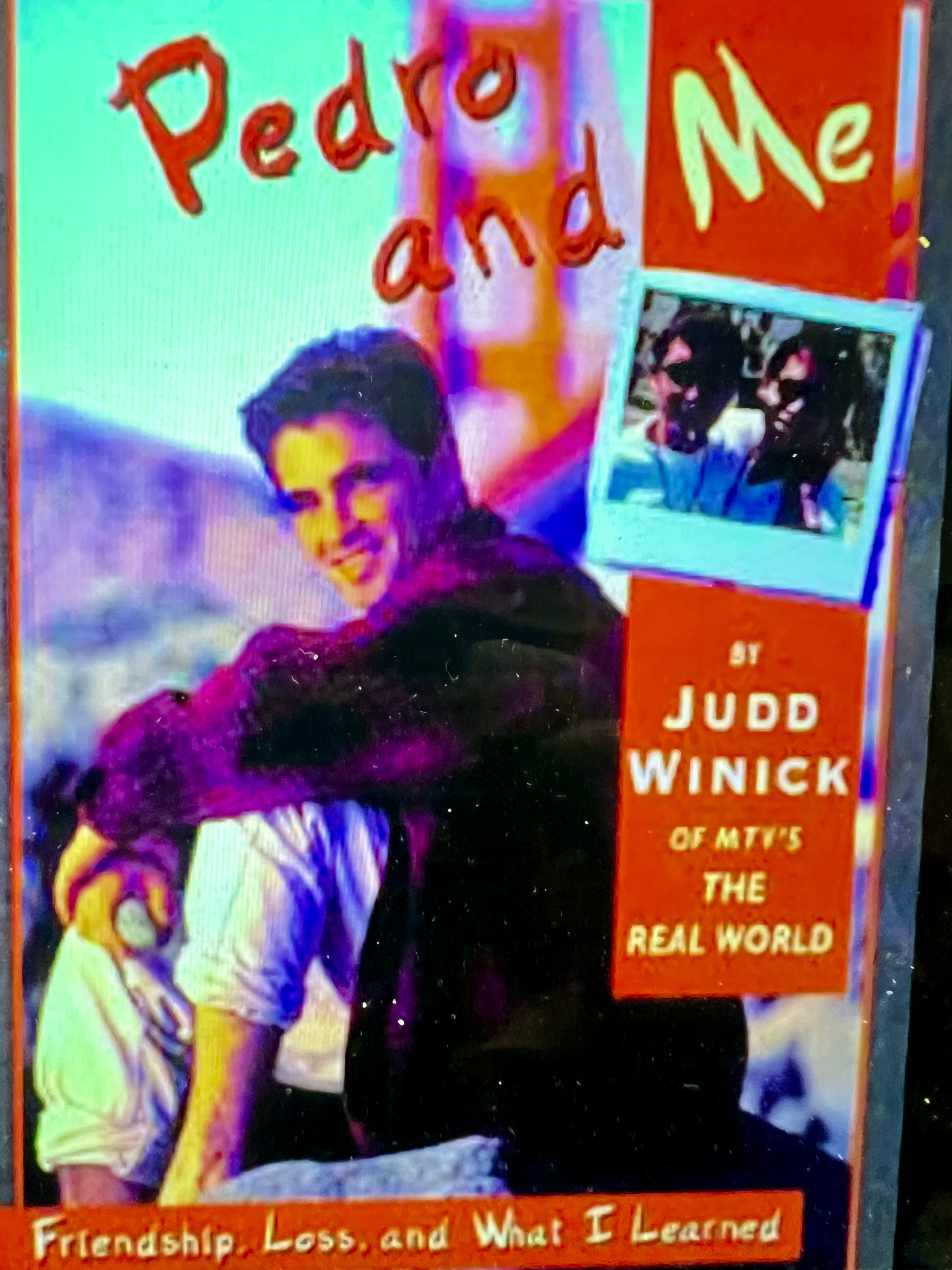
(The cover of Judd Winick’s graphic novel, “Pedro and Me,” (Henry Holt & Co, NY, 2000) which tracked Judd and Pedro’s friendship on MTV’s “Real World,” and how Pedro proceeded to change the world.)
Marco Rubio was five miles away from the bedside of Pedro Zamora when the first Cuban born, internationally recognized AIDS educator died of severe complications from HIV/AIDS related illnesses on November 11, 1994.
Zamora, then 22 years old, catapulted to global fame by revealing his HIV positive status in MTV’s pioneering series “Real World,” died at Merci Hospital in Miami, while Rubio, age 23, was fumbling through his second year of law school at the University of Miami in Coral Gables.
The lives of these two Cuban-Americans—Zamora born just outside Havana; Rubio, born as an “anchor-baby” to his non-US citizen parents in Miami 9 months earlier—never intersected—in substance or in spirit— but the life and death consequences of their diametrically opposite actions have been extraordinary. Zamora gravitated toward the grace-filled path of public health education to help human beings and save lives; Rubio toward a plastic and pathetic path of denying facts he knows to be true for political gain, dismantling programs which he knows advance human health, and then eagerly erasing the memory of all who have died from his failure to act, and the millions more who will.
The U.S. Department of State’s order this week to stop recognizing World AIDS Day, despite the US being one of the original 148 nations supporting it as an effective tool for public health education since 1988, is a specific case in point, and it is happening direcly under Marco Rubio’s watch. Erase the memory of 700,000 Americans who have died of HIV/AIDS related-illnesses—and the enormous efforts to minimize that death and suffering—and you erase the problem, Rubio’s actions tell us.
In Pedro Zamora’s four brief years of life following his graduation from Hialeah High School in 1990, the year after he was diagnosed as HIV Positive during a routine Red Cross Blood Drive at his North Miami high school, Zamora became a source of life-saving information about HIV/AIDS to tens of millions of young people worldwide. His heroic efforts as a private citizen, with no power other than that of his own voice and conscience, saved lives and has only grown decades after his death.
The New York Times obituary written on November 12, 1994, described Zamora’s high school—in an overwhelmingly Cuban community—as “the place he returned to as a public speaker to warn young people like him to be careful.” Infected with the HIV virus in his Junior year at Hialeah High, Pedro’s goal was “to graduate before I die.”
A few months after he did graduate, as an honor student, President of the Science Club, captain of the Cross-country team, and voted by his peers as “most intellectual and most all-around,” Zamora—whose grades and school activities could have gained him admission to the most prestigious colleges in the United States—elected instead, to go to work for a Miami-based non-profit HIV/AIDS Resource Center, named Body Positive. He became an AIDS educator and travelled the country speaking to high school and college students about how to protect themselves from getting infected.
The New York Times wrote about Zamora’s work:
“It was in schools that he seemed to have his greatest effect. He passed around condoms in classrooms and minced no words…He would tell students that he got the virus from having unprotected sex, and that he’d probably not live to reach age 30. Some of them faced the same danger, he warned, unless they took precautions.
For many students, Zamora—articulate, the picture of good looks and good health—took the stigma away from what people had been bullied to believe about AIDS, and humanized the disease. If it could happen to him…
Zamora spoke in schools, colleges, churches and anywhere he could reach people, as a full-time AIDS educator, reaching thousands of his peers in Latino and Black communities, who were most at-risk of getting the virus. In 1993, the year Marco Rubio lumbered into law school, Pedro testified before Congress—during the height of the AIDS epidemic— calling for more explicit HIV/AIDS education programs that would speak in the language young people understood.
The different journeys of the Zamoras and the Rubios from Cuba to the United States only partially explain the differences in fundamental human values and community commitment between both families. Marco Rubio’s mother and father, natives of Cuba, left the Island in 1956 for economic reasons, and to escape the repressive and corrupt regime of President Fulgencio Batista, a paid puppet of Meyer Lansky and American organized Crime. Contrary to what Marco Rubio repeatedly claimed in his cavalcade of campaigns for public office in Florida since 1998, his parents did not flee Castro’s Cuba, since Castro did not come to power until three years after they had already left, and were settled in Miami. It was the first of many lies Rubio would tell in his public career.
Zamora’s father on the other hand, fought alongside Fidel Castro in the Cuban revolution against the corrupt and repressive Batista government, but quickly became disillusioned when the new Castro regime became just as authoritarian as Batista’s. The Zamoras did escape from Castro’s Cuba during the Mariel boat-lift of 1980, during the Presidency of Jimmy Carter. Pedro was eight years old at the time, when he, his parents, and one brother and sister, were packed onto a dangerously overcrowded boat, and made it to Hialeah, where they settled. Pedro’s mother would die of skin cancer several years later, in Florida, inspiring her youngest child to excel in science, with a goal of studying medicine to protect others from a similar gruesome death.
In twisted contrast, Marco Rubio’s family relocated from Florida to Las Vegas for a short time, where both of his parents worked in Casinos, reminiscent of the predominant jobs Cubans were force into in Batista’s reign of corruption in Cuba, when Lansky and his mobster associates were given carte blanche to operate casinos throughout Cuba, as long as they continued to pay off Batista and other corrupt officials in power.
Unlike Pedro Zamora, Marco Rubio did not show much promise or intelligence in high school, or immediately after. He went to a third-rate local Florida college on a football scholarship, and transferred within one-year to Sante Fe Community College, in Gainesville, Florida, where he received his BA in 1993—the same year Pedro Zamora was testifying before Congress about the AIDS epidemic. It was only after he graduated law school in 1996, and his election to the West Miami City Commission just two years later, that Marco Rubio begin to make his murky mark.
Unfortunately, like Rubio himself, that mark was only drawn in the sand of Florida’s beaches, and easily washed away by the most recent political currents. Originally a supporter of PEPFAR while a US Senator from Florida, who said that “every American should be proud of the program,” as Secretary of State, Rubio has presided over the systematic decimation of HIV/AIDS treatment programs of great urgency to millions of people living with HIV/AIDS around the world. According to USAIDS, more than 40 million people are living with HIV worldwide, including 1.3 million infected within the past year. For Rubio, there are no votes there.
Immediately upon being sworn in as Donald Trump’s Secretary of State in 2025, Rubio issued a “Stop Work Order,” on all PEPFAR programs—programs which had saved more than 26 million lives across 50 countries since being implemented by President George W. Bush two-decades ago.
“Does Marco Rubio want to be remembered as a Secretary of State who chose cowardice while PEPFAR was decimated and millions faced risk of death?” said Asia Russell, Executive Director of Health GAP. “Because that is the path he is choosing.”
“If these cuts to PEPFAR continue from Donald Trump, Marco Rubio, and the MAGA regime, their legacy will be the deaths of millions of people across the world,” said Matt Rose, senior public policy advocate for the Human Rights Campaign.
As we’ve witnessed with catastrophic cuts to HIV/AIDS programs at home and abroad, and to the termination of USAID food and medical assistance globally resulting in the deaths of 600,000 people—since Marco Rubio became Secretary of State—that appears to be the “legacy” Trump, Rubio, and his supporters seek.
Last month, the Kaiser Family Foundation reported on the current status of PEPFAR, thanks to Marco Rubio’s cowardice, and the ideological anti-science, anti-public health, anti-LGBTQ screed known as Project 2025 which Rubio still follows:
Funding freeze/stop-work order: The stop-work order initially froze all PEPFAR programming and services, halting existing work in the field, including provision of antiretroviral therapy. Because it halted payments, many implementers had to let go of thousands of staff and end some services.
Limited Waiver: PEPFAR received a limited waiver on February 1 (with additional information on February 6), allowing it to continue “life-saving HIV services”. However, the waiver only permits certain activities: HIV treatment and care, prevention of mother-to-child transmission (PMTCT), pre-exposure prophylaxis (PrEP) for pregnant and breastfeeding women, and HIV testing. Other services, including PrEP for anyone else (including those already on PrEP) and HIV prevention more generally, as well as programming for orphans and vulnerable children, are not permitted. Even with the waiver, implementers faced challenges in getting permission to resume HIV programming and difficulties getting paid.
Dissolution of USAID: USAID was the main government implementing agency for PEPFAR, obligating 60% of its bilateral assistance in FY 2023. Without USAID and most of its staff, PEPFAR’s implementation capacity has been affected. In addition, announcements of reductions at CDC, PEPFAR’s second largest implementing agency (obligating 37% in FY 2023), could further affect PEPFAR.
Canceled awards: In early 2025 it was reported that the administration canceled 86% of all USAID awards. KFF analysis found that of the 770 global health awards identified, 379 included HIV activities, 71% of which were terminated, including several HIV treatment awards as well as most HIV prevention..Impact on PEPFAR Services and OutcomesNumerous other reports have documented the impacts of these actions on services and outcomes:
A recent analysis found that the disruption in PEPFAR funding was associated with reduced access to HIV services and commodities, including antiretroviral treatment, PrEP, and HIV, CD4, and viral load tests.
UNAIDS offices have identified several impacts including: the loss of thousands of HIV health workers in Kenya, Malawi, South Africa and Mozambique; disruptions to diagnostic and treatment services for pregnant women and children in Zimbabwe; partial or complete cessation of community outreach services in Angola and Eswatini; and the expected loss of a quarter of the workforce of the largest network of people living with HIV in Ukraine.
A rapid assessment survey of 108 WHO country offices found that almost half reported moderate or severe disruptions to HIV services, including for medicines and health products, due to the U.S. foreign aid freeze and other shortages.
In addition to these impacts, several modeling studies have estimated potential effects of funding reductions. For example, one estimated that in sub-Saharan Africa, ending PEPFAR funding could result in 565,000 new HIV infections over 10 years and reduced life expectancy of people living with HIV by 3.71 life-years.
Despite Rubio’s mad-dash away from reality, the World AIDS Day theme for 2025 is perfectly on point: “Overcoming Disruption, Transforming the AIDS Response.”
Those of us who remember the courageous, visionary work of Pedro Zamora, and the thousands of others who are still fighting valiantly to ease the lives of the 40 million people worldwide still living with AIDS, have overcome greater disruptions, and more difficult threats to human life. HIV/AIDS is evolving, but by no means over. As my mother, a polio-survivor until age 92 continually reminded me: “It was 60 years since the identification of the Polio Virus, and the discovery of the Polio vaccine.”
Long-time leading AIDS Activist, educator and the co-founder of PrEP4ALL Peter Staley put all this agita into the proper perspective for The Advocate: “ It just seems to be petty and hostile, frankly. It’s very reminiscent of the Reagan Administration which largely ignored the epidemic.”
As the New York Times observed on November 25, 2025, when Marco Rubio ordered Department of State employees to “refrain from publicly promoting World AIDS Day through any communications channels,” the Times noted:
“Every year since 1988, the US has marked December 1, as World AIDS Day, when people mourn those who died of the the disease, honor efforts to contain the epidemic and raise awareness among the general public. Not this year.”
Yet, the original acts of AIDS Awareness since the discovery of the HIV Virus in 1981, did not come about because of government policy, but because of the absence of government policy. AIDS activists, like Pedro Zamora and Peter Staley and Cleve Jones drove awareness and action, and treatment and care, and pushed governments in the US around the world to respond.
We still will not be silenced, nor erased, nor go away. Too many friends have been lost, too much suffering has been endured; too much hope is at stake.
Look at Pedro Zamora’s life; look at his face, his promise, his struggle. Look at the enormous impact he had upon millions of lives in his too-short 22 years of life.
Then, look at the “petty, hostile” acts of Marco Rubio, Trump and Pogrom 2025’s hate screed. Then, ask yourself, whose side are you on? Will you permit all of what we’ve achieved over the past 40 years to be erased? Will you quietly allow the East Wing of the White House to be demolished? Will you stay quiet while 400,000 children are starved to death by the assassination of the food programs of USAID? Will you be silent while who and what you’ve loved all your life is obliterated?
Like Judd Winick, it’s Pedro and me. . . and you, who will determine the outcome.