


Our friend died this week. He marched with Dr. Martin Luther King, Jr., in 1963; befriended singer Harry Chapin and they founded an anti-hunger organization still saving lives, 51 years later.
Aug 24, 2026
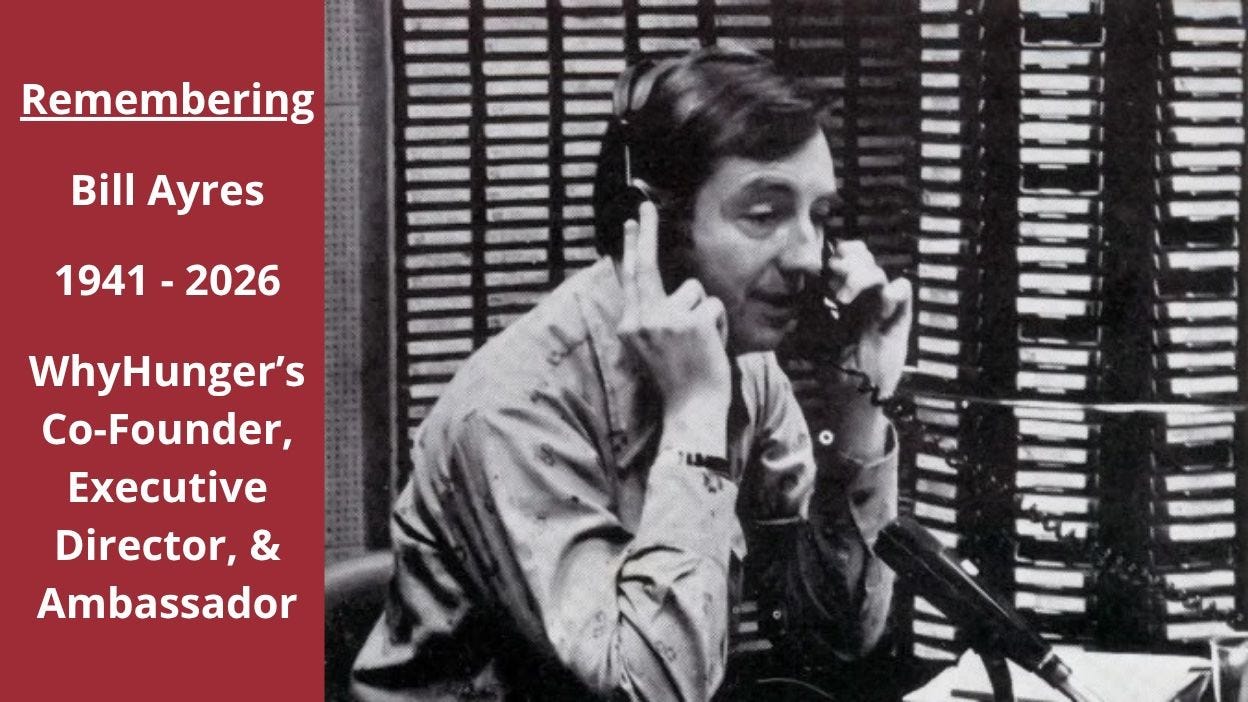
(Bill Ayres died this week, just one week after the death of Rolling Stone Magazine’s long-time music writer, Dave Marsh, who wrote the forward to the book Bill co-wrote with Pete Fornatale, entitled “All You Need Is Love.” It was the central message of Bill’s life, and he acted on it, in every way he could, every single day. I first wrote this opening piece 30 months ago, on Martin Luther King’s birthday to celebrate, during his lifetime, the lessons of love and humanity Bill Ayres taught us. I repost it today, to honor Bill’s life and the impact it had upon me and millions of others who lives he touched, and changed. My piece is followed by the posting of an article from “WHY Hunger” Magazine, honoring the life and legacy of Bill Ayres, which continues to this day. Please contribute to WHY Hunger to carry on the fight against poverty and hunger, to which Bill dedicated himself. You can find a link to donate at the very bottom of the article.)
One of Dr. King’s Disciples of Love, Hope, Humanity & Social Action.
How a small town Catholic priest from Long Island, gained a nationwide congregation of the hungry, the exhausted, and the powerless, and brought out the best in everyone to make life better.
By Steve Villano
To be in the presence of Bill Ayres, former Catholic priest and co-founder of WHY Hunger with Harry Chapin, is to be bathed in the warm glow of hope and love.
Whenever we celebrate human service, and try to replicate in some small way, the life and actions of Dr. Martin Luther King, Bill Ayres’ life gives us mortals some practical instructions of just how to do it.
As with Dr. King, the driving forces of Bill Ayres’ activism are his faith, and his love of the dignity of all human beings. It’s what’s guided Bill’s life for some six decades—in addition to a unique sense of how music can change individual lives, and through it, the world.
Our Bill Ayres of Huntington Station, NY, whom I know and love–the real Bill Ayres, as I call him, so he cannot be confused with the Chicago-area, headline-grabbing, violence-winking, Weather Underground’s Bill Ayers (different spelling) —is the real, long-term radical social activist. His indefatigable efforts fighting hunger and poverty continue to make a difference in thousands of lives each day. Beyond his remarkable work fighting hunger, poverty and food insecurity with singer/songwriter Harry Chapin, and the Chapin family over the past 5+ decades, Bill Ayres’ own life and work is the stuff of inspiration.
It’s fitting that Huntington’s Bill Ayres—our Bill Ayres– shares a birthday with long-time Civil Rights leader, Julian Bond, on the day before Dr. Martin Luther King’s birthday. Not only did both men march and work with Dr. King, but they devoted most of their lives to practicing the kind of targeted, effective, never-ending non-violence which Martin Luther King preached.
Both Bill Ayres and Julian Bond became aware of the continuing struggle for civil and human rights in this country at roughly the same time. Bond co-founded the Student Non-Violent Coordinating Committee (SNCC) while a student at all-Black Morehouse College in 1960, where he first met Dr. King. He risked his life registering new voters during Freedom Summer in Mississippi, in 1964. Ayres, entered the seminary to study the priesthood, in 1963—not to escape the troubled world, but to embrace and repair it, influenced by the teachings of Catholic progressives like Dorothy Day & Thomas Merton.
Just after the 50th Anniversary of the assassination of Dr. Martin Luther King, I interviewed our Bill Ayres, in the New York City headquarters of WHY Hunger, and in the tranquil beauty of his beloved Heckscher Park in the Village of Huntington, L.I., not far from his home. We peacefully strolled around the Park’s lake, when I asked him about the influence of Dr. King on his life’s work:
“In 1963, I was in the March on Washington, I was a kid, in the seminary. Then I marched with him lots of times, heard him preach in the church, read all his stuff, and, I knew that racism was an evil; poverty was an evil and that they were all very much connected…”
Ayres attended the Immaculate Conception seminary in Huntington for six years in the early 1960’s where he began reading Dr. King’s “stuff”, as he described it.
“The inspiration for me in all of this is, of course, the social teachings of the church and the Gospel of Matthew, and lots of other places. King is kind of the one who put that into action. Paulo Freire, a Brazilian educator driven out of after a military coup in 1964, wound up in Boston College and taught with a friend of mine up there and at UN. I met him a few times and heard him speak. He had this whole thing that the root cause of hunger is poverty and the root cause of poverty is powerlessness—I repeated this mantra to Harry Chapin a couple of times when I first met him. That’s always been our theme.”
We stopped walking as Bill’s kind, gentle-blue eyes, underscored that point:
“It’s the powerlessness that comes from on top, from oppression; racial oppression, sexual and, economic injustice. That’s where we came from and that’s where we’ve always been.
Serving Catholic parishes in conservative Long Island towns like Babylon and Seaford, Father Bill Ayres, did not look the part of the “radical priest,” despite, his deep, Catholic Worker beliefs. I asked him if he ever met the Berrigans, the “radical priests” of the 1960’s, arrested on many occasions for protesting the War in Vietnam, and destroying draft board records.
“Interesting. I met them, but didn’t know them. After I was ordained there was a priest friend of mine, who was a friend of the Berrigans. And Berrigan invited him and me to meet Thomas Merton. I never got there. Berrigan couldn’t go and we cancelled the whole thing. It’s one of those missed opportunities. I was on marches with the Berrigans; I was part of the anti-war movement. I would have loved to have met Merton. His book, The Seven Storey Mountain, influenced me to become a priest. He was a convert; He was a big influence on lots of people including me. A remarkable man.”
Thomas Merton’s writings and teachings influenced not only Bill Ayres, but generations of progressive Catholic activists to move well beyond the fundamentalist strictures of the hierarchy of the Catholic Church establishment.
It was the Church’s unyielding restrictions against priests marrying that drove Bill Ayres from the organized priesthood. After 13 years of serving two Catholic parishes, Bill met and fell in love with his wife, Jeannine, to whom he was married for almost 50 years. But while, Ayres may have formally left the priesthood, his life of service to others never left him. His congregation grew to a national size when he met Harry Chapin by interviewing him on Ayres’ radio program “On The Rock,” in 1973.
Serendipitously, Chapin’s great-aunt through marriage was Dorothy Day, one of the heroic figures in Bill Ayres life:
“If You look on my desk, I have a picture of Dorothy Day. I used to go down to her gatherings on Friday night on Christopher Street. (In NYC) I was very influenced by Dorothy Day; she was one of my role models, radical Catholic, sort of who I am. Harry and I talked about her, “Well, you know, I’m related to her,” he said, “and he was proud of it”.
It was Bill Ayres who alerted me to the remarkable book by Day’s granddaughter Kate Hennessy, “Dorothy Day: The World Will Be Saved by Beauty,” which, in intimate and exquisite detail, illuminates the life that the revolutionary Catholic worker lived, and how much she accomplished for others.
And it was Bill, ever the teacher and mentor, who took from his personal bookshelf, a the dog-eared, underlined, hard-copy of a book—a guide for social action, really—which meant a lot to him—and gifted it to me. It was his copy of Paulo Freire’s “Pedagogy of the Oppressed, “ a blueprint for honoring—and acting for– the humanity in all of us.
Bill Ayres’ all-encompassing humanity can leave you in quiet awe, and I was sure he must have had the same effect upon Harry Chapin, whom he met while still a practicing priest. I asked him if Harry believed in God:
“There’s an interesting thing here,” Ayres said. “ I’m a Catholic priest here and he’s this rock and roll guy. An interesting partnership. He loved it. He just thought it was a wild thing. He called me “Wild Bill” because I did all this crazy stuff. But he said to me, ‘you know, I’m not a believer; I come from a bunch of agnostics; I grew up in the Episcopal Church, I sang in the Episcopal Church. But I’m not really religious. ‘
“However, he evolved. And, part of the evolution was that he saw the goodness in the people who were running these food pantries and soup kitchens. And he had this great line, “I believe in the believers.”
“ Just a few months before Harry died, we were having this conversation about religion. He said , “I believe in God.” Big breakthrough. “But I don’t believe in a god of fear or vengeance. I believe in a god who loves people. I believe in a God that gives lots of hugs.” Harry liked to hug people. He and I talked about Jesus over the years. The whole thing is love and justice; it’s what’s it all about.”
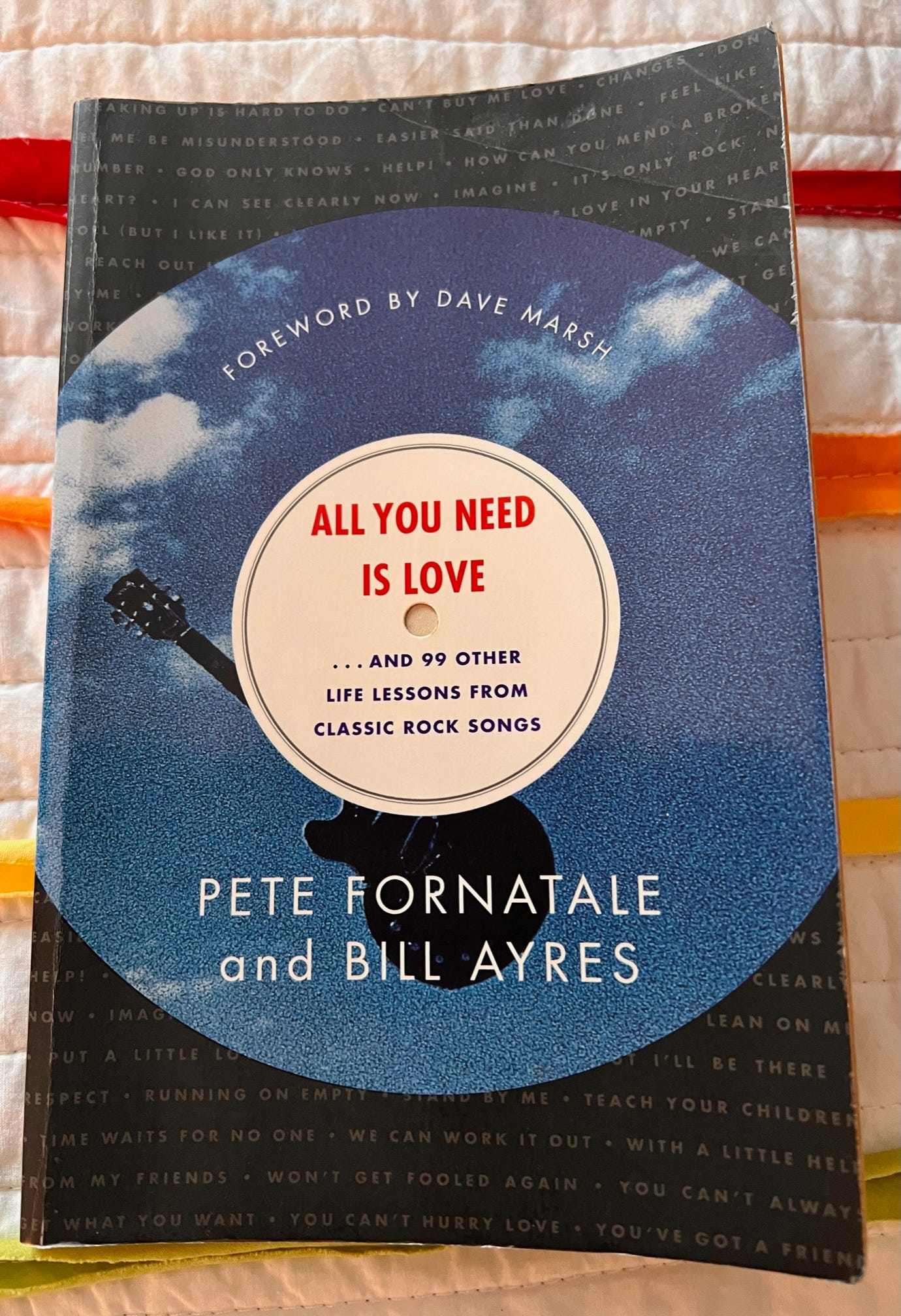
Bill Ayres’ book, from which I frequently seek inspiration, hope and guidance, is his simple, soul-refreshing teaching tool which he wrote with his radio soul-mate, Pete Fornatale, entitled “All You Need Is Love..and 99 Other Life Lessons from Classic Rock Songs.” The book is dedicated to Harry Chapin, especially for Chapin’s use of his music, song and story-telling gifts to help “millions more to have food in their stomachs, dignity in their lives and hope in their spirits.”
It’s what Bill Ayres devoted a lifetime of service to doing, and practiced every single day.

Honoring Bill’s Legacy
Bill Ayres believed that ending hunger required more than providing food. It required healing, justice, and the power for communities to shape their own futures.For five decades, that conviction guided Bill’s work as WhyHunger’s co-founder, Executive Director, and Ambassador. He helped build an organization committed not only to meeting immediate needs, but to confronting the root causes of hunger and investing in lasting, community-led change.Bill taught us to listen before acting, to lead with hope, and to keep going even when the road ahead loomed long and difficult. A gift in Bill’s memory will carry that work forward by helping WhyHunger connect people with nutritious food, invest in grassroots solutions, and advance the human right to food for all.You can honor Bill’s extraordinary life by helping continue the work to which he devoted it.
Please donate to WHY Hunger to recognize the lifelong work of Bill Ayres, Harry Chapin, Sandy Chapin and the entire Chapin family in fighting hunger and poverty.
Donations in Bill’s honor can be made here.
THE LIFELONG LEGACY OF BILL AYRES (reprinted from this week’s publication of WHY Hunger, the official publication of the international anti-hunger, anti-poverty organization co-founded by Harry Chapin & Bill Ayres, in 1975.)
William J. Ayres lived a truly remarkable life, leaving behind a profound legacy of love, compassion, community and enduring hope. Born on January 14, 1941, Bill credited his grandmother with teaching him to keep an open heart and to “try and see the good in everyone.” That early foundation set him on a lifelong path of seeking justice and serving others.
In 1963, Bill joined a quarter of a million people at Dr. King’s March on Washington, D.C., an event that forever shaped his understanding of race, justice, poverty and power. Over his lifetime, he participated in many more protests and marches for social justice. He attended St. John’s University for two years before studying philosophy and theology at the Seminary of the Immaculate Conception in Huntington, N.Y. He remained a devoted St. John’s Red Storm basketball fan, attending games into his eighties.

(Photo By Moya McAllister)
Deeply moved by his faith, Bill answered the call to become a Roman Catholic priest in 1966 and served in two parishes over 13 years, embracing a life of service. In 1968, the Diocese of Rockville Centre on Long Island asked Bill to host a local Sunday radio show, launching a long and storied career on the airwaves. As host of “On This Rock,” Father Bill Ayres played rock music, interviewed guests, told stories, and seamlessly wove in lessons about faith, justice and compassion. Bill soon brought that same unique blend of storytelling and purpose to television when Charles Dolan gave him a platform on his pioneering Cablevision network.
When he fell in love with his future wife Jeannine, Bill left the active priesthood to build a life with her. His ministry of compassion and service didn’t end; it simply took a different form. Together, Bill and Jeannine raised two beloved daughters, Michelle and Suzanne Ayres, and their cherished granddaughter, Jaida Blatt.
For 40 years, he hosted “The Bill Ayres Show” on WPLJ-FM, a late-night call-in radio show where he played music and offered advice to young people. Bill became the longest-running continuous host on the station before broadcasting his final live show in May 2019.
Radio brought together Bill’s love of music, storytelling, faith and rock ‘n’ roll. He was the first person to interview Bruce Springsteen on network radio. That encounter sparked a lifelong friendship and partnership with Springsteen, Jon Landau, and Barbara Carr that was rooted in a deep commitment to harnessing the power of music to end hunger.
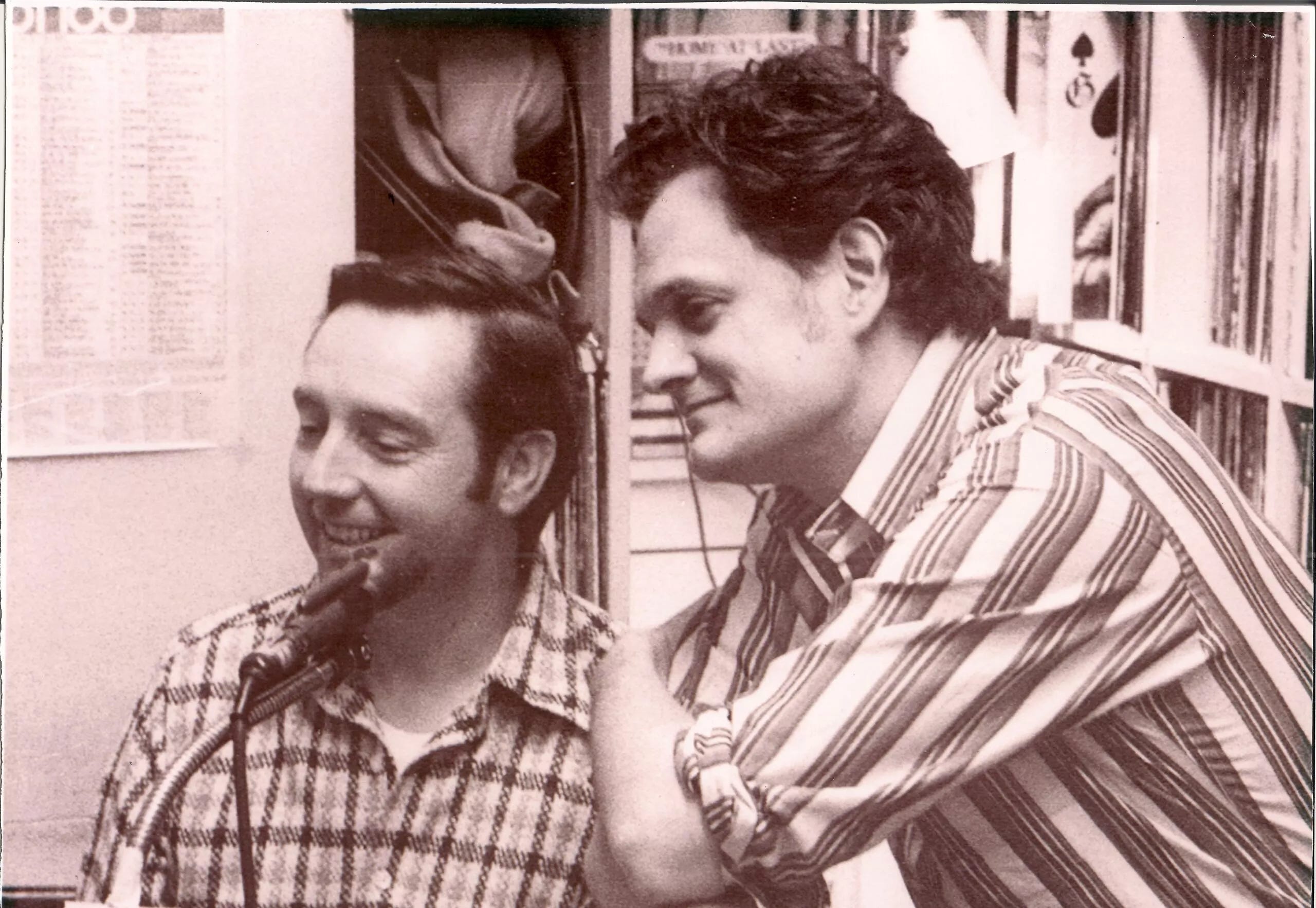
Then, a serendipitous series of radio interviews, first with musician Tom Chapin and later with his brother Harry, changed the course of Bill’s life yet again.
(Photo by Diane Maple)
After Bill and Harry connected on-air about their shared outrage over the growing crises of hunger and poverty, they decided to meet for dinner. Around the kitchen table, Bill, Harry and his wife, Sandy Chapin, sketched out a plan to make a lasting difference. In 1975, they founded the anti-hunger and social justice organization now known as WhyHunger.
A gentle visionary with steadfast conviction, Bill fiercely believed that hunger is solvable. He knew that making nutritious food a human right for all required digging deep to address hunger’s root causes. He also knew that local communities held the wisdom and power to solve it, if we could only learn to listen and follow their lead.
Guided by these principles, Bill and Harry created the first Hungerthon in 1975, a 24-hour radio show that raised funds and brought national attention to hunger, alongside radio DJ Pete Fornatale and general manager Mel Karmazin at WNEW-FM.
Now in its 41st year, the Hungerthon campaign has raised tens of millions of dollars through radiothons, concerts and community action. Its national broadcasts have become synonymous with the Thanksgiving season, airing across the nation on SiriusXM, iHeartRadio New York, and CBS Radio New York/Audacy New York.
Bill’s belief in the power of music to drive change extended far beyond Hungerthon. He forged an innovative partnership with Hard Rock International and helped galvanize the “Imagine There’s No Hunger” campaign with Yoko Ono Lennon to expand access to healthy food for children around the world.

(Photo by Diane Bondareff)
Together, Bill and Harry held numerous benefit concerts and opened a national policy office in Washington, D.C. Their advocacy drew steadfast bipartisan support from former Board Member Senator Patrick Leahy, D-VT, and Congressman Ben Gilman, R-NY, and helped lead to the creation of the first Presidential Hunger Commission, the first National Hunger Hotline, school meals, and millions of dollars in federal food and nutrition aid. Working side by side, Bill and Harry also helped start Long Island Cares and the Center for Food Action New Jersey.
When his dear friend Harry died tragically in 1981, Bill saw a promise that still had to be kept. He devoted the rest of his life to securing WhyHunger’s future and expanding its impact, serving as its Executive Director until his retirement in 2015. That year, as WhyHunger celebrated its 40th anniversary, Bill received the organization’s Lifetime Achievement Award.
At WhyHunger’s 50th anniversary gala in 2025, Bill helped present the inaugural Bill Ayres Social Justice Award to CNN’s Laura Coates. This annual award honors individuals like Bill who are driven by moral conviction to unite communities, amplify marginalized voices and fight systemic injustice.
In 1998, Bill co-authored All You Need is Love: And 99 Other Life Lessons From Classic Rock Songs with his dear friend and radio colleague, Pete Fornatale. And in 2021, he wrote The Journey into the Mystery: Finding God in Your Everyday Life, which was formatted by his daughter, Suzanne Ayres.
Bill leaves us with an indelible legacy and a powerful example of what it means to live with purpose. His warmth, care and generosity left a mark on everyone he met. He taught us to listen before acting, to lead with hope, and to keep going even when the road ahead looms long and difficult. Those of us who knew Bill, worked alongside him, or called him a friend were lucky to be part of his story and to witness what an open heart, a bold vision, and a relentless commitment to justice can make possible.
Our hearts are with his wife, Jeannine, Bill’s family and friends, the Chapin family, and the extraordinary community of people he brought together around this mission.
Donations in Bill’s honor can be made here here.