


And the fact that Steyer is a no bullshit New Yorker, whose mother worked at the Brooklyn House of Detention, goes a long way with me.
Apr 24, 2026
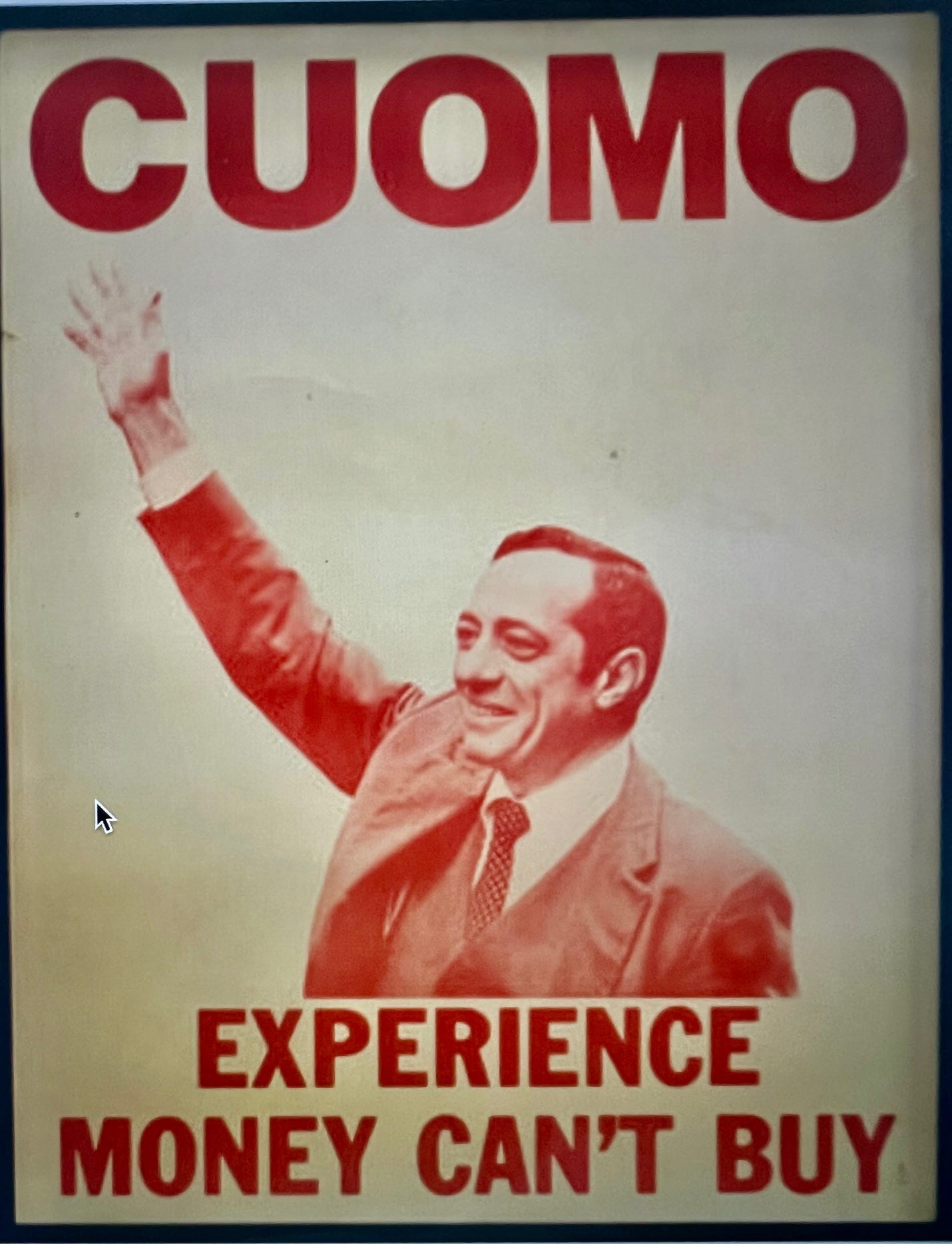
(Campaign poster from Mario M. Cuomo’s 1982 New York State Gubernatorial Campaign against multi-millionaire Lewis Lehrman, heir to the Rite Aid Pharmacy fortune.)
In 1982, Mario M. Cuomo, ran for Governor of New York State as a Democrat. He had no money, but was the incumbent Lt. Governor of NY State, and Secretary of State for the four years before that. Those eight years were Cuomo’s sum total of experience in public office.
A lawyer by training, and a brilliant one of the highest integrity, Cuomo gained another kind of hands-on public service experience when he was called upon by NYC Republican/Liberal Mayor John Lindsay in 1971, to mediate a highly controversial public housing proposal in Forest Hills, Queens. Cuomo, acting as a private citizen, succeeded by cutting the size of the NYC Housing Authority proposal in half. He documented his work in the book, Forest Hills Diary: The Crisis oif Low Income Housing, by Mario Cuomo, 1973. The preface to Cuomo’s book was written by the journalist Jimmy Breslin.
During his campaign for Governor, Cuomo picked up the endorsement of the State’s progressive public sector labor unions, and mercilessly attacked his GOP opponent—Lew Lehrman, heir to the Rite Aid Pharmacy fortune—for his “excessive” wealth of what was then $25 million, and of his trying to “buy” the Governorship by spending $8.8 million of his own money on the campaign. All of that, came against the backdrop of a Rockefeller (Nelson) spending a total of $10-12 million for all four (4) of his NYS Gubernatorial campaigns from 1958 through 1970.
Fast forward to California, 2026, and the battle for the Governorship of the nation’s largest state, and the world’s 4th largest economy. Again, the issue between two of the leading candidates in our State’s June 2 “Open Primary” election, is coming down to experience vs. money. In this instance the money gap is much greater, but the experience differences are far more difficult to pigeonhole.
For California voters, we’ll be fortunate if it we get to choose between Progressive environmentalist and change-agent Billionaire Tom Steyer—who has already spent $121 million of his own money on his campaign, and Xavier Becerra, a self-professed institutionalist, and a steady, life-long staple of California’s public life, and former Biden Administration HHS Secretary. Because of California’s crazy “Open Primary” system, the alternative to either of those solid and sane candidates could be calamitous.
The latest polling averages as of April 23, 2026, from the Race to the White House/California 2026 Governor’s Polling have such a Democratic dream match-up within the range of possibility, with the polling—two weeks before mail balloting begins —reflecting a tight battle between: MAGA Fox News commentator Steve Hilton at 18.2%; Tom Steyer, 14.5%; former Far Right Oathkeeper Chad Bianco, 14.3 %, and former HHS Secretary, Becerra, 13.7%. Less than four percentage points separates all four of them.
Having grown up on the intensely competitive political party primary system in New York State—and waging my one and only campaign for public office as a “reform Democrat” more than a decade before I began working with Mario Cuomo—I’ve always found California’s “Open Primary,” multi-party, anything goes system of voting to be both bizarre and begging for abuse, since it’s inception 14 years ago. The only thing I see as more “Open” here, are more open-ended political spending, more never-ending campaigning, and more second and third rate and perennial candidates who somehow persuaded themselves that they were ready for prime time, or were what we needed.
Barring the unlikely catastrophe of the two MAGA monsters finishing first and second in the voting on June 2—with the looney law precluding any opportunity to write in a new candidate, run on a third party line, do the whole nightmare over, or declare a state of emergency—the best scenario for sensible Californians would be for either Steyer or Becerra to finish in the top two.
Ideally, if those two Democrats finish as the top two vote getters, than we voters—who receive our mail ballots for the ‘Open Primary’ in two weeks—will face the best of all possible choices, between Steyer and Becerra, which could be an informative campaign for the heart and soul and future direction of the Progressive movement in this country.
Unlike Cuomo’s campaign against Lew Lehrman 44 years ago, it won’t be a campaign of “experience” vs. “money”, but of substantively different and compelling experiences and backgrounds, and of who can best control the runaway wealth of billionaires, and best deliver public services to all Californians. It’s well worth taking a look at the backgrounds and stories of Becerra and Steyer, both 68 years old, to understand what drives them, how hard, and what could be in store for all of us.
BECERRA:
Xavier Becerra is a true American success story, especially for many of us from immigrant families. The Sacramento-born son of Mexican immigrants, Becerra is the first member of his family to ever attend college, and that was as a Stanford University undergraduate, and Stanford Law School graduate, Class of 1984.
Becerra first worked for Legal Aid, and then joined the State Senate Staff of Senator Art Torres, an early and consistent mentor for many young Latinos in California government and politics, and the longest serving chair in the history of the California State Democratic Party. The Sacramento native stayed close to home, working for three years as a Deputy Attorney General in the California Department of Justice from 1987-1990, before getting elected to the State Senate for one-term, in 1990. In 1992, Becerra ran for, and won, a Congressional seat in the Los Angeles area, which he represented until 2017, or some 24 years.
Yet, Becerra’s smooth political career glide path was just beginning. In 2016, he found himself on Hilary Clinton’s short list for potential Vice Presidential running mates. When then California Attorney General Kamala Harris was elected to the US Senate from California that same year, Becerra popped up on another high-level “short list,” and was appointed by California Governor Jerry Brown to become the State’s first Latino AG—a position to which he was elected in his own right in 2018. During his tenure as State Attorney General, Becerra sued the First Trump Administration some 122 times on issues from the Affordable Care Act to DACA.
When Joe Biden was elected President in 2020, he selected Becerra to become the first Latino to run the federal Department of Health and Human Services in U.S. history. Now, the man with the golden resume is running to become the first Latino Governor in California, since 1875.
While Becerra’s political path appears to have been charmed from the outset, he has been consistently criticized during his pubic career for not being a risk-taker; not rocking-the boat; for moving too slowly and methodically on crucial social justice, economic, public health and environmental issues in Congress, as a State Attorney General and as the head of HHS under the Biden Administration. In an opinion piece in the LA Times (4/23/26), he was again labeled as too “chill” by the writer Gustave Arellano, and his preternatural imperturbability and pre-boiled boilerplate answers to most questions can often come across as glib, insincere, or just a polished way of avoiding any answer at all.
For example in a recent televised interview with CNN’s Dana Bash, the journalist asked Becerra if he didn’t think it was a bit strange that even though he was a former HHS Secretary, California’s Nurses had officially endorsed Steyer. Becerra’s smiling, stonefaced answer was incomprehensible, leaving the fact of the Nurses endorsement floating out there like a hot air balloon.
STEYER:
Tom Steyer’s story of success is no less compelling than Becerra’s and completely different.
He was born on the other side of the country, on the Upper East Side of Manhattan, to a mother who was a remedial reading teacher at the Brooklyn House of Detention, and a father with the white shoe law firm of Sullivan & Cromwell, who served as a prosecutor at the Nuremberg trials. Steyer’s mother was a devout Episcopalian, and his father was Jewish, a fact of birth that has not prevented Steyer from courageously criticizing AIPAC’s “dark money” influence on American Political campaigns.
Steyer earned his BA at Yale, where he captained the University’s Soccer Team, ironically, a position held a few decades later by California’s current Attorney General Rob Bonta, who succeeded Xavier Becerra as California’s current Attorney General.
Stanford’s Graduate School of Business brought Tom Steyer out to Northern California in 1981, putting him and Becerra on the same campus—but at different Stanford professional schools—Business and Law—at precisely the same time. They were both in their mid-20’s. While at Stanford completing his MBA, Steyer worked on Walter Mondale’s long-shot campaign for President, against former California Governor Ronald Reagan. Not many Stanford Business School graduates could be found working on Walter Mondale’s presidential campaign in 1984.
A passionate environmentalist, Steyer was active in every Democratic Presidential campaign from Mondale’s right on through both of Barack Obama’s, becoming the single biggest fundraiser for Obama, and securing for himself a speaking position at the 2012 Democratic National Convention in Charlotte, North Carolina. Already a leading voice on environmental and energy policy, and working with leaders like Bill McKibben, Steyer told the nation that the election of 2012 was “a choice about whether to go backward or forward. And that choice is especially stark when it comes to energy.”
Steyer, whose present net worth hovers around $2.4 billion, made his fortune through the San Francisco-based hedge fund he founded, Farallon Capital. When he left the hedge fund in 2012, at the age of 54, Steyer disposed of his carbon polluting investments and his investments in private prisons—both of which have come under fire during this year’s Governor’s campaign. Steyer has rebutted those charges by pointing to his impeccable environmental credentials since then—and his support from leading environmental groups and environmentalists like McKibben—and his no-holds barred position on ICE, calling for the complete abolition of the agency.
In addition to being the founder and driving force behind “Next Gen America,” Steyer—a consistent backer of major environmental and voter protection initiatives— was the biggest contributor (some $12 million) to the Campaign to pass Prop 50, the historic California redistricting Proposition passed in November 2025, with some 64% of the Statewide vote.
And, unlike several other leading Democrats in the State of California—including incumbent Governor Gavin Newsom and San Jose Mayor Matt Mahan, the quixotic captive of tech billionaires attacking Steyer for being a billionaire—Tom Steyer has given his full support to a wealth tax on billionaires and millionaires, winning him Progressive support from Bernie Sanders, Ro Khanna, Our Revolution, the California Teachers Association, the California Nurses Association, Smart Justice California, Courage California and State Assemblymembers who have supported prison reform legislation, including, Isaac Bryan, Lola Smallwood-Cuevas, and Mia Bonta—the partner of present California Attorney General Rob Bonta, Becerra’s successor in the AG’s Office, and himself, a prison reform champion.
In a story in the April 23, 2026, San Francisco Chronicle entitled “Bernie Sanders Group Makes Suprise Endorsement in Cal.Governor’s Race,” the Bay Area’s Our Revolution group—which vehemently opposes billionaires’ involvement in politics—defended its endorsement by saying Steyer is working “to challenge the very system that benefits people like him.”
Since leaving his private equity firm, some 14 years ago, Steyer has spent hundreds of millions of dollars on behalf of liberal/progressive candidates and causes across the country. In addition to supporting a wealth tax on California’s wealthy like himself, Steyer has pushed progressive ideas like breaking up the PG&E monopoly, and supporting a single-payer health care system—admitting that Bernie Sanders was right in 2020 on the single-payer issue and he was wrong.
Tom Steyer’s experience—and the crucial causes and progressive candidates to which he has devoted his personal fortune over the past decade—is extraordinarily different and far more enlightening and inspiring than anything that wealthy candidates like the GOP’s Lew Lehrman, 44 years ago in New York, or Meg Whitman, 16 years ago in California, brought to the public’s table on opposite coasts of the country.
Steyer is giving us the opportunity to give him the kind of chance we can all benefit from, and he’s got the tenacity, courage, fearlessness, flexibility, record, commitment, and yes, wealth, to fight with everything he’s got on our behalf.