


In the final week of the Second Season of “The Pitt,” I ended up as a patient in two different emergency rooms in two separate states, and had two unique experiences.
Apr 18, 2026
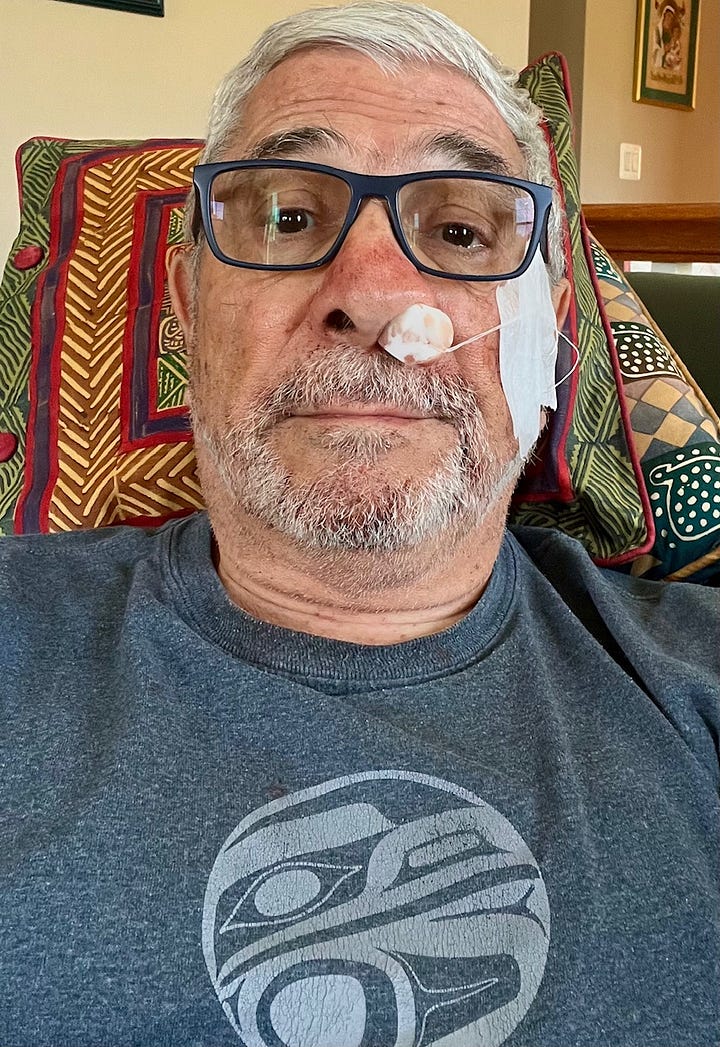

(Is a nose with deviation such a crime agains the nation? Me and my “Rhino Rocket,” and Dr. Robby (Noah Wyle).
I didn’t start out searching for Dr. Robby.
All I wanted was for my spontaneous nosebleeds to stop.
The first one hit me some 36 hours after I flew from the West Coast into Nashville, Tennessee. It could have been from the dry air on my flight, or the even drier air in the hotel, or my parched and aging blood vessels in my nose, or a sinus infection, or allergies, or a deviated septum, fixed once, but ever quirky, or the fact that my nose is like a large landing-field for anything airborne. Whatever it was, I couldn’t stop the bleeding.
I bled for a half-hour straight that morning, pinching my nose, plugging it up with anything I could get my hands on to try to stem the red tide. I filled two hotel towels and two washcloths with blood, until finally, just as suddenly and unpredictably as the bleeding started, it stopped. I must have exhausted my blood supply, I thought, knowing that probably could not be true. But, I hadn’t had a nosebleed in decades, so it spooked me.
I was comforted being only minutes from Vanderbilt Medical Center, just in case my blood felt like flowing again, like the long, serpentine Cumberland River that was close by. And, I thought, I had a former colleague who administered the COVID vaccine to Dolly Parton at Vanderbilt, so what could possibly go wrong. I’d be in great hands. Vaccine, vaccine, Vaccine! The thought of Dolly made me smile.
Two days later, after viewing the Dolly exhibit at the Country Music Hall of Fame, with my nose still dry & tender, we flew from Nashville to Baltimore/Washington Airport to visit friends we’ve known for nearly six decades, from our college days, when our noses—and other organs—were young, supple, and resilient.. Mine bore scars from being broken by a baseball bat when I was 10 years old, and playing the catchers position in sandlot baseball without a catcher’s mask. It was a schnozz with “character” I was told.
At dinner with our friends in suburban Washington, D.C. the night we arrived, the only character my nose knew to play was the role of a bloody mess, once again. Pinching, plugging and bathroom hugging didn’t help. Off we dashed to an urgent care clinic around the corner. Paging, Dr. Robby.
I arrived bleeding profusely through my proboscis, was immediately admitted, and laying my finger aside of my nose, an Emergency Medicine, MD, appeared—unusual for an Urgi-care center these days. And, as we’d later learn, a rarity for 1 in 13 Hospital Emergency Rooms around the country.
Unfortunately, the Urgi-care center was under-equipped—not unusual at a time of crippling health care cuts— and the specific device they needed to stop the bleeding—known as, yes, a “Rhino Rocket,”—was not available. They only had a child-sized gizmo, and in my cavernous size schnozzola, it could only hold back the Red Sea for so long, and could do nothing for the coagulating of blood in my throat, making it tough to breathe. I panicked that I would bleed to death, or, worse, choke on my own blood, in an understaffed, poorly equipped Urgi-care center, a continent away from home.
“I’ve never lost a patient to a nosebleed,” the Urgi-Care Doc said, who also told me he worked as an ER Doc at a major medical center for 20 years. Comforting.
When all you can taste is your own blood, and you’re gasping for air, none of that matters. In fact, nothing else matters. I didn’t want to make medical history and be the first patient to die such an ignominious death. The Urgi-Care MD called the large, local teaching hospital and told them to take me immediately. Paging, Dr. Robby, or Head Nurse Dana.
My nose was bleeding non-stop for nearly 90 minutes when I arrived at the Washington Metro Area Hospital’s ER, and was immediately ushered into the hospital’s Emergency Department. I was greeted by two nurses, and a Physician’s Assistant who were on duty. They were caring and concerned but could not stem the blood flow for several hours, despite rigging up a Y-shaped wooden splint to slow the flow.
“Am I hemorraging?”, I spit out to the Physician’s Assistant along with a mouthful of blood. He didn’t think so, and like the Urgi-Care Doc, he’d “never lost a patient to a nosebleed.” Hmmmmm. A mantra, that, somehow, did nothing to calm my anxiety, which was driving my blood pressure up.
I gasped for air, and everytime I cleared my throat to grab a breath, the PA scolded me to not do that because it would unclot any clots that were forming to block the bleeding. The PA kept going back and forth to consult with the Attending ER Physician, whom I had not yet seen, and came back with the recommendation of applying the Nasal “Nuclear Option”: the “RhinoRocket.”
“You’re going to hate me,” he said, “because it’s painful to insert, but it will stop the bleeding.” Paging, Dr. Robby, please.
At that point, gurgling for air, and convinced my obit would read “Died of a Never-ending Nosebleed”, I would have agreed to anything, including slicing off my nice big nose entirely, so I said yes to the “Rocket.”
Billed as a “Tampon” for the nose, which soaked up the blood, The “Rocket” made me feel like a Rhino (not the nasal kind) overcome with rage. As it was inserted deep into my left nostril, I followed its upward trajectory by climbing up off my chair, making the pain much worse. The PA screamed at me.
“You can’t fight me,” he shouted.
“I’m not fighting, “ I sputtered. “It’s instinct.”
Once back on earth, with the “rocket” jammed up my nose, and it’s anchoring string taped to the side of my face, the bleeding was held a bay, for a while. The PA assured me he was contacting the ENT (Ear, Nose, Throat Physician) on call and that he would come and remove the “RhinoRocket,” once the bleeding stopped.
Two hours into this nasal nightmare, and I still hadn’t seen Dr. Robby, or any ER attending physician, and the DC-area emergency room was no where near as crowded as Pittsburg Trauma Medical Center on “The Pitt.” Such gaps in care, according to the American Academy of Emergency Medicine (AAEM), are not unusual and raise serious concerns about corporate medicine’s ties to private equity firms.
The National President of the AAEM, Dr. Robert Frolich Stein calls it a “national trend,” which “unfortunately, are not rare. Across the country, independent physician groups are increasingly being replaced by large national staffing companies. These conflicts are becoming a defining issue in Emergency Medicine.”
And, according to AAEM, “about half of all Nurse Practitioners (NPs) and Physician’s Assistants (PAs) who work in Emergency Departments now work independently—without the supervison of a physician.”
Around midnight, or some three full hours after I’d continued to bleed in the hospital’s ER—despite the presence of a tampon up my nose and continual labored breathing—the PA announced to me triumphantly, that the ER’s Attending Physician, was about to see me. Sound the trumpets, but not too loudly because it might make me want to blow my nose.
The ER Doc came in, and quickly saw that the first-stage of the Rhino Rocket had misfired, was not doing its job, and that I was still gagging on my own blood. He carefully, and painfully, pulled the “rocket” out by it’s string, and told me I could blow my nose to get rid of all the clotting so he could have a look into the dark recesses of my Nose’s unknown. I was fearful of even clearing my throat, under the PA’s uncertain and anxiety producing demeanor.
Globs of clots came out enabling me to breathe again, and the ER Doc, calmly and competently painted the inside of my nostrils with Afrin to prepare my nose for a second, more skilled launch of the raging Rhino Rocket. He did the procedure in a matter of seconds, and I didn’t leap out of my chair as I did the first time.
I thought of what Dr. Jacob Lentz, a real ER Doc at UCLA Health and an advisor and instructor to the actors on “The Pitt,” said: “I think a lot of the success of the show is probably that people just like seeing people who are competent do nice things for other people and try to help them.” It was a relief but took much too long to get there.
Three days later an ENT specialist removed my now-saturated “Rhino tampon,” in preparation for my flight back to the San Francisco Bay Area from BWI. Things looked stable enough with my exhausted nasal septum, to risk a cross-country flight “rocket” free, but he loaded my partner and I up with cotton balls, and gauze pads—and a portable nose-tampon—just in case.
The flight home was blood free, and so were the next few days, but on the morning after the final Season 2 Episode of “The Pitt,” the nasal blood gates spontaneously opened again in my own bed at home. Fortunately, we live across the street from a terrific community hospital—Healdsburg Hospital—staffed 24/7 with an ER Physician on site. Just minutes after we walked into our community hospital’s ER, Dr. Robby appeared.
I didn’t have to wait hours to see him, nor endure a never-ending nosebleed; I wasn’t pre-screened by an NP, nor by a PA, to see if my condition was serious enough to bring it to the ER’s Attending Physician’s attention. My partner shepherded me into the ER with blood pouring out of my nose, and even out of my eyes in the form of tears. In the early morning hours, of a beautiful calm day at our small community hospital an hour north of San Francisco, the ER Doc saw me immediately—not because he knew me, which he did not, but because he knew exactly what to do for me.
Without hesitation or more bleeding on my part, he asked me to clear all of the clots of blood out of my nose, so he could see clearly what was going on. What he discovered was that I was a perfect candidate for nose cauterization, using the chemical silver nitrate to stop my recurring nosebleeds. “Chemical cautery” he called it.
Relieved to finally be in the care of a medical professional who knew what he was doing and remained unflappable throughout the process, I was finally able to joke:
“Good thing I have a Big New York Italian Jewish nose,” I said. “It gives you plenty of room to work.”
My own Dr. Robby laughed: “We are fortunate,” he said, making me laugh, and relax even more. I felt swaddled in his calmness and confidence.
Meticulously, he “painted” the inside of my nose and the bleeding areas with the silver nitrate. and carefully told me what I could and could not do over the next few days. With more than 20 years of intense ER experience in larger Emergency Medicine Departments in San Francisco, and Oakland, we were incredibly fortunate to have such a calm, competent, experienced ER physician in our corner.
The night before my lucky experience at our local community hospital, in our small, rural wine country community—the kind of places which around the country are starved for high quality Emergency medical care, since 92% of all Emergency Care occurs in urban areas—we watched the final episode of Season Two of “The Pitt.”
The incredibly written, acted and produced episode—some of the best, most effective storytelling and patient advocacy on TV since Dr. Neal Baer’s pioneering work on the orginal ‘“ER”—left our family in tears, especially during a few eloquent soliloquys by the main ER Docs. Dr. Robby’s monologue was superb:
“The most important things I’ve ever done in my life has been in this hospital. Nothing will ever matter more than what I’ve done in this hospital, but it is killing me. You know how they say that a part of you dies when you lose something you love? I’m not convinced that a part of you doesn’t die every time you see a fellow human being pass…”
Or, as his ER colleague, Dr. Jack Abbott summed up in an equally emotional comment, sharing with Dr. Robby the beauty and laughter and life that keeps him carrying on: “That’s what we’re here for.”
And, I’m glad they are.