


My love for my father, a working-stiff from Brooklyn who loved his family, his beer and his Yankees, was stronger than all the money & power arrayed against us in New York.
Jun 20, 2026
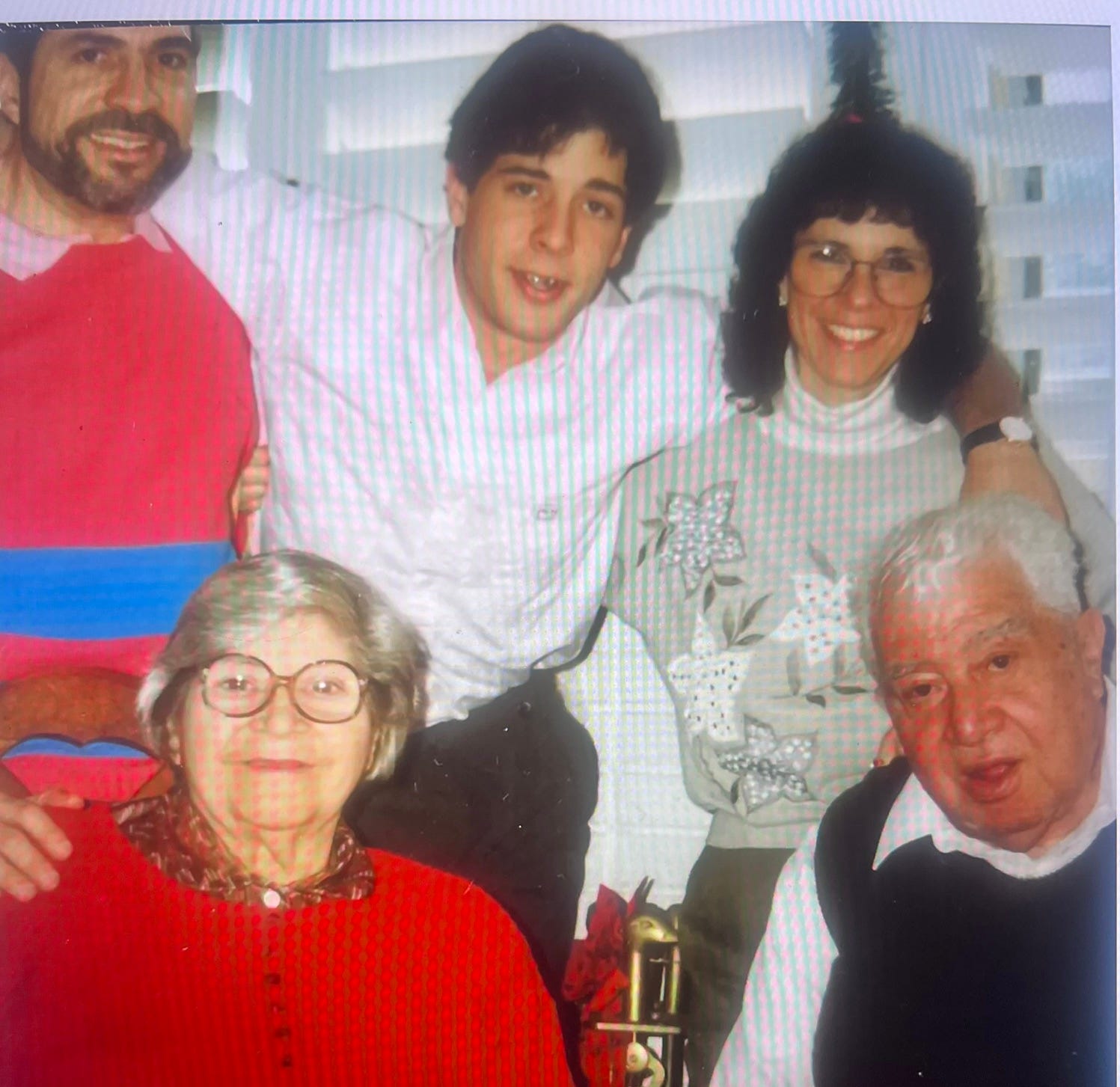
(Our family celebrating our last Christmas holidays together a few months before my father, Alphonse Villano (lower, right, seated) died in May, 1993. Seated next to my father (front, left) is my mother Margaret Julia Villano, and standing behind both of them (from right to left) are Carol Villano, our son Matthew Villano—now a father himself—and me.)
My father died on my 21st wedding anniversary, and my first Fathers’ Day of being a son without a father came three weeks later. His death sent me reeling, spiraling out of control for months.
I watched my father die a painful, drawn-out death from a carnivorous cancer which started in his prostate and spread to his spine, paralyzing him.
I read him the sports section everyday for the last two weeks of his life, quoting every line of each Yankee box score, and telling him the horse-racing results from race-tracks around the country. In addition to his family, baseball and horse-racing were my father’s passions. He had watched Ruth, Gehrig, DiMaggio & Mantle play ball in the Bronx, and had winning tickets on other thoroughbreds named Affirmed, Secretariat, Native Dancer, and Seattle Slew.
Days after my father’s death, my friend Jim Morgo invited me to join him at Yankee Stadium on Father’s Day. He had prime box seats behind the Yankee dugout for a Yankees/Red Sox game. Jim knew I loved the Yankees as much as he adored his beloved Red Sox, especially watching them play at the Stadium. What better way to feel closer to my father, I thought, than to be in the surroundings where we spent our sweetest hours together.
At least once a year, every August since I was 10 years old, my father was given use of the field box owned by the Pershing Square Building Corporation, his employer. Six days a week, every week, for 35 years, my father labored in the bowels of their office building at 100 East 42nd Street, operating the old steam boilers, to make sure the wealthy lawyers and accountants who worked on the upper floors were always comfortable.
My father knew I loved watching double-headers, and that none of the corporate executives who had first dibs on the tickets, wanted to sit in the sweltering sun on an August Sunday to watch two baseball games. For me, six solid hours of baseball was a double treat. The world consisted of nothing but baseball all day, and I had my father all to myself.
The seats I sat in on my first fatherless Father’s Day were only a few rows behind where my father and I sat, year after year, inning after inning. I looked around the Stadium imagining I saw him everywhere. There he was, getting a beer, or mopping the sweat off his brow with a clean, white handkerchief. Each time I spotted an old guy with a beer belly, I thought of my father hauling his paunch up and down those flattened Stadium steps to “hit the ‘head,” as he said.
Maybe coming to Yankee Stadium so soon after my father’s death was not such a good idea, after all. I was grieving him deeply, but quietly. Being there, so close to where he and I shared so many perfect moments, made me melancholy. I was in the final months of my work in Mario Cuomo’s Administration, and was depressed over conversations I knew were going on between Cuomo, George Steinbrenner, Rupert Murdoch and NYS’ Commissioner of Economic Development Vincent Tese, to move the Stadium out of the Bronx and put it on the site of the West Side Rail Yards—where the Hudson Yards are today—in mid-town Manhattan. How dare they even think about doing that, I thought. My father is here.
I sat there, drinking in the Stadium’s atmosphere, memories swirling around me like one of those tiny dust tornadoes that swept across the infield every so often. I looked at the majestic white facades towering over right field and realized what a place of peace this was for us from an otherwise chaotic life. To remain silent while the old Stadium’s future was being decided would have been to commit a sacrilege against the memory of my father.
I knew how forcefully committed the Governor was to economic development, and how the sinister George Steinbrenner was threatening to move the Yankees to New Jersey if he didn’t get a brand new ballpark in Manhattan, where he could build high-priced skyboxes for corporate oligarchs. I knew that Rupert Murdoch was exploring the possibility of building a sprawling entertainment center, including TV studios, on the site of the new Stadium. And I knew that somehow, I had to find a way to stop this from happening.
That “way” came within days of my 1993 Father’s Day visit to Yankee Stadium. I came across a copy of a scheduled secret meeting between the Governor, Steinbrenner, Murdoch and Tese with a two-word topic: “Yankee Stadium.” I knew I had to act quickly to create a public outcry to save the old Ballpark. With the forces of money and political power in New York aligned against the original House that Ruth Built, I took the only route left open to me, in my low-key position where I had neither money nor power: I leaked the information about the “secret” Yankee Stadium meeting to New York Times Sportswriter, Richard Sandomir.
The following day, June 30, 1993, a front page story by the Times’ Ian Fisher carried a headline announcing: “Fearing Move by Yankees, Cuomo Explores Idea for a NewStadium.” The Governor was livid when the story dropped, and was convinced that Sandy Frucher, a former top official in the Administrations of both Gov. Hugh Carey and Mario Cuomo, was the source of the leak because Frucher worked for Olympia-York, a company with an interest in the Rail Yards. Sandy insisted it wasn’t him, and he was correct. I was the “source close to the Governor” the New York Times quoted throughout the story.
The uproar caused by the Times story stopped the proposed move of Yankee Stadium to Manhattan, literally, in its tracks. It bought the old Ballpark a reprieve of another 15 years, kept the Bronx Bombers in the Bronx, and enabled the spectacular Hudson Yards—without a new Manhattan Yankee Stadium—to be built.
For me, I wasn’t proud of betraying Mario Cuomo’s trust, nor of his betraying mine in believing he would always do the right thing. More importantly, I wasn’t about to let my pride, or politics, or anything or anyone else for that matter, get in the way of fulfilling a sacred promise I made to my father: to keep the old Ballpark alive, for as long as I could, after he was gone.
Over the next 15 years, I shared dozens of Yankee ballgames at “the old Ballpark” with my son, as we cheered on the historic Yankee teams of 1996 through 2001, with Dan McCourt and Sue Conroy and JoAnne DeCarlo, and firefighters and cops, and all the members of our new extended family in Section 622, who shepherded us through the terrible struggles following 9/11. The “old Ballpark,” helped all of us heal.
And, each time we entered the Stadium before a game, or stayed late to watch the field and the fans empty out, and heard the recording of Sinatra singing “New York, New York”, I could feel my father’s presence, and every once and a while I imagined that I saw him give a wink, to assure us that we’d be all right, and our world would be saved by beauty, and loyalty to each other, and love.