


A new documentary film entitled “Mario” premieres at the Tribeca Film Festival next week. I had a front-row seat observing Mario Cuomo for 8 years, and my unedited film still runs in my mind.
May 30, 2026
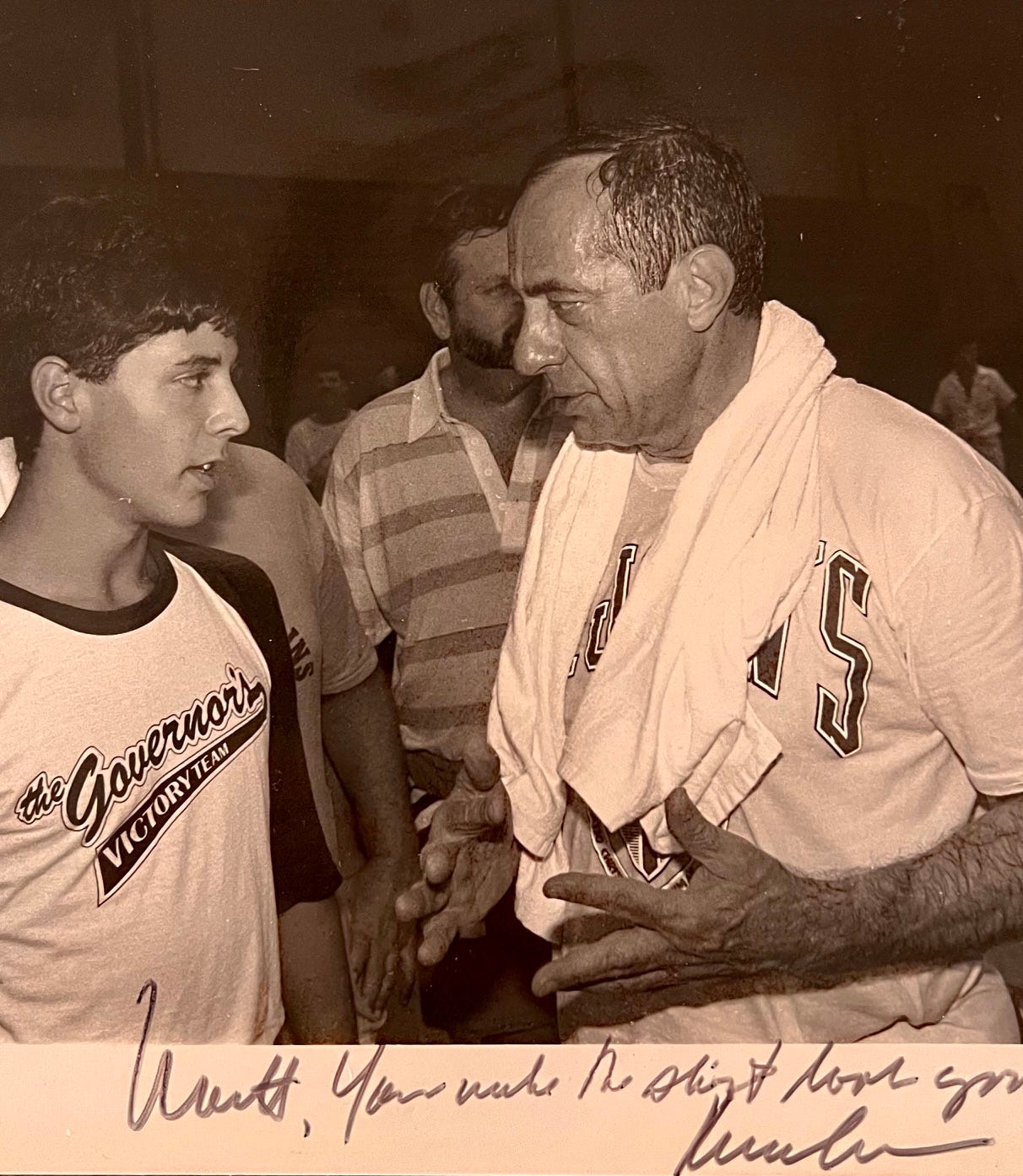
(Mario Matthew Cuomo, r., speaks with my son, Matt Villano, following an exhibition basketball game in 1990; the inscription on the photo says “Matt, You make the shirt look good!” (photo by Ted Kaplan).
The brilliant Kunhardt Film Family—father Peter W, and son’s Teddy & George—have produced the first, first-rate documentary about former New York State Governor Mario Cuomo debuting at the NYC’s Tribeca’s Film Festival on June 4, 2026, at the School of Visual Arts (SVA) in Manhattan.
The multiple Emmy Award winning family film team—which has made many HBO Original documentaries— has a long and superb track record of making movies that matter about individuals who have had a positive impact on improving our lives. Their filmography includes docs about transformational leaders like Barack Obama, John McCain, Gloria Steinem, and the Founder of the Equal Justice Initiative, Bryan Stevenson. This new film, entitled “Mario” fits squarely into that genre.
“We are trying to make moral leadership the core of many of the films we do,” said Peter W. Kunhardt, now 73, who founded the Kunhardt Production Company in 1987 (now Kunhardt Films) with his father, Philip Kunhardt, Jr., and his brother, Philip Kunhardt, III.
The Kunhardt family, which dates back to Peter’s great-great-grandfather who was a Major in the Union Army in the Civil War; his great grandfather Historian Frederick Hill Meserve; and his grandmother Dorothy Meserve Kunhardt, who wrote the classic children’s book, Pat the Bunny, merits an HBO documentary about their own unique place in U.S. history. Peter Kunhardt himself—not to be confused with his son Peter, Jr., who has run the Gordon Parks Foundation for the past 15 years—worked on ABC News “20/20” for a decade before founding the family film company in 1987.
“What we are really after is the kernal of character who is universal, whom people can identify with, which is the driving force within someone,” Peter Kunhardt told Westchester Magazine (November 18, 2018, “Reel to Reel,” by Gale Ritterhoff’).
The Kunhardt’s could not have found a more fitting person to apply their storytelling knack to for “moral leadership,” than Mario M. Cuomo, whose unshakeable sense of values, integrity, morality and personal purpose was the focus of my book “Tightrope: Balancing a Life Between Mario Cuomo & My Brother (Heliotrope Books, NY, 2017) I have since published a number of articles profiling Mario Cuomo as the “Anti-Trump.” One such story appeared in the Albany Times Union at the time of Trump’s first Inauguration in January, 2017. Link here: http://socialvisionproductions.com/2017/mario-cuomo-the-anti-trump/
I wrote the book (and many subsequent articles) because I became increasingly infuriated when I was asked at weddings, Bar Mitzvahs and every event where people knew I worked with Mario Cuomo, if it was true that Cuomo opted out of running for President because he had “mob connections.” Time after time, that thoughtless comment triggered me, and I transformed into the skunk at many “garden parties” by pugnaciously retorting “you wouldn’t ask that question if his name didn’t end in a vowel.”
I decided it was time for me to tell the story as only I could: that I knew from first hand experience that Cuomo had NO mob connections, because I did, and that my brother’s mob associates, considered Mario Cuomo “untouchable,” because of his impeccable integrity. Then, when people asked again, I could simply say, “Read my book,” and walk away from them, with my temper a bit more in check.
In Tightrope, (pages 118-120) I detailed my first-hand observations of the moment, in my judgement, that I knew Mario Cuomo would never run for President:
“ In early September, 1986, the Governor was already in a testy mood. His re-election, vb was never in doubt, but he was no longer having fun. The press, led by the New York Post,was pummeling (his son) Andrew’s law firm for allegedly doing business with State agencies, and for accepting clients who were seeking to curry favor with the Governor by hiring a law firm in which his son was a partner.
Halfway to the speaking event we were headed for (I sat in the unmarked State Trooper’s car directly behind the driver) the car phone rang. It was Andrew. I watched Mario Cuomo pick up the phone and listen quietly to his son for several minutes, deeply massaging his forehead with the large hand that wasn’t cradling the phone to his ear. Suddenly, the Governor staeted shouting into the receiver.
“What do you mean you’re a liability to me? What kind of talk is that? You’re tired, you’re working too hard on this campaign and you need some rest. Don’t let me hear you talking like that,” Mario Cuomo said to his oldest son, slamming down the car phone into it’s cradle.
There was complete silence in the car for a few moments. Finally, the Governor spoke, seething with anger.
“Imagine that. My own son, thinking he’s a liability to me. This is some god-damned business,” Mario Cuomo said. “You go into government because you try to do some good, and what do they do? They attack your kids. They spread rumors that somehow you must ne connected to the Mafia because your name ends in a vowel. And for what? All because you want to serve? At what price? And when did my kids ever agree to pay the price.”
I watched him look out of the passenger-side window of the black, unmarked State Police car, his anger barely contained and knew at that precise moment that Mario Cuomo would not run for President of the United States; he would never subject his children to the brutality of a Presidential campaign.
“Ah, the whole thing stinks,” Mario Cuomo said, waiving his right hand as if chasing away a fly, swatting his frustration into the air; brushing away the stench of stories which hurt his son and his family, and gagged him. With one wave of his large hand, he pushed aside any of the tightly reasoned arguments being advanced in favor of a “Cuomo for President” campaign in th next (1988) Presidential election.
“Mario Cuomo understood how news, rumor & innuendo worked better than any American politician of his time. He knew that a story, no matter how far-fetched, took on a life of its’ own, once reported and repeated. . .The damage was often subliminal, a mere suggestion to a jury quickly withdrawn, and it became impossible to erase from public consciousness despite detailed rebuttals or outright denials. All that was necessary for the phony charge to pass for fact, was for it to be repeated over and over again, until it became one with the Cuomo name, indivisible.
“Above all, he would not allow his children to be maligned by anyone or used as props in the no-holds barred media reality show which political campaigns were quickly becoming. His family had not asked for a life in public service; he had, and he would stand as a bulwark against their being bullied. I loved him for leaping to Andrew’s defense, and admired his certainity in being an unflinchingly protective father.”
In the Tribeca Film Festival synopsis that accompanies the information about the Kunhardt’s documentary “Mario,” one line jumps out and underscores the truth I observed first-hand over eight years:
“As he finally ends his political life and turns more deeply to family, Cuomo’s story is more than just one of leadership, but one of love, empathy and commitment to service that goes beyond a chronicle of political life.”
Only a multi-generational film-making family like Peter Kunhardt’s, with deep roots in American history, a passion for moral clarity, a track-record of uncovering universal “kernals of character” and with a fierce loyalty to those they love, could do justice to telling the story of the humanity of Mario Cuomo.