


“Dying’s part of the wheel, right next to being born. You can’t pick out the pieces you like and leave the rest. Being part of the whole thing, that’s the blessing.”–Angus Tuck, Tuck Everlasting.
May 17, 2026
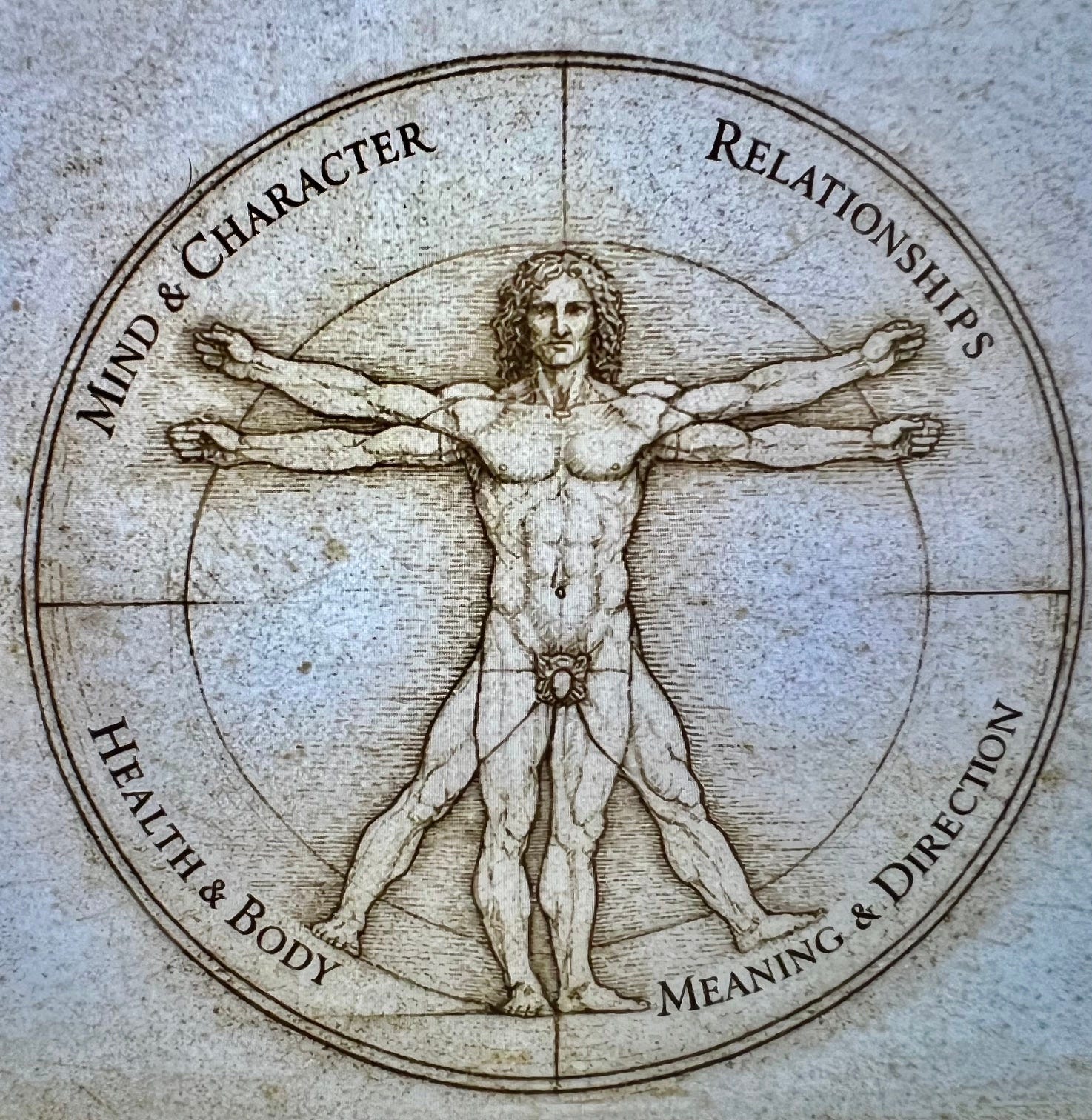
(The Vitruvian Wheel of Life; based upon Leonardo da Vinci’s Vitruvian Man, dated to c. 1490, and inspired by the Roman architect, Vitruvius.)
.
It’s not even August yet, but I feel like we’ve been enduring the dog days for a very long time.
The bright promise of it not being 2025 faded early this year, with the news of the death of one of our closest friends from college, whose daily decline from dementia dragged on over seven years. Like a slow-growing cancer, the disease diminished her physical abilities—except for still going on her long, beloved walks; it robbed her brilliant mind and sharp wit from engaging in intellectual or cultural talks; and, soon, it would take away her capacity to talk at all, or even feed herself. Risa was the human we most enjoyed laughing through life with, from when we were 19 years old. Gone now; no longer ours.
To witness the gradual hollowing out of this friend so full of life and love, and easy laughter, whose mental quickness I first enjoyed in Professor Warren Roberts Advanced World History Class at SUNY Albany nearly 60 years ago, was to experience our own demi-death, in small cuts, each time we exchanged Zoom calls with her and her wonderful partner.
Toward the end, I could still make her laugh by loudly repeating the booming message which emerged from this petite five foot friend, when she needed to command the attention of students acting rowdy on her watch as a dorm Resident Assistant.
“Get Off the Quad,” she’d bellow, causing obnoxious, college boys a full-foot taller than her to quiet down and clear out. They didn’t mess with Risa.
“Get Off the Quad,” I’d shout to her, toward the end of all of our conversations, bringing a twinkle to her sometimes blank eyes, and eliciting laughter which carried us back to our college days for a split second. There was that spark of momentary connection once again, compounding the cruelty of watching her disappear into someplace none of us knew, nor could find her.
I understood the constant pain Mae & Angus Tuck felt in Natalie Babbitt’s eternal masterpiece, Tuck Everlasting, (Farrar Strauss, New York, 1975), who, blessed/cursed with unending life, outlive all the people they loved, including their contemporaries:
“We Tucks are stuck; so we can’t move on. We ain’t part of the wheel anymore. Left behind everything around us…Dying’s part of the wheel, right next to being born. You can’t pick out the pieces you like and leave the rest. Being part of the whole thing, that’s the blessing.”
Like the Tucks, I did not feel blessed to be part of the “changeless sweep of change,” especially when it recently swept away a sweet and good and decent man, our friend, Ed, who graced our lives for decades, casually crushing him over time by stealing his life, breath by breath, and pushing him off the wheel, before he wanted to go.
Now Ed, was dead, my calming model for how well a man could act under all circumstances, steady and kind at all times. His passing pulled the rug out from under me, careening me out balance, and making me useless to comfort his grieving partner, who was to us, like another sister. Ed’s death, and his characteristic acceptance of its’ arrival, knocked out my breath, and left me gasping for the clean, quiet air, that was, in the end, denied to this good friend.
Like Job, I lamented to God, whether she existed and was paying attention, why all the wrong people, the good people, were dying, while the evil were left behind to destroy the world, not repair it. My argument with any “higher power” who would listen went like this:
“When needed most, God, why aren’t you near?
All the wrong people are dying.
If there’s a God, she must be hiding—
Averting her eyes & ears to wailing and crying.
Taking Risa & Ed, Pretti & Good,
And Caroline Kennedy’s daughter.
Withholding food, medicine & water,
From babies within our own borders,
And Lebanese & Gazan children, tagged for slaughter.
Are you there, God?
Those innocents are NOT your target;
Unless you are gathering the best around you,
Creating Hell’s Tenth Circle of evil here, on earth,
Governed by ghouls, pedophiles and thieves,
Teaching the rest of us who want to believe,
That justice only comes to those of us who grieve
The good already gone from us.”
The actor Martin Short, now 76 years old—who has endured the Job-like tragedies of the death of a brother when he was 12; of his mother from cancer, when he was 17; of his father from a stroke three years later,; of his wife, Nancy, dying from ovarian cancer 15 years ago; and his daughter Katherine, dying from suicide, just this February—told the New York Times last week (“Martin Short and the Secret to Finding Joy While Surviving Tragedy”, May 15, 2026, by Jason Zindman); https://www.nytimes.com/2026/05/15/movies/martin-short-marty-life-is-short.html?unlocked_article_code=1.jFA.pGsD.HIMhk6S-VF29&smid=url-share), that he believed “grieving gives you muscles to survive.”
In Short’s Job-like consideration of the role of a “higher power” in the death of loved ones, he quotes the legendary Director Mike Nichols: “I see no reason why you just can’t keep the conversation going.”
To those of us, like Martin Short, who’ve made it past 75 with our physical and mental abilities pretty much in tact—a rare gift, as noted by Dr. Zeke Emanuel in his controversial piece published in the Atlantic Monthly, October, 2014 Issue, entitled “Why I Hope to Die at 75,” in which he does not argue for a Kevorkian-like conclusion to our lives—Emanuel discusses the unrealistic arrogance of “American immortality,” in our obsessive belief that each of us is an exception to the norm, and like fame, will somehow “live forever:”
“American immortals operate on the assumption that they will be precisely such outliers. But the fact is that by 75, creativity, originality, and productivity are pretty much gone for the vast, vast majority of us. Einstein famously said, “A person who has not made his great contribution to science before the age of 30 will never do so.” He was extreme in his assessment. And wrong…There are some, but not huge, variations among disciplines. Currently, the average age at which Nobel Prize–winning physicists make their discovery—not get the prize—is 48.
Embracing our own mortality, instead of trying ot erase it, is Emanuel argues, essential to getting the most out of however much more time we have left, and simultaneously, recognizing our obligation to our children and grandchildren to redirecting scarce resources for improving life’s quality—not only for us, but for them, now and forever, Amen. Such courageous, selfless decisions are at the very heart of accepting that we are part of a “wheel,” as my father tried to tell me on his death bed by pointing at my watch, and mouthing the words, “time to go.” The wheel works because we are all part of it.
Emanuel goes on to explain how we are not like the Tucks, who have sipped from the waters of immortality, nor should we aspire to be:
“And I am not advocating 75 as the official statistic of a complete, good life in order to save resources, ration health care, or address public-policy issues arising from the increases in life expectancy. What I am trying to do is delineate my views for a good life and make my friends and others think about how they want to live as they grow older. I want them to think of an alternative to succumbing to that slow constriction of activities and aspirations imperceptibly imposed by aging. Are we to embrace the “American immortal” or my “75 and no more” view? (https://www.theatlantic.com/magazine/archive/2014/10/why-i-hope-to-die-at-75/379329/?gift=CMu1iNc-Sy6nzR8uCo5sAk7f3NMnGDlhxRnBJCPm7M0&utm_source=copy-link&utm_medium=social&utm_campaign=share).
At 77, I know that each day is a gift, especially as I near the 33rd Anniversary of my father’s death at 78. Mortality, mine and that of people I love, is ever present, in every waking moment. Bearing witness to too much desperation, suffering, disease and the deaths of children, friends and siblings; cradling my parents in my arms as they took their last gasp of life; and collapsing in shock when a bright, young 40-year old colleague was ravaged by an inhuman infection ripping him from his babies, is, I am aware, the high price of still being alive, after they have left us.
Like Natalie Babbitt’s Tucks, it is the passage of time that worries me most. For those of us neither “cursed,” nor “blessed,” with immortality, as Mae Tuck tells 10-year old Winnie Foster, who discovered their secret, we can no longer pretend we won’t die, when people who comprise important parts of our lives do, and take parts of our existence with them. The question for those of us surviving and trying to make sense out of why we are still here, is what do we do with what time we’ve got left? How do we give our lives more meaning? How do we live out our days well? How do repair a world that has been ripped apart? Love more? Or, as Martin Short, suggests, how do we, “head for the light?”
Noah Kahan, the extraordinarily talented singer/songwriter, who has struggled with mental health challenges for all of his nearly 30 years, and founded “The Busyhead Project” (named after his first Album to raise money for local mental health care groups), has just released his newest Album, at the same time Netflix is airing a revealing documentary about him entitled, “Noah Kahan: Out of Body.”
The album, The Great Divide (Mercury Records, 2026), opens with a beautiful, haunting song entitled “End of August,” where the sound of contemplative piano keys pull you immediately into Kahan’s musical explanation of belonging and loss, seamlessly coupling one with the other, of death with life:
“Ending of August,
The bugs are just starting to die;
All the neighbors are votin’ for someone
Who wins every time;
I thought getting older
Meant knowin’ it’s too late to try…
Kahan’s chorus celebrates how two things, life & death, attachment & loss, are true at the same time, underscoring the wisdom of Angus Tuck about “everything being part of the wheel,” and the need to “make a difference in the world:”
“Oh everything you see out here will die—
Oh, it’s a matter of time
‘Til its fields of ice and reflected lights,
‘Til it’s our time, ‘til it’s our time, ‘til it’s our time;
And it’s ours now,
Cause it’s ours now.
###