


What’s obscene is not just the $93,000 watches, & the MET Gala’s’ $100,000 tickets, but that 215,000 working people per day are forced to sell their blood plasma to afford food, rent & health care
May 08, 2026
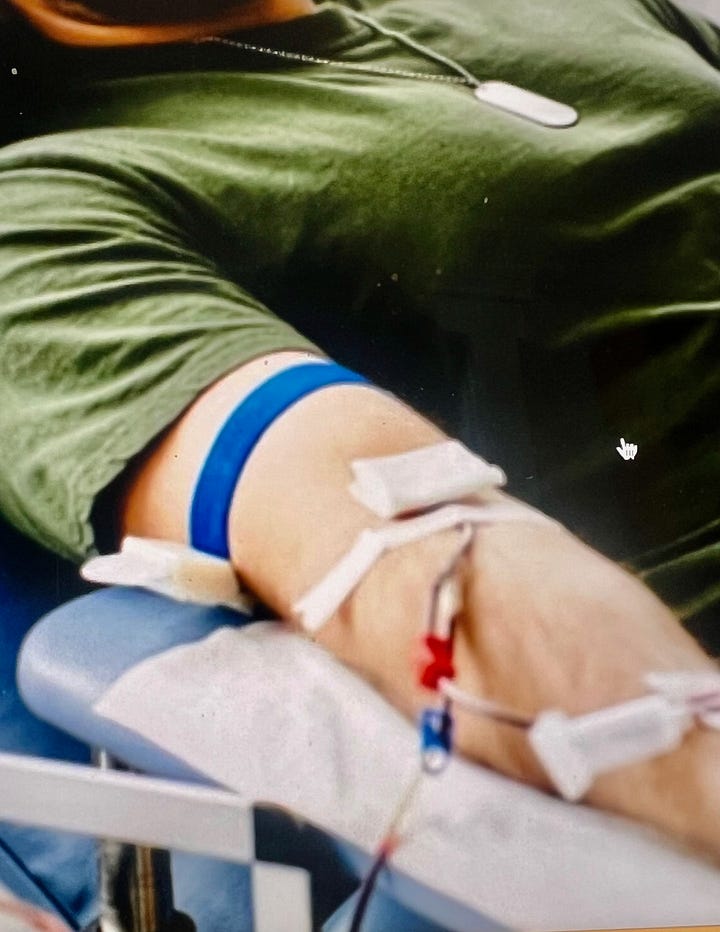

(An average American (l.)—one of 215,000 per day—sells his blood plasma for $60 to $80 per litre at one of 1,200 Plasma Extraction Centers in the US, while the 26-year old actor Connor Storrie arrives at the $100,000 per ticket MET Fashion Gala wearing a $93,000 Omega gold watch on his wrist, instead of a Y-tube for separating blood from plasma. There are more Plasma Extraction Centers in the United States than there are Costco Stores, according to NBC News.)
One month and one-day before the utterly over-the-top, garish Metropolitan Museum of Art’s 2026 Fashion Gala for the fabulously rich, famous and momentarily famous, a life-and-death story bled out of the New York Times Sunday Business Section—dwarfed by a full-color graphic that dominated 3/4’s of the page dealing with “Teens and Chatbots.”
The story (April 5, 2026) by Kurtis Lee and Robert Gebeloff was headlined: “The Middle Class Is Selling Blood Plasma to Get By.”
In the daily orgy of news about Trump’s billion-dollar-a-day War against Iran; exploding oil prices that now cost a family at least $100 per week just to fill up one car; Jeff Bezos’ $10 million sponsorship of the MET Gala and $50 million Venice wedding to Lauren Sanchez, $120 million NYC townhouse, AND his $500 million yacht; and the Trump family’s plundering of the Presidency for their own pig-like, personal profit, no one paid much attention to the “blood-selling” story.
Two months earlier, NBC News’ Shannon Pettypiece did an eye-opening version of the “Blood Money” story , but few others paid attention, since most corporate network producers preferred puffing up their tiny nightly newscasts with a ‘feel good’ story about “America Strong.” Social media sites didn’t as much as sneeze at the story in the lead-up to the MET Gala, because lingering too long on tough-to-take stuff loses them clicks and cash.
In the Hunger Games-like dystopian world in which we dwell, where a completely corrupt government and a rich, removed, powerful ruling class controls the narrative and the wealth, no one of consequence wants the well-heeled citizens of “The Capitol,” to be made uncomfortable by whats actually happening to nobodies in the “poorer Districts” of the country. Better to fawn over how cute it was that singer Sam Smith’s boyfriend, designer Christian Cowan, held up the fabric train of the 52 pound ensemble he designed for Smith, than to worry about strangers starving to death.
Since the real-life interviews in Pettypiece’s NBC’s piece back in February of people selling their blood plasma for money to survive, hardly any other news organizations wanted to be bothered by the millions of Americans shamefully slipping quietly into so-called “Plasma Extraction Centers” in suburbs, cities and rural communities across the country several times per week. According to NBC, there are now over 1,200 “Plasma Extraction Centers” across the United States, more outlets than Costco, driving the multi-billion dollar industry American blood industry, which provides 70% of the world’s blood plasma., raking in billions of dollars in profits.
Of course, It’s far easier, loads more fun, and laughably more lucrative for all—including the flush-with-money blood plasma conglomerates—to amuse ourselves to death, by focusing on the “Hunger Games” model of a multi-million dollar celebrity costume party known as the MET Fashion Gala to which no working stiffs—and certainly no blood sellers— were invited.
Lost on the effusively empty-headed entertainment reporters gagging on every gaffe at the Gala, was the double irony that “The Devil Wears Prada 2” premiered at exactly the same time as the MET Gala, with Stanley Tucci reprising his role as high-fashion’s facilitator, and reminding us of his portrayal of Cesar Flickerman in the Hunger Games, where his bizarre character, demeanor and appearance ridiculed everything about the entire culture. Tucci’s dual roles served as a perfect validation at the precise time for the vacuity of all involved.
The price of admission to the MET’s Hunger Games Gala was fame, fortune or being carefully chosen (by the fashion elite) for a precious $100,000 ticket to attend the pretty predators’ ball in a city where 1 in 4 people live in poverty and the median household income is $79,000.
New York City’s extraordinary Mayor Zoran Mamdani recognized as much by skipping the grotesque gala of the greedy, and honoring NYC’s Garment workers, where the average annual salary for a seamstress is $41,271, or $793 per week. The Democratic Socialist Mayor wisely chose to stay in the Districts.
For those starved for sensory stimulation, why worry about 215,000 normal people a day, many of them your neighbors, selling their blood plasma to survive, when you can be whisked away from the gritty realities of the world on the long, flowing trains of the sparkling million dollar garments draped over the toned and tony, dripping down the MET’s storied staircase; or, when you be distracted and dazzled by the $93,125 Omega Constellation Watch in “moonstone gold” flashed by the Fashion Industry’s latest “It-boy”, Connor Storrie, one of the instantaneous stars of the wildly successful “Heated Rivalry” Netflix series. After all, wouldn’t you rather look at the smoothly muscled arm and perfectly pierced ears of a young Robert Mapplethorpe, than the scarred, unsightly arm of a middle-aged man’s pierced with with tubes designed to suck valuable plasma from the rest of his blood?
Why be such a downer when all everyone wants to talk about was which celebrity was wearing whose clothes? Who really cares if you had to sell your own blood plasma—twice per week, at $60, $70, or $80 per pop, to afford day-care for your child? Isn’t watching this Oligarchs’ orgy more fun? After all, like the Hunger Game’s competition for survival, it’s only entertainment— can’t you forget your troubles for a few hours?
Well, actually, no. Not when you have to sit still for a few hours every week in a “Plasma Extraction Center,” in suburban Houston, or downtown NYC, or rural Idaho, with a Y-tube hooked up to your arm, feeling the blood plasma being pumped out of you with the same mechanical, methodical way cows teats are milked.
The Times reporters Lee & Gebeloff described a typical day at two Webster, Texas “Plasma Extraction Centers” just down the road from the Johnson Space Center:
“On recent mornings, people waited in lines outside both locations. Many described themselves as middle class, and said that even a few years ago they would not have imagined exchanging their plasma for cash There was a 30-something tech worker trying to save for a house, a sixth-grade special education teacher looking to cover rising health care costs; a night shift nurse struggling to pay for child care fees.”
Most of the blood “sellers” were visiting the stark “Plasma Extraction Centers” twice per week—the maximum allowed under FDA regulations—earning an average of $70 per visit, or $140 per week, and in many cases, nearly $600 per month. Alternatively, they could do what’s done by the citizens of most other countries in the world—donate their blood for free to their fellow citizens, and family members. The World Health Organization discourages the practice of individuals selling their blood plasma, since long term health effects on the human body are not known.
Kathleen McLaughlin, an award winning journalist who specializes in reporting on economic inequality, wrote in her 2023 book, Blood Money: The Story of Life, Death and Profit Inside America’s Blood Industry (Simon & Schuster, NY) about how many of these so-called “plasma extraction centers,” first targeted communities of laid-off auto workers in the Rust Belt, and poorer communities along the US/ Mexico border. Now those extraction centers—which literally suck the plasma out of people for pay— are ubiquitous in suburban shopping malls in virtually every community in middle-class America.
Outside one such community near Phoenix, Arizona, a women laid-off from her job in finance making $87,000 per year and now making $16.11 per hour, told NBC’s Shannon Pettypiece a few months ago:
““I’m angry that I’m working this much, that I’m educated, that I’m articulate, that I have marketable skills, and that I’m reduced to selling my plasma,” said Jill Chamberlain. “I was ashamed at first, but now I’m angry. This is not how things are supposed to be.”
Peter Jaworski, a Georgetown University Professor who studies the ethics and economics of America’s plasma business told NBC, that: “As America’s economic divide widens, with the top 1% of households owning more than 30% of the country’s wealth, the payments people receive for selling plasma are playing a quiet role in keeping households above water financially.”
One of the most striking stories of blood literally being squeezed out of Americans gasping to breathe and stay afloat, was told to NBC’s Pettypiece by Michelle Egan from suburban Minneapolis, selling her plasma to pay her young son’s $700 per month pre-school tuition:
“It’s a nice preschool. Sometimes I do think, ‘I bet there are no other parents here that are donating plasma to pay for this preschool,’” said Eagan, who has made around $400 a month from her plasma since September.
NBC went on to report that:
The money has become a necessity for Eagan’s family after she left her job making $75,000 a year as a paralegal for UnitedHealth Group to care for her son full time. Even living in a relatively affordable part of Minneapolis, her husband’s $90,000 salary as a business manager hasn’t been enough for the family of three to get by, and their credit card balances have been steadily rising.
Eagan told NBC that she sells her plasma to BioLife— a part of the large Japanese drugmaker Takeda. Pettypiece went on to report that many plasma centers are run by a handful of biopharmaceutical companies that turn the fluid into medicine.
BioLife, like others, uses incentives to keep Michelle Egan coming back:
“For instance,” the NBC story goes on, “her first payment of the week is $45, but if she goes back a second time that week, she gets $65. In November, the company ran a “Sweater Weather” promotion where clients who sold their plasma eight times that month would get entered into a raffle to win $1,000. In December, BioLife offered reward points for people who donated seven times in a month or for three consecutive months that they could redeem for gift cards” Astonishing.
“It’s like a drug dealer,” Eagan added. “Once they have you in there, they have to keep you coming back.’
The Plasma Protein Therapeutics Association notes that it can take plasma from more than 100 people to support one patient each year. In a major American industry—the Blood Plasma Industry—which exported more than $6.2 billion of Plasma last year— the need for an endless supply of plasma sellers— driven to desperation by an increasingly crushing economic system—who must earn money to support their own families—even if those already-low Plasma harvesting fees are reduced as some of the blood-sucking companies have already talked about doing. Increased financial pressure on plasma sellers, and the industry’s ghoulish push to maximize its’ profits, are the two most powerful forces propelling this twisted, purely American, capitalist phenomenom.
Jill Chamberlain, scrambling to pay her bills for herself and her 18-year old son, has neither the time, nor the inclination to watch the obscene Hunger Games-like MET Gala, which mocks the daily struggles of working families, and glorifies gaude, greed, celebrity and vast differences of wealth in this country:
“We always heard the middle class was disappearing,” she said. “But really, really quickly, the rich are getting richer and the rest of us are sinking.”
Ten years ago, singer/songwriter Paul Simon wrote prophetically that “Wristbands” (Stranger to Stranger, 2016, Concord Records) were symbols of the increasing stratification of our society and the growing chasm between the very rich, and the rest of us who weren’t:
“Wristband, my man,
You’ve got to have a wristband;
If you don’t have a wristband, my man,
You don’t get through the door.”
I’m not sure even such a profound poet and visionary as Simon ever imagined a glittering gold $93,000 watch as the wristband of admission to a comfortable life, and a Y-shaped Plasma/blood sorting tube, as a Yellow tattoo, signifying omission from it.