


The world’s first Nuclear weapon, dropped upon the civilian population of Hiroshima, Japan, by the US in 1945, erased humans from existence. American journalist, John Hersey, wrote an early report.
Apr 07, 2026
(With the unhinged American President hallucinating about “sending Iran back to the Stone Age” or of wiping out Iranian civilians, and civilization, in “one night”, the terrifying possibility of the use of nuclear weapons against innocent human beings has become very real, for the first time in my 77 years of life. Having written and researched this subject extensively for over five decades, the prospect of the use of nuclear weapons against humans once again, must be exposed for the utter insanity—and international war crime that even the threat of committing such a genocide—constitutes.
It was 81 years ago this summer, when the United States dropped two nuclear weapons on the Japanese population centers of Hiroshima and Nagasaki, three days apart, wiping out nearly 200,000 humans going about their everyday lives. (The first bomb, dropped on Hiroshima had more power than “20,000 tons of TNT,” far and away the largest bomb ever used in the history of warfare,” up until that time.
American journalist & author John Hersey wrote one of the earliest accounts of the horrific effect on human life of the dropping of the first of the two ”Atomic” bombs upon ordinary, non-combatant Japanese citizens. Originally planned to be published as a series of articles in The New Yorker in 1946, the publication devoted its’ total issue of August 31, 1946, to publishing Hershey’s entire story of “Hiroshima.”
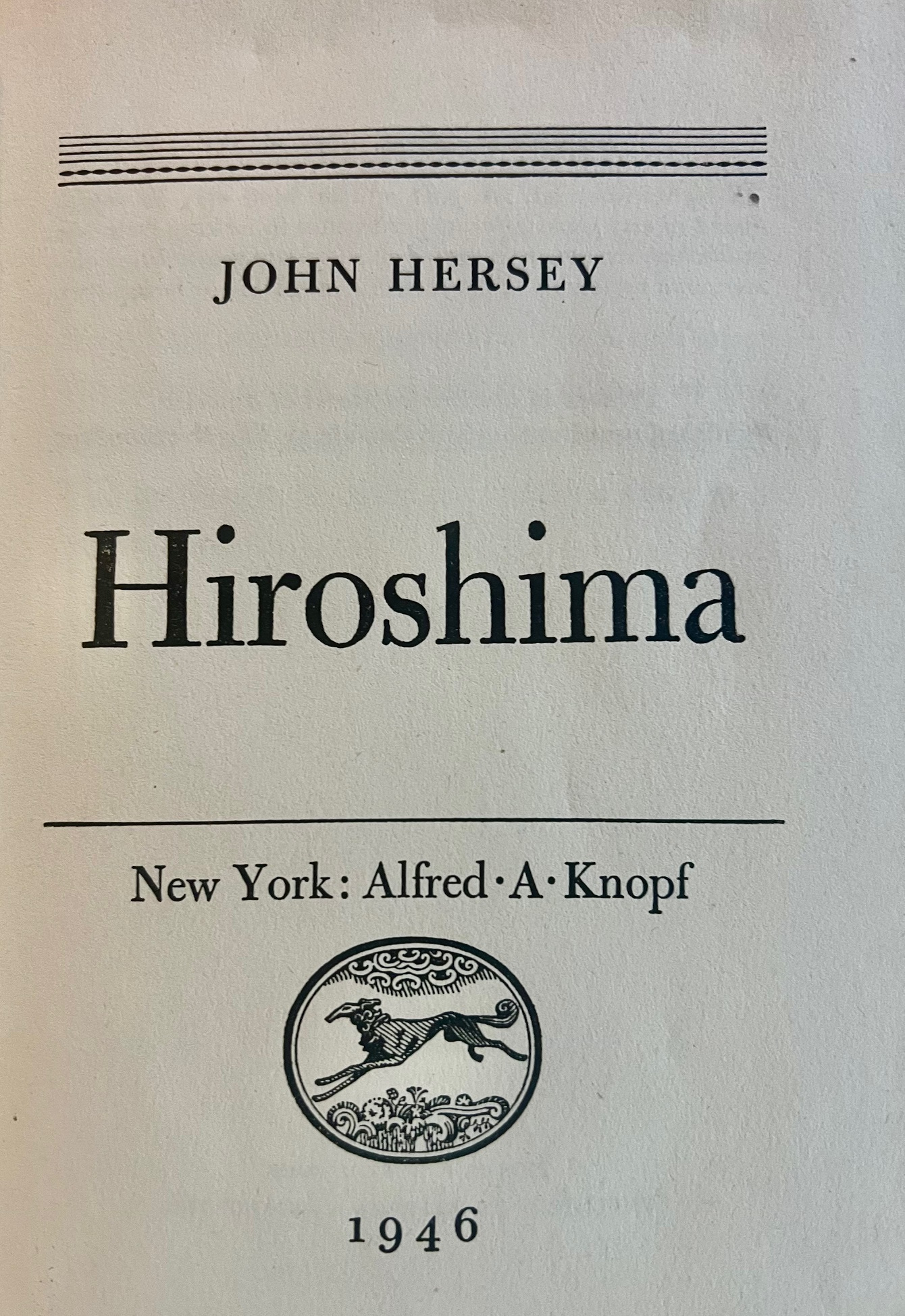
Later published in hardcover book format by Alfred A. Knopf publishers of New York, in 1946, Hiroshima, has gone on to sell more than three million copies. Owning one of those original copies, has given me a deep sense of duty to read and share Hersey’s words over and over again, so that no such intentional mass torture of fellow human beings is every contemplated again.
This week, in my most recent re-reading of Hiroshima, as the madness of American threats against Iran have escalated to genuine Genocidal proportions, the simplicity and clarity of Hersey’s writing struck me as pure as a poem, demanding that we pay attention to the kind of terror we are, once again, threatening to inflict upon the innocent. The vision and observations in this version I’ve entitled “Hiroshima, Revisited”, are all Hersey’s; the extraordinary words of John Hersey’s are bracketed by quotation marks; other transitional words or phrases are mine; the selection, editing and emphasis of them are mine. The responsibility to prevent this crime against humanity, and war crime, from happening again, is all of ours.)
HIROSHIMA, Revisited.
A normal workweek began with a noiseless flash;
Clerks at their desks, nurses with patients,
Clergy at their best, families paying rent.
The windows of their offices,
Hospitals, churches and homes
Welcoming the morning light, one last time.
“A tremendous light cut across the sky;
It seemed a sheet of sun.”
The Reverend reacted in terror,
His instinct was to run.
“He threw himself between two big rocks in the garden,
Bellying up very hard against one.”
“He pushed his face against the stone, eyes shut,
Feeling a sudden pressure, and then splinters
And fragments of tile fell on him.
When he dared, the Reverend raised his head,
And thought the bomb fell directly on his neighbor’s house,”
And left him dead.
“Under what seemed to be a local dust cloud,
The day grew darker and darker.” It was 8 am.
The mother, a soldier’s widow, watched
“Everything flashed whiter than any white she had ever seen.
Her mother’s reflex set her in motion toward her children;
She took a single step when something picked her up
And she seemed to fly into the next room over the raised sleeping platform,
Pursued by parts of her house.”
“Timbers fell around her as she landed
And a shower of tiles pommelled her.”
“Everything became dark, for she was buried.
She rose up and freed herself;
She heard a child cry, ‘Mother help me,’
And saw her youngest—the five year old—
Buried up to her breast, and unable to move…”
She “started frantically to claw her way toward the baby,
She could here nothing of her other children.”
The Medical Doctor saw the flash.
“Startled, he began to rise to his feet;
The hospital leaned behind his rising, and
With a terrible ripping noise
Toppled into the river.”
An entire hospital, with patients and nurses; gone.
“The Doctor was alive, squeezed tightly by two long timbers
In a V across his chest—like a morsel
Suspended between two huge chopsticks.”
“Wounded people were hurrying across the bridge
In an endless parade of misery;
Many of them exhibited terrible burns
On their faces and arms.”
The Doctor “saw a nurse hanging in the timbers
Of the hospital by her legs, and then, another
Painfully pinned across the breast.
He thought he heard the voice of his niece for a moment,
But he could not find her; he never saw her again.”
“Of 150 Doctors in the city, 65 were already dead, most of the rest, wounded;
Of 1,780 Nurses, 1,654 were dead, or too badly hurt to work.”
“Wounded people supported maimed people;
Disfigured families leaned together.
Many people were vomiting.
In a City of 245,000, nearly 100,000 had been killed…
Or doomed at one blow; 100,000 more were hurt.”
“The eyebrows of some were burned off, and
Skin hung from their faces and hands.
Others, because of pain, held their arms up,
As if carrying something in both hands.
Some were vomitting as they walked.
Many were naked, or in shreds of clothing..
Those who were burned moaned,
Mizu, Mizu! Water, Water!”
“No country except the United States,
With its industrial know-how,
It’s willingness to throw 2 billion gold dollars
Into an important wartime gamble,
Could possibly have developed”
The largest bomb—an Atomic bomb—used,
In the history of warfare.
The morning after the Bomb was dropped on Hiroshima,
The Reverend went to “fetch water for the wounded
In a bottle or teapot he had borrowed…
There were many dead in the garden.
At a beautiful moon bridge, he passed a naked, living women,
Who seemed to have been burned from head to toe…”
When the Reverend had given the wounded water,
“the woman by the bridge was dead.”
On his way back with the water,
As he looked for a way back through the woods,
“He heard a voice ask from the underbrush:
Have you anything to drink? He saw a uniform.
Thinking there was just one soldier, he approached with water.
When he penetrated the bushes,
He saw there were about 20 men, and they were all in the same
Nightmarish state: their faces were wholly burned;
Their eyesockets were hollow;
The fluid from their melted eyes had run down their cheeks..”