


Healdsburg, California has become a haven for outstanding food, wine, art and community, and our new TRUE WEST Film Center is serving up a feast of “Big Night” on the Big Screen for Valentine’s Day.
Feb 10, 2026
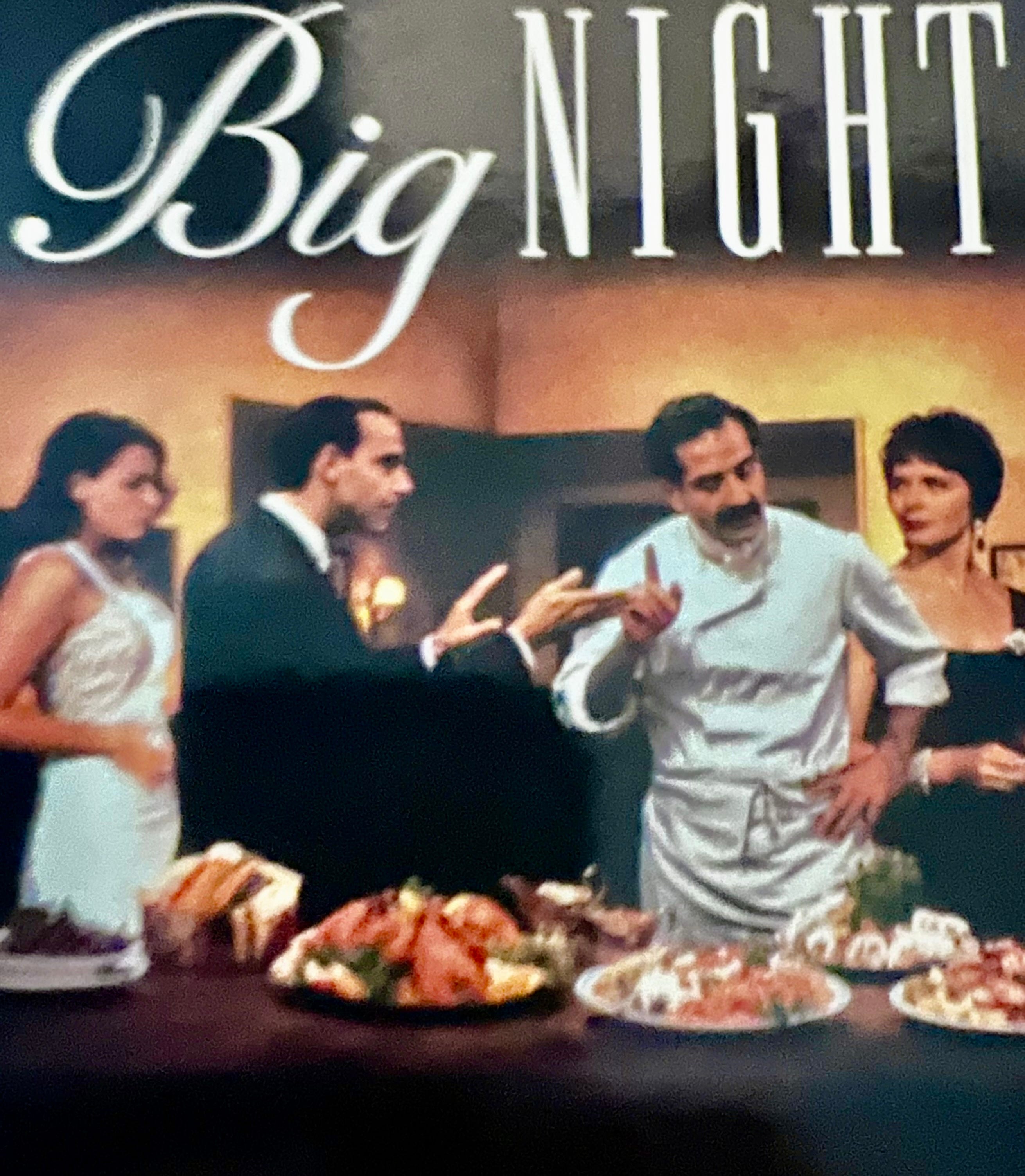
(Stanley Tucci’s transformative film, “Big Night,” written & produced 30 years ago, was an ode to life, love, food and art, and his first screenplay. It won the prestigious Waldo Salt Award for Screenwriting at the 1996 Sundance Film Festival, launched Tucci’s incredibly diverse acting career, and helped change stereotypical roles being written for Italian-Americans in movies. Pictured with Tucci above are (l. ot r.), Minnie Driver, Tucci, Tony Shalhoub, and Isabella Rossellini.) Promotional photo from Rysher Entertainment.)
Thirty years ago this month, a little film entitled “Big Night,” with a screenplay written by two young Italian guys from New York, Stanley Tucci and his cousin Joe Tropiano, swept the Sundance Film Festival off its feet by winning the career-making Waldo Salt Award for Screenwriting.
This coming Valentine’s Day, Healdsburg’s phenomenal new, 3-screening room cinema arts center, TRUE WEST, (https://truewestfilmcenter.org) is bringing “Big Night” to the foodie haven of Healdsburg, for two Saturday night showings, at 5 and 8 pm. It’s perfectly fitting, because in this small cosmopolitan community which boasts world class chefs like Charlie Palmer and Dustin Valette, and first-rate restaurants such as Single Thread, Dry Creek Kitchen, 106 Mathieson, Folia at Appellation and Le Montage. every night is a big night for culinary delights.
“Big Night” is much more than a moving story about two Italian immigrant brothers struggling to make it on the Jersey Shore in the 1950’s with a small Italian restaurant called “Paradise.” It’s much more than a tale of two talented dreamers, for whom English was not a first language, pursuing their futures in the “land of fucking opportunity,” as their unsentimental competitor, played by the actor Ian Holm, crudely put things.
It’s a love song to food, and art, and longing, and love, directed by Tucci’s life-long friend and fellow actor Campbell Scott (the son of actors George C. Scott and Colleen Dewhurst), and punctuated by delirious dancing, drinking, eating and the irresistible music of Louis Prima and the pull of a party. From the opening word spoken by Primo (Tony Shalhoub) in Italian, “taste” (which, 25 years later became the name of Tucci’s New York Times best-selling memoir) to the closing, intimate kitchen scene between the two brothers, “Big Night” is an emotional, visual and artistic feast. And, as an added treat, the nourishment joy and tears lavished upon the audience by the screenplay, the film and the entire experience , gives us all front-row seats to Stanley Tucci’s yet-to-take-off career.
Before Stanley Tucci played Caesar Flickerman in The Hunger Games movies; Nigel Kipling in Devil Wears Prada (with a sequel coming this May); Paul Childs, the husband of Julia Childs, in Julie and Julia; or Adolf Eichmann in his Golden Globe winning performance of the HBO film, Conspiracy; and before his string of best-selling cookbooks, or his Emmy winning CNN Food Travel Documentary Series “Searching for Italy,” Tucci found himself stuck in an ethnic acting rut.
I first talked to Tucci about his being type-cast in “mobster” roles, when I interviewed him the year Big Night came out, on the Upper West Side of Manhattan set of Deconstructing Harry, a movie he was making with Woody Allen. The interview was for Ambassador Magazine, and I asked Tucci if he felt that because he was an Italian-American actor he was being stereotyped into many “mafia” roles on television and in movies:
Villano: You’ve played heavies on television and in the movies—Richard Cross in “Murder One,” Lucky Luciano in “Billy Bathgate,” mobsters in television’s “Wiseguy” and tough guys in “Men of Respect”, & “Prizzi’s Honor, and as the assassin stalking Julia Roberts in “The Pelican Brief. Did you feel you were being stereotyped?
Tucci: With Richard Cross, I said specifically to Murder One Director Stephen Bochco that I did not want the character to be Italian…I hate Mafia film characters because Italians have given so much more to this country and to the world. Also in most Mafia films , there is never a reason given for the gangsters behavior: they are just innately evil.
Villano: With Big Night, did you consciously set out to make a movie that would not have any Mafia figures in it?
Tucci: My cousin Joseph Tropiano and I co-authored the screenplay and we did not want to have any Mafiosi or gangsters in it at all…Big Night makes a very different, pointed statement that runs counter to the prevailing image of Italian-Americans portrayed in film. Primo & Secondo are bright guys; they’re articulate, not violent; well read, they appreciate art…I’m sick of young directors who want to do that tough, shoot-em up Mafia stuff. Their pictures are completely false and worse, they’re boring. I want to tell them: “You’re not Scorcese; you’re not Coppola. Isn’t there another story you can tell? Scorcese and Coppola told great human stories with tremendous internal conflicts. The only obligation an artist has is to tell the truth, whatever it is. That’s the artist’s obligation. And if artists don’t do that, then they aren’t doing their jobs.”
Francis Ford Coppola’s Scenario Magazine (Fall 1996, Vol. 2, No. 3) which published the complete Big Night screenplay similarly asked Tucci (and his cousin Tropiano) about them intentionally wanting to present a different picture of Italian-Americans from what is usually seen in films:
Tucci: The way these portrayals have evolved into caricatures in so many movies now has really affected how people look at Italians in everyday life. I remember somebody saying to me not that long ago, “isn’t your mother one of those big, fat Italian Mamas?” As a matter of fact, my mother is very slender and looks Irish, if you want to know the truth. All of these stereotypes are really insulting. I’ll do interviews with people who will be shocked when they find out that my Dad is an art teacher, or that Campbell Scott and I grew up together or that my cousin Joe (Tropiano) went to Yale….
Tropiano: So that was definitely one of the driving forces behind us wanting to write this…
It took Tucci and Tropiano six years to collaboratively write the screenplay because they not only wanted to craft the characters just right, but they had so much to say on art, love, relationships, food and family. The constant conflict between an uncompromising dedication to art or craft, and the cloying, annoying, soul-destroying commercial call to compromise to be a “success,” is a persistent tension throughout Big Night.
I asked Tucci about the central role played not only by food in the movie—which he considered as important a “character” as any of the human characters in the film—but also by “the artist’, represented not only by Primo, the chef, but by Louis Prima, the special “guest” at the timpano dinner. Both Tucci & Tropiano saw the musician Louis Prima—who popularized the “jump blues” in the late 1940’s and 1950’s— as having realized “the American Dream,” by successfully combining being a great artist, an excellent musician and a commercial success.
Villano: Your character spells out Primo’s specialness as an artist to Ian Holm’s character, Pascal, a crass businessman only interested in money, who wanted Primo to come to work for him. “You would never have my brother,” you tell Pascal; “he lives in a world above you. What he has, and what he is rare.” You put Primo on a pedestal that only a pure artist could occupy.
Tucci: That’s what I was brought up with. In our family, to be an artist was the highest rung on the ladder, especially when you see your father, whom you admire and idolize, is one.
And Food?
Tucci: We knew that food would have to play a major role, because we were making a movie about an artist, and food is his art. It had to be there.
Just like “Big Night” had to come to Healdsburg.